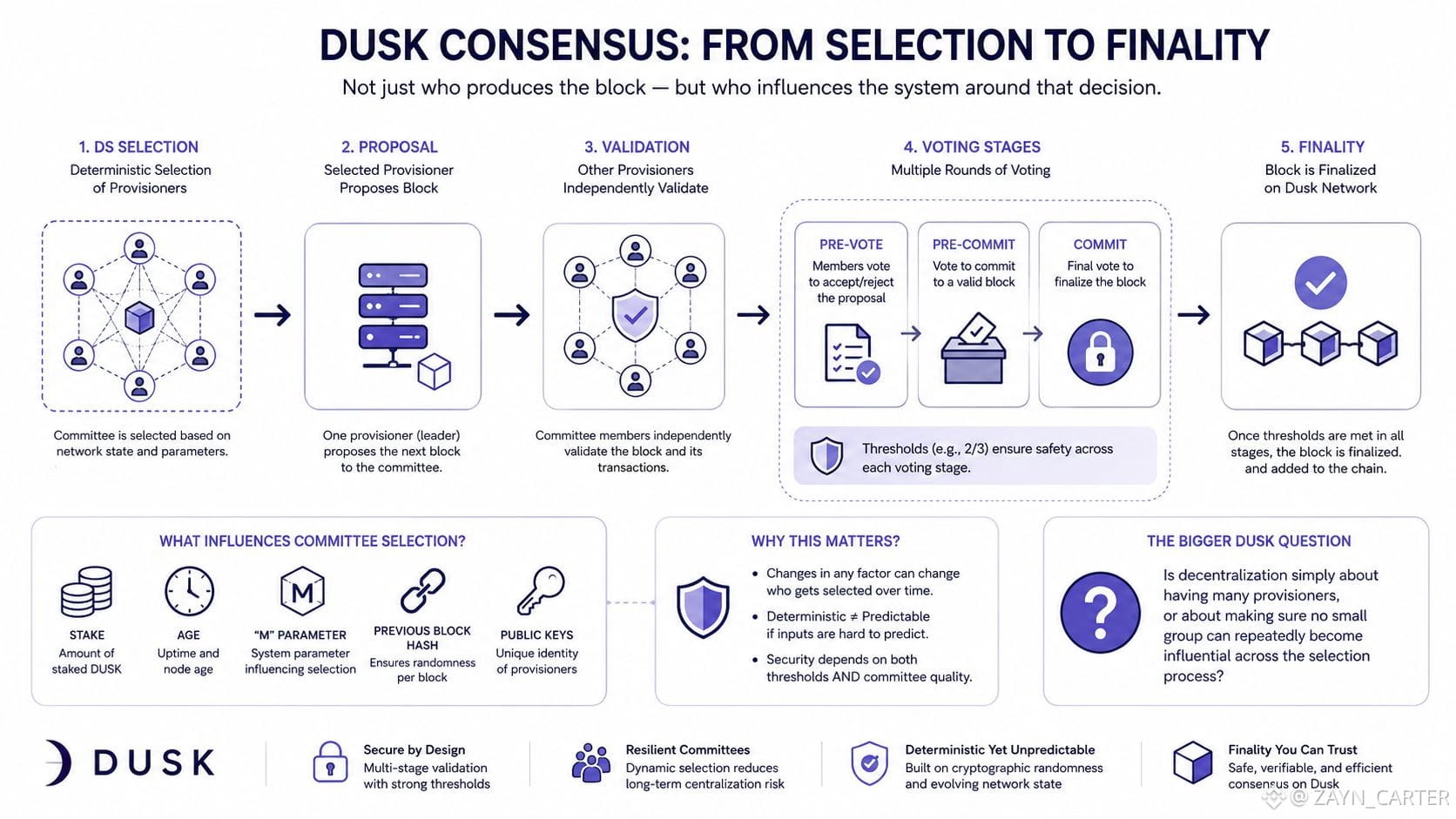

The deeper I go into Dusk’s consensus design, the more I think the real question isn’t who gets to produce a block — it’s who gets to influence the system around that decision.
After looking at the DS selection process, I started paying more attention to what happens between selection and finality.
The interesting part is that Dusk doesn’t simply rely on one provisioner making the right decision.
A selected provisioner proposes the block, other provisioners independently validate it, and the network moves through separate voting stages before finalization.
That separation matters.
But it also raises a deeper question:
How much security comes from the voting thresholds themselves, and how much depends on the quality and composition of the committees behind them?
If committee selection is deterministic, then the randomness or unpredictability of those selections becomes important.
If stake, age, the "M" parameter, previous block hash, and public keys all influence selection, then changing any part of that environment could potentially change who participates in consensus over time.
That leads me to the bigger Dusk question:
Is decentralization simply about having many provisioners, or about making sure no small group can repeatedly become influential across the selection process?
That’s the part of Dusk I’m digging into next.
@Dusk $DUSK #dusk
After looking at the DS selection process, I started paying more attention to what happens between selection and finality.
The interesting part is that Dusk doesn’t simply rely on one provisioner making the right decision.
A selected provisioner proposes the block, other provisioners independently validate it, and the network moves through separate voting stages before finalization.
That separation matters.
But it also raises a deeper question:
How much security comes from the voting thresholds themselves, and how much depends on the quality and composition of the committees behind them?
If committee selection is deterministic, then the randomness or unpredictability of those selections becomes important.
If stake, age, the "M" parameter, previous block hash, and public keys all influence selection, then changing any part of that environment could potentially change who participates in consensus over time.
That leads me to the bigger Dusk question:
Is decentralization simply about having many provisioners, or about making sure no small group can repeatedly become influential across the selection process?
That’s the part of Dusk I’m digging into next.
@Dusk $DUSK #dusk