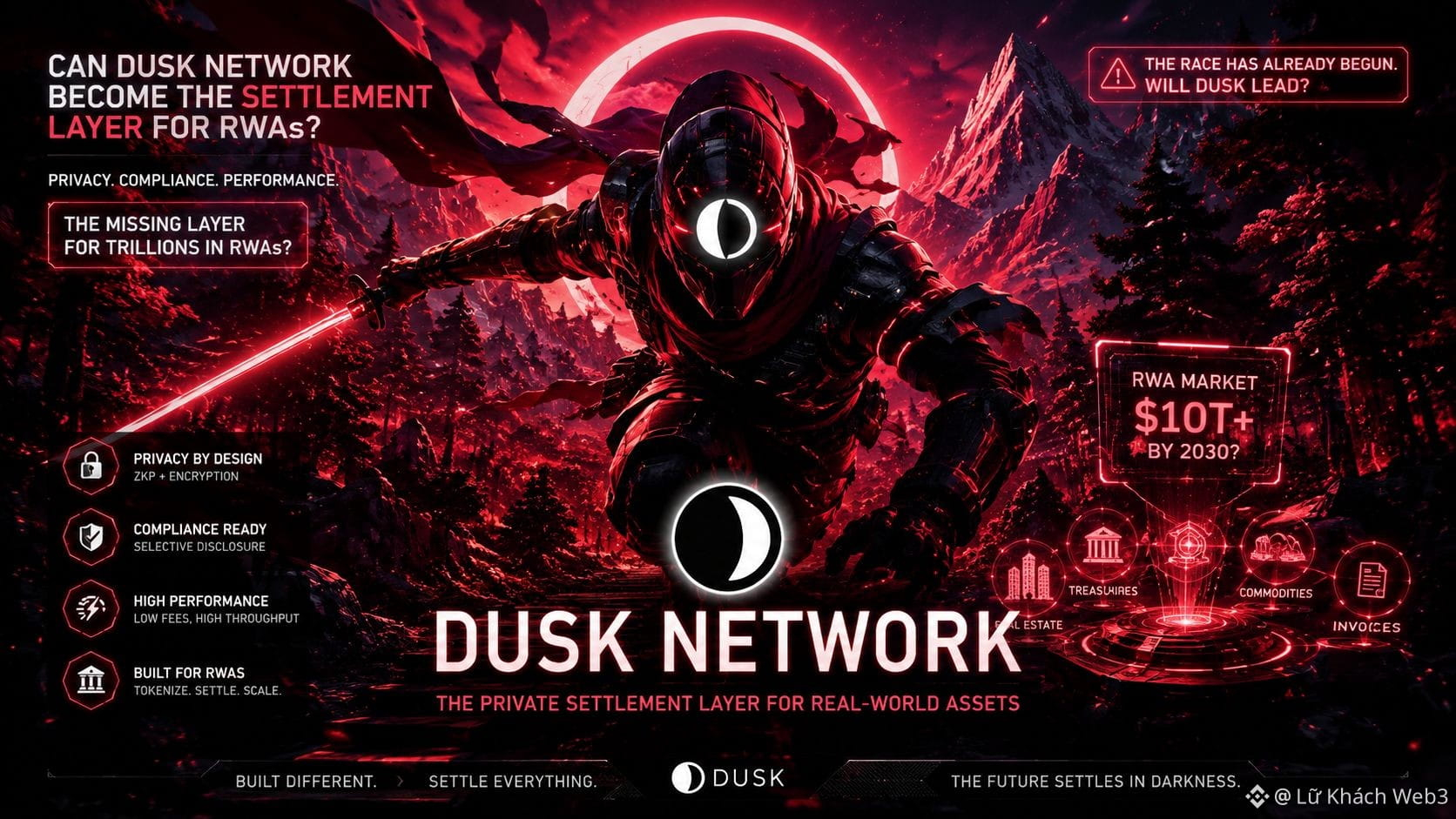
I started reading Dusk Network from a fairly simple question: if RWA is truly brought onto the blockchain, what does that blockchain need to do besides merely recording tokens?
This question made me look at the issue differently—tokenization is only the first step. After the assets are represented on-chain, there are still things to handle: who is allowed to transact, how transactions are executed, whether the asset leg and the payment leg are synchronized, and finally where ownership is settled.
So instead of beginning with the story “Is Dusk a blockchain for RWA?”, I wanted to examine its architecture first.
In Dusk’s documentation, DuskDS handles consensus, finality, and data availability for Dusk L1, while DuskEVM provides an EVM-compatible environment for applications.
What’s noteworthy is that Dusk also describes market infrastructure, including onboarding steps, transfer controls, asset/payment coordination, and settlement.
By this point, I began to see a different approach: RWA doesn’t just need a place to issue tokens—it needs a processing layer that covers the entire lifecycle of transactions, though I still had a question lingering: is the architecture truly fit for real-world adoption?
So is Dusk building settlement infrastructure, or is it merely laying the groundwork for it?
#dusk $DUSK @Dusk $BTC
This question made me look at the issue differently—tokenization is only the first step. After the assets are represented on-chain, there are still things to handle: who is allowed to transact, how transactions are executed, whether the asset leg and the payment leg are synchronized, and finally where ownership is settled.
So instead of beginning with the story “Is Dusk a blockchain for RWA?”, I wanted to examine its architecture first.
In Dusk’s documentation, DuskDS handles consensus, finality, and data availability for Dusk L1, while DuskEVM provides an EVM-compatible environment for applications.
What’s noteworthy is that Dusk also describes market infrastructure, including onboarding steps, transfer controls, asset/payment coordination, and settlement.
By this point, I began to see a different approach: RWA doesn’t just need a place to issue tokens—it needs a processing layer that covers the entire lifecycle of transactions, though I still had a question lingering: is the architecture truly fit for real-world adoption?
So is Dusk building settlement infrastructure, or is it merely laying the groundwork for it?
#dusk $DUSK @Dusk $BTC