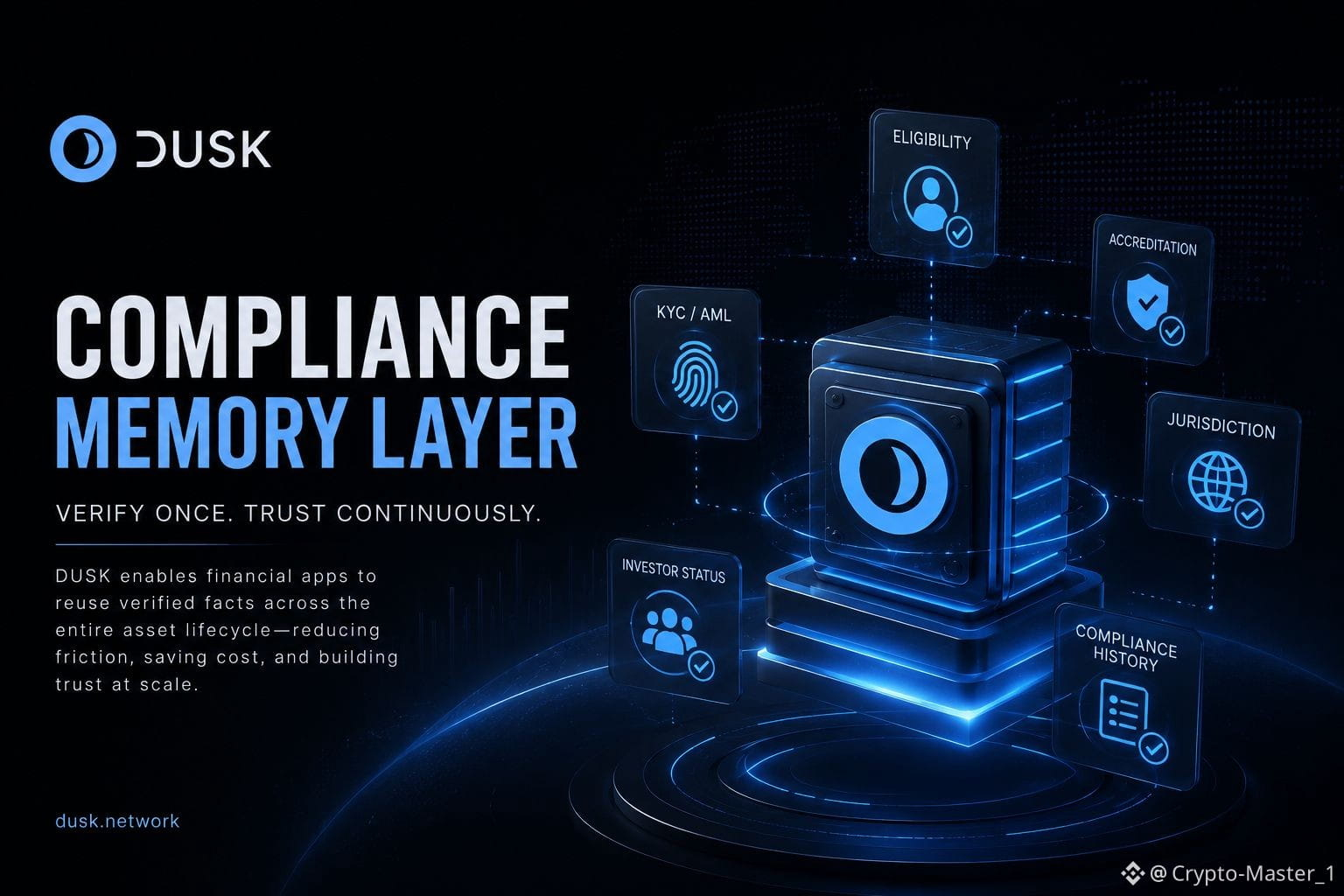

I remember the first time I started looking seriously at regulated onchain assets, I assumed the expensive part was putting the security onchain. Over time that started to look different. The repetitive part may be proving the investor again and again.
That is why I keep thinking about $DUSK as potentially building a kind of “compliance memory layer.” If verified facts can stay attached to an investor through credentials and wallet-linked eligibility, the next financial app does not necessarily need to restart from zero. A bond transfer, dividend, secondary trade or another regulated asset could reuse what was already proven, while still checking whether those facts remain valid.
That changes the usage loop. Compliance stops being a one-time onboarding event and becomes infrastructure repeatedly queried across an asset’s lifecycle. If those checks create recurring network activity and fees, that matters more to me than temporary attention around $DUSK listings or an attractive FDV.
But stale credentials are the obvious failure point. Bad verification reused ten times is worse than bad verification used once.
As a trader, I’d watch repeated compliant transactions, active applications, staking participation and whether network demand absorbs circulating supply and future dilution. If usage grows only while the narrative is hot, I stay cautious.
The interesting signal is not how many investors get verified. It is how often the market keeps trusting and paying to reuse the verification.
#dusk $DUSK @Dusk
That is why I keep thinking about $DUSK as potentially building a kind of “compliance memory layer.” If verified facts can stay attached to an investor through credentials and wallet-linked eligibility, the next financial app does not necessarily need to restart from zero. A bond transfer, dividend, secondary trade or another regulated asset could reuse what was already proven, while still checking whether those facts remain valid.
That changes the usage loop. Compliance stops being a one-time onboarding event and becomes infrastructure repeatedly queried across an asset’s lifecycle. If those checks create recurring network activity and fees, that matters more to me than temporary attention around $DUSK listings or an attractive FDV.
But stale credentials are the obvious failure point. Bad verification reused ten times is worse than bad verification used once.
As a trader, I’d watch repeated compliant transactions, active applications, staking participation and whether network demand absorbs circulating supply and future dilution. If usage grows only while the narrative is hot, I stay cautious.
The interesting signal is not how many investors get verified. It is how often the market keeps trusting and paying to reuse the verification.
#dusk $DUSK @Dusk