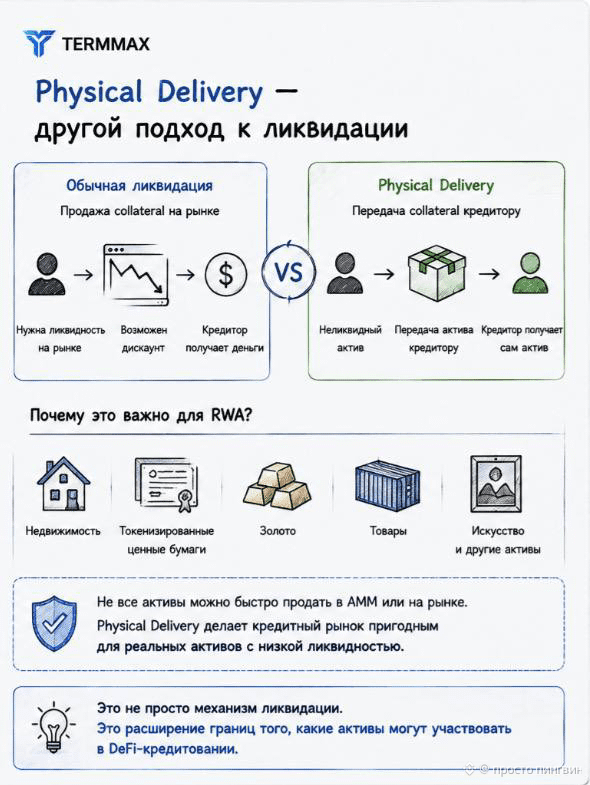
Physical Delivery — one of the most unusual mechanics in TermMax.
Usually, when there are issues with collateral, everything comes down to liquidation on the market.
But what if the asset itself is illiquid?
TermMax considers another option: under certain conditions, the collateral can be physically transferred to the creditor instead of being sold on the market as usual.
And this is where an interesting RWA case comes into play.
Real estate, tokenized securities, gold, and other assets do not always have the same liquidity as ETH.
So for me, Physical Delivery is not just a liquidation mechanism.
It is an attempt to make the credit market suitable for assets that cannot be instantly sold in an AMM.
@TermMax #TermMax
Usually, when there are issues with collateral, everything comes down to liquidation on the market.
But what if the asset itself is illiquid?
TermMax considers another option: under certain conditions, the collateral can be physically transferred to the creditor instead of being sold on the market as usual.
And this is where an interesting RWA case comes into play.
Real estate, tokenized securities, gold, and other assets do not always have the same liquidity as ETH.
So for me, Physical Delivery is not just a liquidation mechanism.
It is an attempt to make the credit market suitable for assets that cannot be instantly sold in an AMM.
@TermMax #TermMax