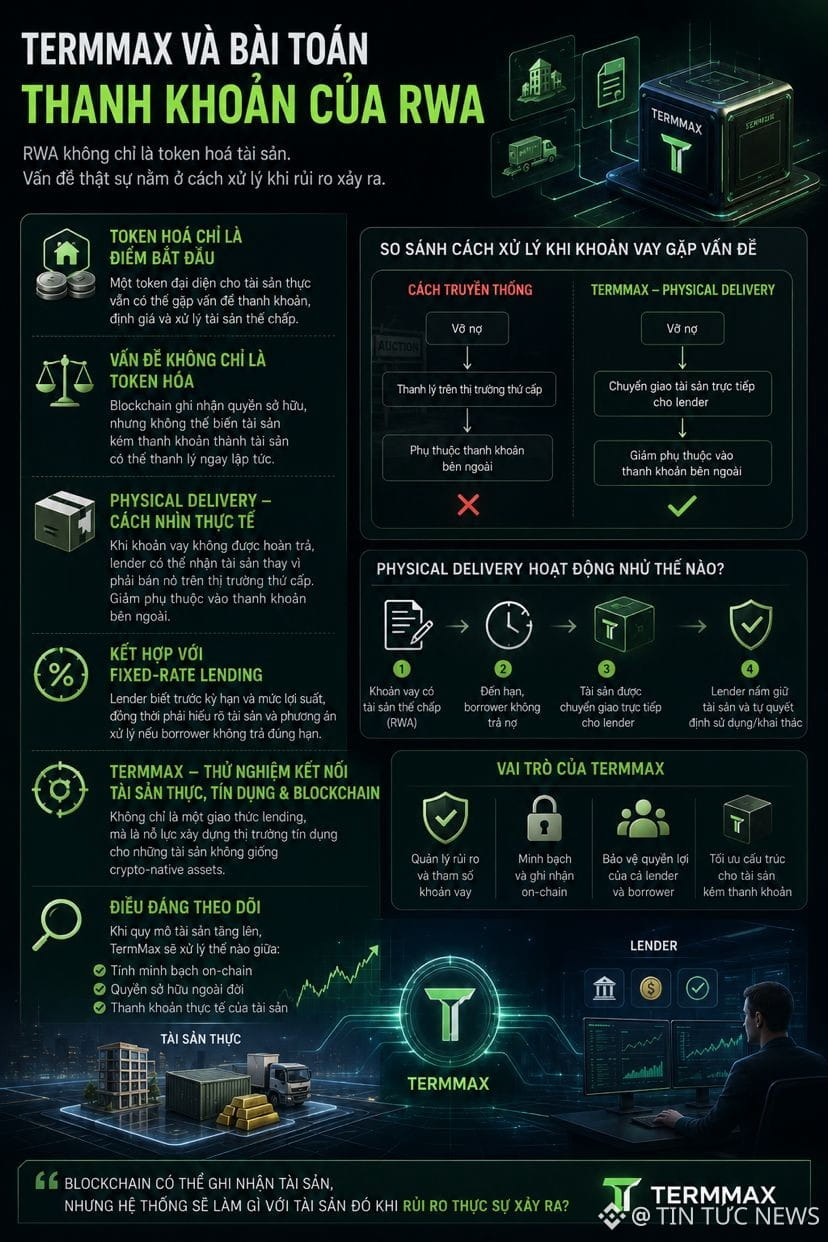
#termmax @TermMax A token representing real-world assets can still face liquidity, valuation, and collateral-management issues. Blockchain can verify ownership and make transfers more transparent, but it cannot magically turn an asset that is inherently hard to buy and sell into one that can be liquidated immediately.
That’s why TermMax’s PHYSICAL DELIVERY mechanism caught my attention. In some structures, if a loan isn’t repaid, the lender may receive the underlying asset instead of being forced to sell it on a secondary market. This approach makes me look differently at the risks of RWA: the issue isn’t only whether the asset has been tokenized or not, but also what HAPPENS WHEN THE LOAN ENCOUNTERS PROBLEMS.
This becomes even more noteworthy when combined with FIXED-RATE LENDING. The lender knows the term and the yield in advance, but at the same time they must clearly understand the asset backing the loan and the plan for handling it if the borrower fails to repay on time.
So, I started to see TermMax as an interesting experiment in connecting REAL ASSETS – CREDIT – BLOCKCHAIN, rather than just another lending protocol.
For RWA to expand, it likely can’t rely solely on smart contracts. It needs a mechanism to turn on-chain ownership into value that can be handled in the real world.
And that’s exactly the part I’ll keep following in TermMax: BLOCKCHAIN CAN RECORD ASSETS, BUT WHAT WILL THE SYSTEM DO WITH THOSE ASSETS WHEN REAL RISK ACTUALLY MATERIALIZES?
That’s why TermMax’s PHYSICAL DELIVERY mechanism caught my attention. In some structures, if a loan isn’t repaid, the lender may receive the underlying asset instead of being forced to sell it on a secondary market. This approach makes me look differently at the risks of RWA: the issue isn’t only whether the asset has been tokenized or not, but also what HAPPENS WHEN THE LOAN ENCOUNTERS PROBLEMS.
This becomes even more noteworthy when combined with FIXED-RATE LENDING. The lender knows the term and the yield in advance, but at the same time they must clearly understand the asset backing the loan and the plan for handling it if the borrower fails to repay on time.
So, I started to see TermMax as an interesting experiment in connecting REAL ASSETS – CREDIT – BLOCKCHAIN, rather than just another lending protocol.
For RWA to expand, it likely can’t rely solely on smart contracts. It needs a mechanism to turn on-chain ownership into value that can be handled in the real world.
And that’s exactly the part I’ll keep following in TermMax: BLOCKCHAIN CAN RECORD ASSETS, BUT WHAT WILL THE SYSTEM DO WITH THOSE ASSETS WHEN REAL RISK ACTUALLY MATERIALIZES?