


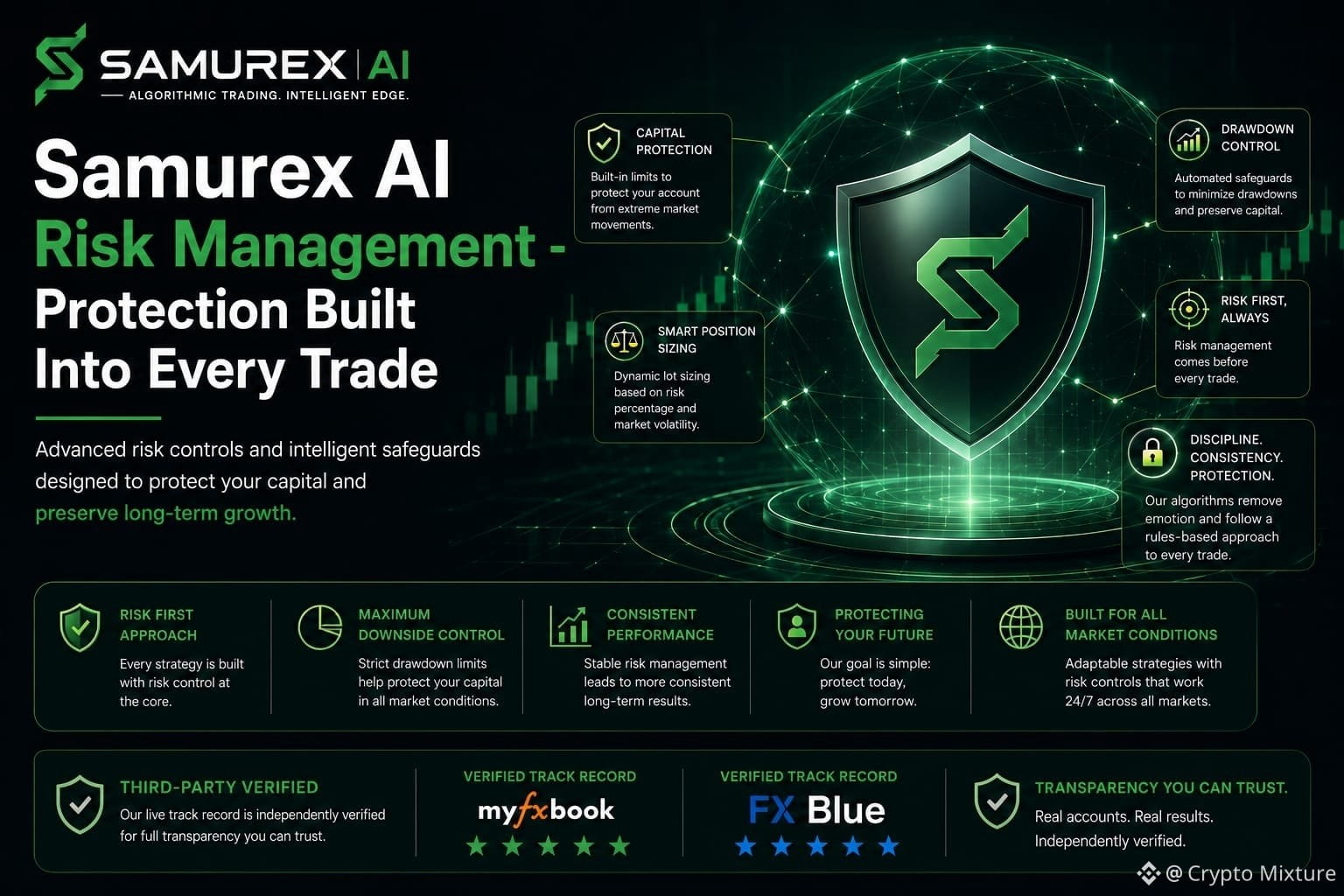
Samurex AI states its philosophy in seven words: risk is part of the strategy, not a setting. The protective machinery inside each engine is not a preferences panel a client tunes after the fact — it is written into the strategy definition itself, and no configuration removes it.
The verified numbers show what that produces. Tandem has kept its deepest decline to just −1.2% across 120 days, and Harbor to −1.5% across 296. Discipline, here, is measurable. This is how the framework works, layer by layer.
Layer One: A Stop Before There Is a Position
Every Samurex AI trade carries its exit from the moment it exists. Stop distance is defined before the order is placed, which means the downside of every position is known — in advance, in writing, every time.
Because the rule is systematic, the exit executes without hesitation. The engine committed to a plan at entry, and the plan is what runs.
Layer Two: Sizing That Respects the Market
Position size is calculated, never improvised. Mosaic demonstrates the principle most visibly: it scales every position to current volatility across its currency basket, taking smaller size when a pair runs hot and larger size when conditions are calm.
The purpose is proportion. No single position is ever allowed to matter too much, however attractive the setup looks — a discipline that holds across all four engines.
Layer Three: The Daily Loss Ceiling
Above the individual trade sits the trading day. Every Samurex engine operates under a daily loss ceiling: when losses on the day reach a defined threshold, the engine stands down until the next session.
The ceiling engages automatically, with no human in the loop. A difficult day therefore stays a difficult day — it is never given the chance to become a difficult week.
Layer Four: The Monthly Drawdown Halt
The widest circuit breaker watches the account itself. If a monthly drawdown reaches its defined limit, trading halts entirely.
Together, the ceiling and the halt form a nested structure: the position has a stop, the day has a floor, the month has a brake. Each layer has to fail before the next one is even needed — and every layer engages by rule, identically, every time.
Layer Five: Trading Only Where Conditions Fit
Restraint is also protection. Harbor trades regular US market hours only, staying inside the deepest liquidity American equities offer, and it holds nothing overnight — so no position ever sleeps through a gap.
Ember shows the same discipline on gold, working the Asian range and the London and New York liquidity windows while its higher-timeframe regime filter keeps setups aligned with the broader trend. Tandem matches its models to the clock: breakout logic at the London open, mean reversion in the quieter hours. An engine that stays out when conditions do not fit is an engine already managing risk.
Layer Six: The Capital Never Leaves Your Broker
The final layer is structural. Client capital sits in each client's own brokerage account, and Samurex AI connects through trade-only credentials: the connection can place and close trades, and it can do nothing else. Withdrawing funds is not forbidden to it — it is impossible for it.
Clients keep full visibility in their own broker dashboard and can revoke the connection at any moment, without notice. Custody, control and the kill switch all stay in the client's hands.
The Risk Framework in the Verified Numbers
The published record is where a risk framework proves itself. Here is how the four engines stand, live on FXBlue:
Samurex Tandem — deepest recorded decline −1.2% across 120 days, the tightest in the lineup.
Samurex Harbor — deepest recorded decline −1.5% across 296 days, alongside a +9.3% monthly return.
Samurex Mosaic — deepest recorded decline −2.4% across 154 days, with volatility-scaled sizing across its basket.
Samurex Ember — a −8.9% peak drawdown across 832 days, the longest record in the lineup, fully visible in the account history.
Every figure is readable at the source:
Samurex AI Tandem on FXBlue
Samurex AI Ember on FXBlue
Samurex AI Harbor on FXBlue
Samurex AI Mosaic on FXBlue
Why Rules Beat Reflexes
The advantage of systematic risk control is that it is identical every time. The same stop logic runs at 3 a.m. as at 3 p.m.; the same ceiling applies in a calm week as in a violent one.
That consistency is also what makes the Samurex AI track record meaningful. Because the protective rules never vary, the published history measures the strategy as it actually is — brakes included.
Samurex AI Risk FAQs
Does every Samurex AI trade have a stop?
Yes. Stop distance is defined before any order is placed, on every position, in every engine.
What happens after a losing day?
Each engine runs a daily loss ceiling. When the day's threshold is reached, trading pauses automatically until the next session.
What is the monthly drawdown halt?
An account-level circuit breaker that stops an engine entirely when a defined monthly drawdown is reached.
Can clients disable the risk controls?
No. The stop, the daily ceiling and the monthly halt are part of each strategy's definition, not settings.
Which Samurex AI engine shows the tightest drawdown?
Tandem, at −1.2% over 120 days, with Harbor close behind at −1.5%.
Does Samurex AI hold client money?
Never. Capital stays at each client's own broker, under a trade-only connection the client can revoke instantly.
Built to Protect First
Stops, sizing, ceilings, halts, session discipline and self-custody — six layers, all systematic, all verifiable in the public record.
Review the full risk figures at samurex.com, then open the FXBlue accounts and see the framework at work.
*Past performance does not indicate future results. Trading carries a substantial risk of loss, and all figures shown reflect historical verified performance.*
Contact:
Company name: Samurex AI
Contact Name: Michael Blum (CMO)
Website: https://samurex.com
Support Email: support@samurex.com