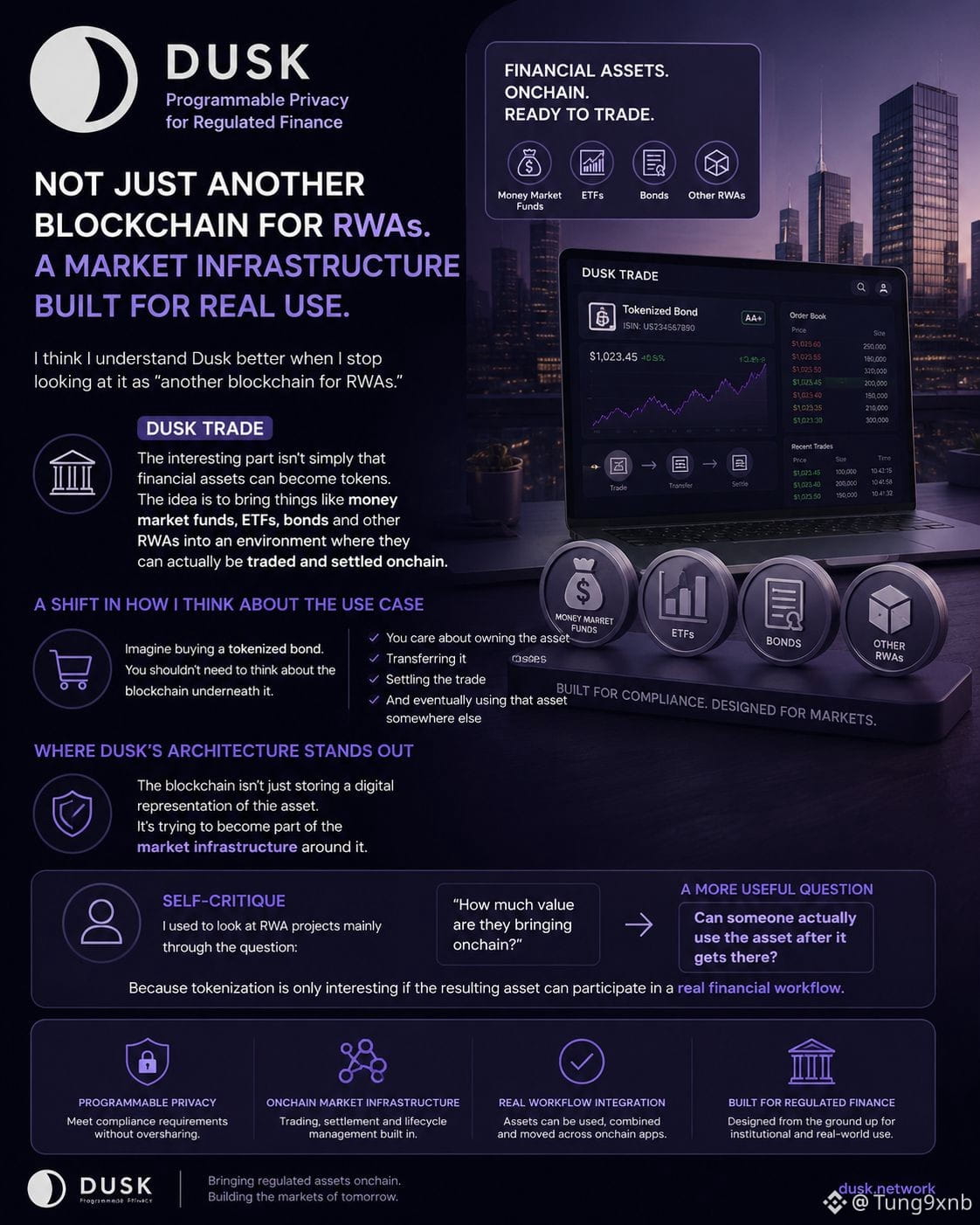
I think I understand Dusk better when I stop looking at it as “another blockchain for RWAs.”
Take Dusk Trade, for example.
The interesting part isn't simply that financial assets can become tokens. The idea is to bring things like money market funds, ETFs, bonds and other RWAs into an environment where they can actually be traded and settled onchain.
That changes how I think about the use case.
Imagine buying a tokenized bond.
You shouldn't need to think about the blockchain underneath it. You care about owning the asset, transferring it, settling the trade, and eventually using that asset somewhere else.
That's where Dusk's architecture starts to feel more practical to me.
The blockchain isn't just storing a digital representation of the asset.
It's trying to become part of the market infrastructure around it.
Self-critique: I used to look at RWA projects mainly through the question “How much value are they bringing onchain?”
But the more useful question may be:
“Can someone actually use the asset after it gets there?”
Because tokenization is only interesting if the resulting asset can participate in a real financial workflow.
Question: What makes an RWA useful?
#dusk $DUSK @Dusk
Take Dusk Trade, for example.
The interesting part isn't simply that financial assets can become tokens. The idea is to bring things like money market funds, ETFs, bonds and other RWAs into an environment where they can actually be traded and settled onchain.
That changes how I think about the use case.
Imagine buying a tokenized bond.
You shouldn't need to think about the blockchain underneath it. You care about owning the asset, transferring it, settling the trade, and eventually using that asset somewhere else.
That's where Dusk's architecture starts to feel more practical to me.
The blockchain isn't just storing a digital representation of the asset.
It's trying to become part of the market infrastructure around it.
Self-critique: I used to look at RWA projects mainly through the question “How much value are they bringing onchain?”
But the more useful question may be:
“Can someone actually use the asset after it gets there?”
Because tokenization is only interesting if the resulting asset can participate in a real financial workflow.
Question: What makes an RWA useful?
#dusk $DUSK @Dusk