I underlined the line in the TermMax whitepaper about “enhanced governance rights” three times, but instead I started to worry about the real boundaries of TMX’s power.
Last night, while reading @TermMax’s TMX whitepaper closely, I got stuck for a long time on a rather obscure description: by staking TMX and obtaining sTMX, you can enhance governance rights, participate in adjustments to market risk parameters, and manage the Curator allowlist. (TS Finance Docs)
At first glance, this doesn’t look much different from ordinary DeFi governance. But after mulling it over repeatedly, I think what’s truly worth watching isn’t simply “whether you can vote,” but what happens when the voting targets run into risk parameters and admission lists—governance power starts to get very close to operational control.
In the industry, people are used to understanding governance as community voting, but they often overlook a blind spot: parameters aren’t abstract numbers—they are returns, leverage, liquidations, and where the capital flows. As a life-like analogy, TermMax is like a large warehouse. TMX holders don’t just decide the décor; they’re deciding who can enter the warehouse, how much collateral the goods require, and what to do when something goes wrong.
That’s when TMX’s role becomes really interesting. It’s not just a gas token—gas for on-chain transactions is still paid to the underlying network. What TMX truly carries is the governance, staking, and incentive entry point. (TS Finance Docs)
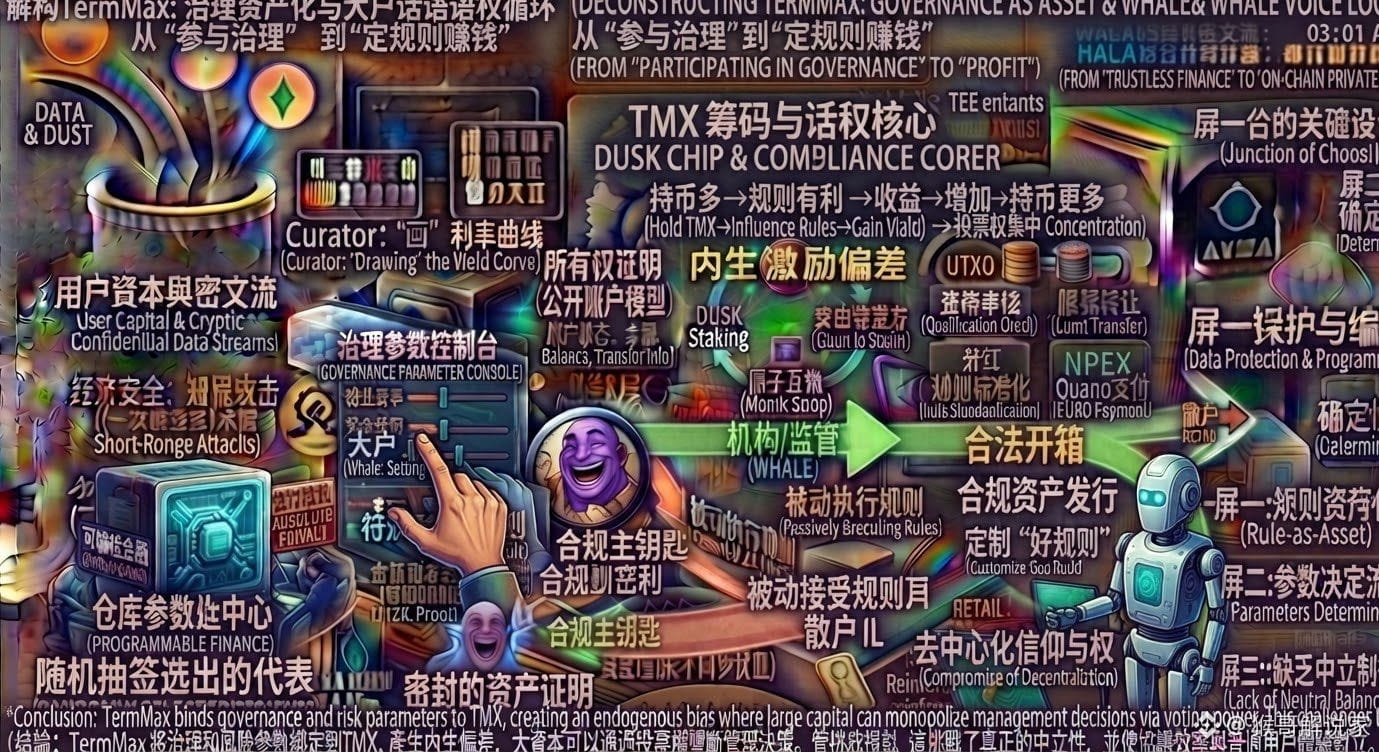
But I’m also wary of the other side: if large holders control more TMX, they can gain stronger influence over governance. Then the cycle—“hold tokens to set rules—earn returns through the rules—use the returns to buy more tokens—further concentrate voting power”—could form a self-reinforcing loop.
My take is that TermMax linking fixed-rate interest, risk-parameter governance, and the staking mechanism has a coherent logic. But the public may interpret “governance” as democracy, while forgetting that governance is, at its core, also about distributing power.
What’s really worth observing is whether, in the future, TMX weight can be long-term tied to actual usage and risk-taking. If large holders can simultaneously decide the rules and the allocation of returns, can this governance still be neutral enough?
#termmax @TermMax
Last night, while reading @TermMax’s TMX whitepaper closely, I got stuck for a long time on a rather obscure description: by staking TMX and obtaining sTMX, you can enhance governance rights, participate in adjustments to market risk parameters, and manage the Curator allowlist. (TS Finance Docs)
At first glance, this doesn’t look much different from ordinary DeFi governance. But after mulling it over repeatedly, I think what’s truly worth watching isn’t simply “whether you can vote,” but what happens when the voting targets run into risk parameters and admission lists—governance power starts to get very close to operational control.
In the industry, people are used to understanding governance as community voting, but they often overlook a blind spot: parameters aren’t abstract numbers—they are returns, leverage, liquidations, and where the capital flows. As a life-like analogy, TermMax is like a large warehouse. TMX holders don’t just decide the décor; they’re deciding who can enter the warehouse, how much collateral the goods require, and what to do when something goes wrong.
That’s when TMX’s role becomes really interesting. It’s not just a gas token—gas for on-chain transactions is still paid to the underlying network. What TMX truly carries is the governance, staking, and incentive entry point. (TS Finance Docs)
But I’m also wary of the other side: if large holders control more TMX, they can gain stronger influence over governance. Then the cycle—“hold tokens to set rules—earn returns through the rules—use the returns to buy more tokens—further concentrate voting power”—could form a self-reinforcing loop.
My take is that TermMax linking fixed-rate interest, risk-parameter governance, and the staking mechanism has a coherent logic. But the public may interpret “governance” as democracy, while forgetting that governance is, at its core, also about distributing power.
What’s really worth observing is whether, in the future, TMX weight can be long-term tied to actual usage and risk-taking. If large holders can simultaneously decide the rules and the allocation of returns, can this governance still be neutral enough?
#termmax @TermMax