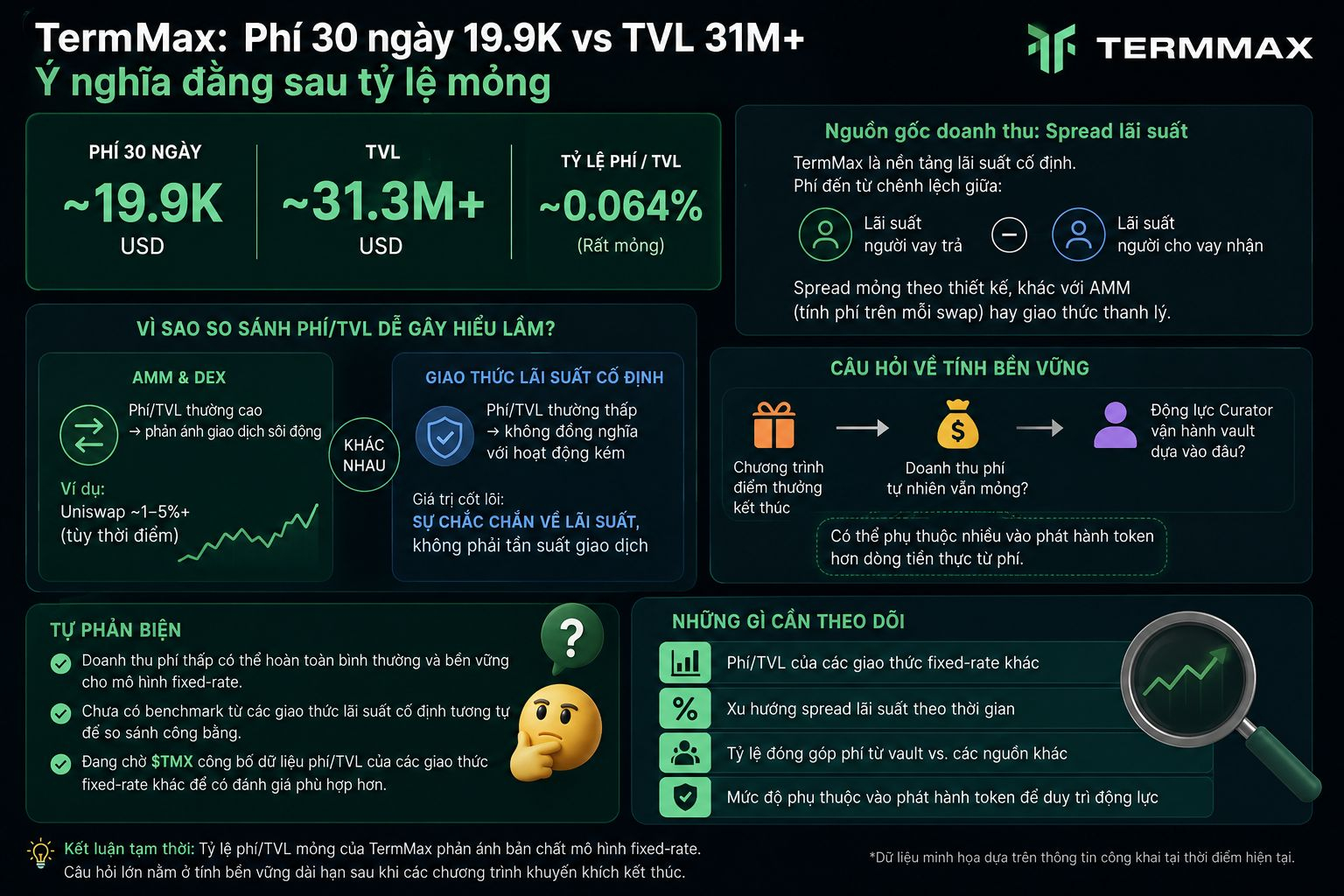
I noticed something when I tried to estimate a 30-day fee—around 19.9K—next to TermMax’s TVL of over 31 million, rather than just looking at each number in isolation.
The fee-to-TVL ratio is quite thin, but what’s interesting isn’t the small number—it’s what it implies about the true source of revenue. In a fixed-rate interest platform, the fee mainly comes from the spread between the interest rate borrowers pay and the interest rate lenders receive—by design, a thin spread, unlike protocols that charge fees per swap or liquidation.
This is what makes comparing TermMax with other DeFi protocols using the fee/TVL metric potentially misleading if you don’t have the right context. AMMs with high fee/TVL often reflect very active trading. But fixed-rate interest protocols with low fee/TVL don’t necessarily indicate weak activity—they may simply reflect the nature of the model, where value lies in the certainty of interest rates, not in the frequency of trades.
But this raises questions about the sustainability of @TermMax after the points/bonus program ends—if fee revenue remains naturally thin, the incentive for a Curator to keep operating the vault may depend more on token emissions than on real cash flow from fees.
Counterpoint to myself: I might be applying the wrong evaluation framework—low fee revenue could be completely normal and sustainable for a fixed-rate model. I don’t yet have benchmarks from similar protocols to compare fairly.
I’m waiting to see whether TMX will publish fee/TVL data for other fixed-rate interest protocols so the comparison is appropriate, instead of self-matching against AMM benchmarks that rely on a fundamentally different revenue model.
#termmax $BTC $ETH
The fee-to-TVL ratio is quite thin, but what’s interesting isn’t the small number—it’s what it implies about the true source of revenue. In a fixed-rate interest platform, the fee mainly comes from the spread between the interest rate borrowers pay and the interest rate lenders receive—by design, a thin spread, unlike protocols that charge fees per swap or liquidation.
This is what makes comparing TermMax with other DeFi protocols using the fee/TVL metric potentially misleading if you don’t have the right context. AMMs with high fee/TVL often reflect very active trading. But fixed-rate interest protocols with low fee/TVL don’t necessarily indicate weak activity—they may simply reflect the nature of the model, where value lies in the certainty of interest rates, not in the frequency of trades.
But this raises questions about the sustainability of @TermMax after the points/bonus program ends—if fee revenue remains naturally thin, the incentive for a Curator to keep operating the vault may depend more on token emissions than on real cash flow from fees.
Counterpoint to myself: I might be applying the wrong evaluation framework—low fee revenue could be completely normal and sustainable for a fixed-rate model. I don’t yet have benchmarks from similar protocols to compare fairly.
I’m waiting to see whether TMX will publish fee/TVL data for other fixed-rate interest protocols so the comparison is appropriate, instead of self-matching against AMM benchmarks that rely on a fundamentally different revenue model.
#termmax $BTC $ETH