"Compliant DeFi"—those four words are basically a joke in the crypto world. If you want privacy, you have to give up oversight; if you want oversight, you have to go “naked,” as if you can only ever choose between the two. But after digging into DUSK’s technical architecture, I found its answer is actually quite interesting: it’s not that privacy is being rejected—it’s that privacy must be explainable.
First, why traditional DeFi naturally conflicts with compliance. On Ethereum, every single transaction is in a “naked” state: how much you transferred and who you transferred it to is visible to everyone on the network. Retail users don’t mind; institutions do. If an asset management company puts all its portfolio rebalancing moves openly on-chain, it effectively lays its cards on the table for competitors. So institutions don’t go on-chain not because they’re not interested, but because the current transparency model of public chains fundamentally can’t coexist with business confidentiality.
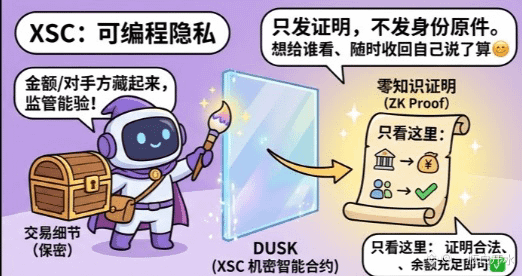
DUSK’s approach is programmable privacy. Its XSC confidential smart contract standard lets developers define which data in each transaction remains private and which is public. Transfer amounts and counterparty information can be hidden, while a ZK proof is left on-chain to show the transaction is legitimate and that balances are sufficient. The public can’t see the details, but regulators can verify.
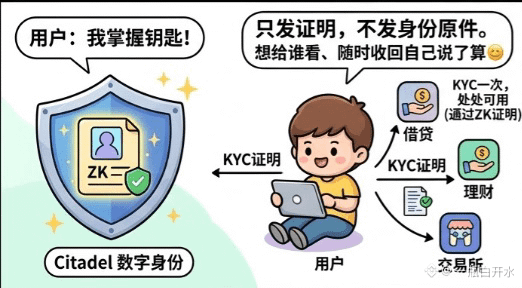
The accompanying Citadel digital identity solution is even more interesting. Users do KYC once; the data is ZK-encrypted and stored on-chain. After that, when accessing any service, they only need to prove “I have passed KYC,” without repeatedly sending ID photos to every platform. And control over the data always stays with the user: they decide who to show it to and when to revoke access.
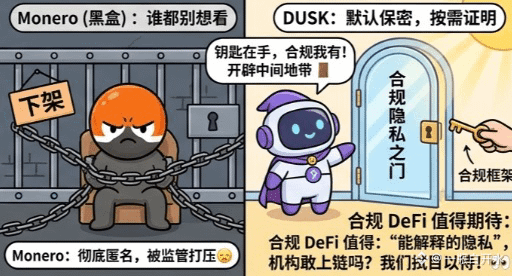
Compare it with Monero and it becomes very clear. Monero is “nobody gets to see anything,” so it has been delisted by a bunch of exchanges. DUSK is “by default, nobody looks—when needed, it can prove.” The former is shutting the door; the latter is installing a locked door, with the key held within a compliance framework.
Of course, ZK proof computation has non-trivial overhead, and whether on-chain performance can handle high concurrency is a question. Also, how “programmable privacy” will be enforced and audited by regulators is still being explored under the MiCA framework.
But the direction is right. Compliant DeFi isn’t a false proposition—the false part is the crude binary logic of “either fully transparent or fully anonymous.” DUSK opens up the middle ground. I’ll keep watching the real-world deployment of XSC contracts. Do you think this kind of “explainable privacy” can help institutions truly take the next step onto the chain?#dusk $DUSK @Dusk
First, why traditional DeFi naturally conflicts with compliance. On Ethereum, every single transaction is in a “naked” state: how much you transferred and who you transferred it to is visible to everyone on the network. Retail users don’t mind; institutions do. If an asset management company puts all its portfolio rebalancing moves openly on-chain, it effectively lays its cards on the table for competitors. So institutions don’t go on-chain not because they’re not interested, but because the current transparency model of public chains fundamentally can’t coexist with business confidentiality.
DUSK’s approach is programmable privacy. Its XSC confidential smart contract standard lets developers define which data in each transaction remains private and which is public. Transfer amounts and counterparty information can be hidden, while a ZK proof is left on-chain to show the transaction is legitimate and that balances are sufficient. The public can’t see the details, but regulators can verify.
The accompanying Citadel digital identity solution is even more interesting. Users do KYC once; the data is ZK-encrypted and stored on-chain. After that, when accessing any service, they only need to prove “I have passed KYC,” without repeatedly sending ID photos to every platform. And control over the data always stays with the user: they decide who to show it to and when to revoke access.
Compare it with Monero and it becomes very clear. Monero is “nobody gets to see anything,” so it has been delisted by a bunch of exchanges. DUSK is “by default, nobody looks—when needed, it can prove.” The former is shutting the door; the latter is installing a locked door, with the key held within a compliance framework.
Of course, ZK proof computation has non-trivial overhead, and whether on-chain performance can handle high concurrency is a question. Also, how “programmable privacy” will be enforced and audited by regulators is still being explored under the MiCA framework.
But the direction is right. Compliant DeFi isn’t a false proposition—the false part is the crude binary logic of “either fully transparent or fully anonymous.” DUSK opens up the middle ground. I’ll keep watching the real-world deployment of XSC contracts. Do you think this kind of “explainable privacy” can help institutions truly take the next step onto the chain?#dusk $DUSK @Dusk