I used to think that a blockchain mainly needs good technology to go far. After a few cycles, I began to realize the problem is not the number of features, but whether the system generates sustainably usable behavior.
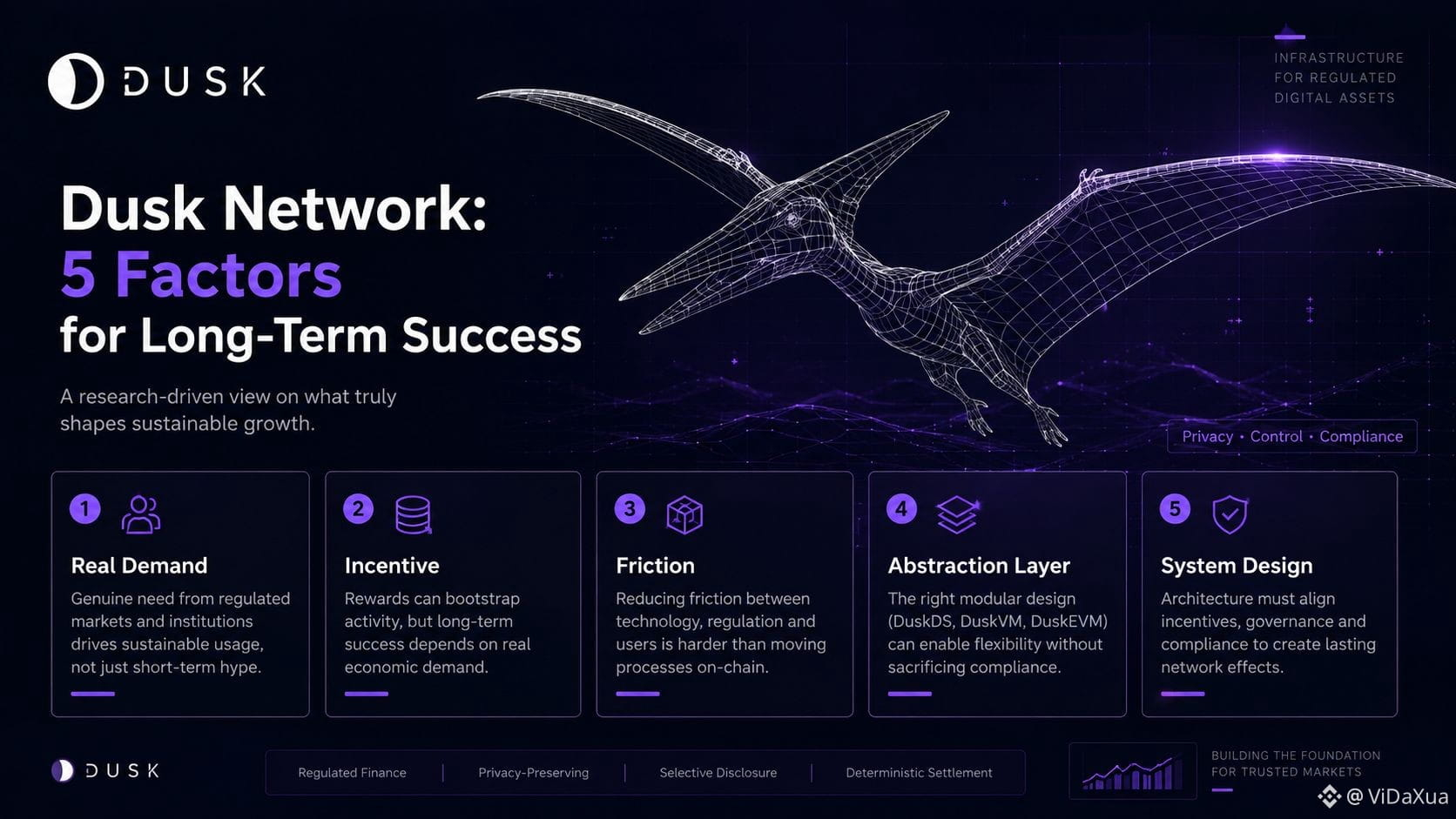
Looking at Dusk Network, I see five variables worth tracking: real demand, incentives, friction, the abstraction layer, and system design. Dusk is built around regulated finance, with DuskDS for settlement, and DuskVM and DuskEVM for different execution environments.
It sounds convincing, but good architecture doesn’t automatically mean adoption. The interesting part isn’t how many components Dusk has, but whether those components cause the market to change its behavior.
The issue isn’t that the token has utility; it’s whether real demand is actually created by network activity. DUSK is used for gas and staking, while block rewards still include token emission. So I still want to distinguish signal from noise—does the activity come from genuine demand, or from incentives?
However, friction in regulated markets doesn’t disappear just because it’s brought on-chain. That’s only true when processes like eligibility, privacy, disclosure, and settlement are truly used.
At least from my perspective, the long-term question remains: does this system design create repeatable behavior without depending too much on incentives?
#dusk $DUSK @Dusk $BTC