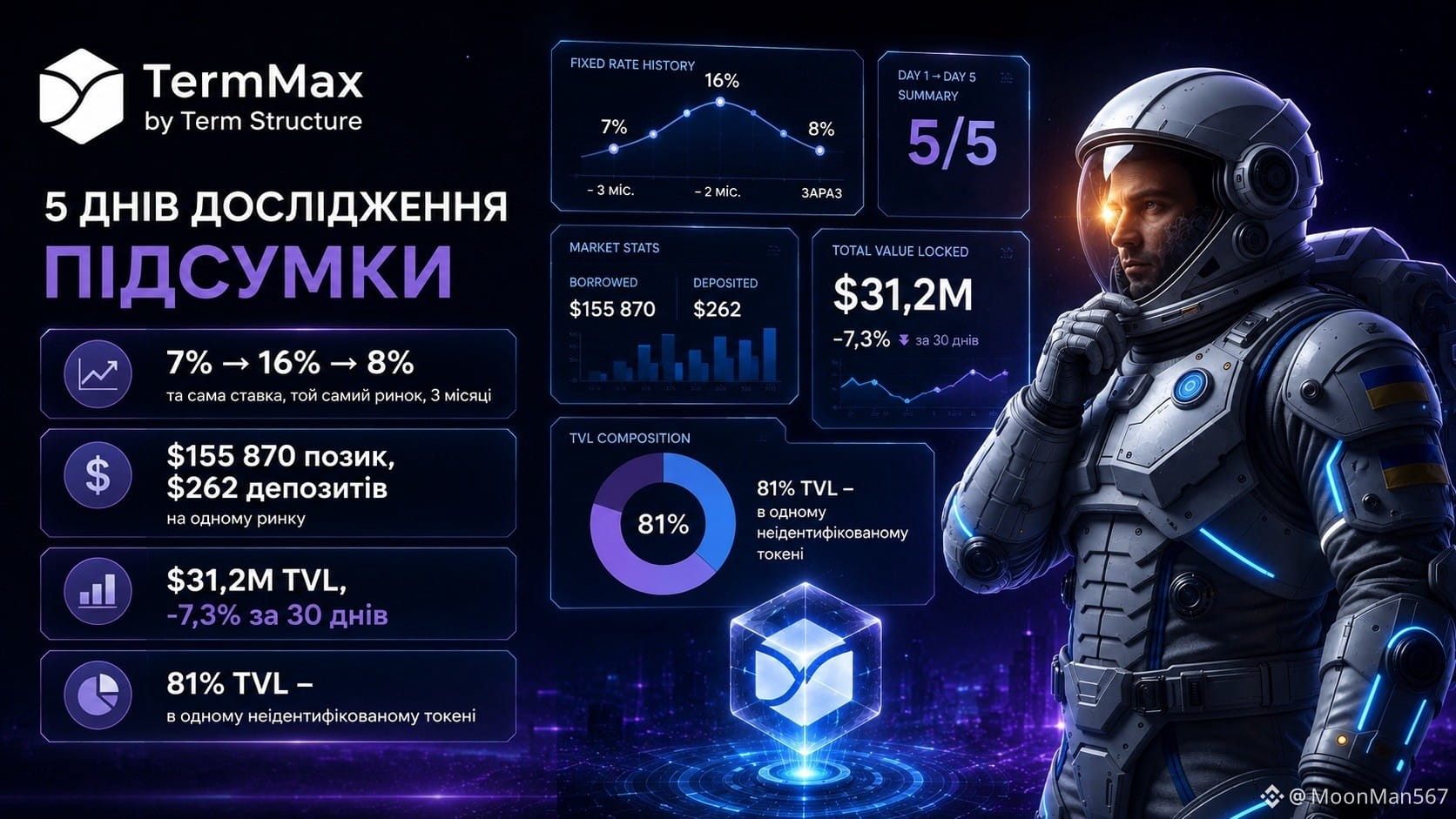
For five days, I was checking what exactly is hidden behind the word "fixed" in TermMax. A short weekly summary, fact by fact.
A fixed rate for a specific position at the time of the match—not capital safety—the market rate on the same market meanwhile wandered from ~7% to ~16% and back (Day 1). Liquidation takes 2 hours, and if the debt isn’t fully repaid, the lender receives the collateral directly, not the money (Day 2). More types of collateral— from PT tokens to tokenized shares—means more different rules of the game at the same time, not just more options (Day 3). And what’s claimed—new markets, TVL, safety—doesn’t always equal what you can see on-chain: 31.2M TVL overall, and 81% of it is in a single token that I still haven’t been able to identify (Day 4).
One more detail clarified only yesterday: besides FT and GT, there’s a third token, XT—specifically it’s responsible for the interest obligation tied to FT. Five days of checks, and the mechanism is still being revealed in layers.
@TermMax calls itself fixed-income infrastructure. As for the structure, that’s honestly true—it really fixes specific parameters, one by one.
I have an awkward question after the week of checks: is a fixed structure the same as a reliable structure, or are these two different issues that are easy to confuse?
#TermMax
A fixed rate for a specific position at the time of the match—not capital safety—the market rate on the same market meanwhile wandered from ~7% to ~16% and back (Day 1). Liquidation takes 2 hours, and if the debt isn’t fully repaid, the lender receives the collateral directly, not the money (Day 2). More types of collateral— from PT tokens to tokenized shares—means more different rules of the game at the same time, not just more options (Day 3). And what’s claimed—new markets, TVL, safety—doesn’t always equal what you can see on-chain: 31.2M TVL overall, and 81% of it is in a single token that I still haven’t been able to identify (Day 4).
One more detail clarified only yesterday: besides FT and GT, there’s a third token, XT—specifically it’s responsible for the interest obligation tied to FT. Five days of checks, and the mechanism is still being revealed in layers.
@TermMax calls itself fixed-income infrastructure. As for the structure, that’s honestly true—it really fixes specific parameters, one by one.
I have an awkward question after the week of checks: is a fixed structure the same as a reliable structure, or are these two different issues that are easy to confuse?
#TermMax