#termmax The more I research @TermMax , the more I feel that its curator design is not just about technical details—it may be a signal of the evolution in DeFi asset management.
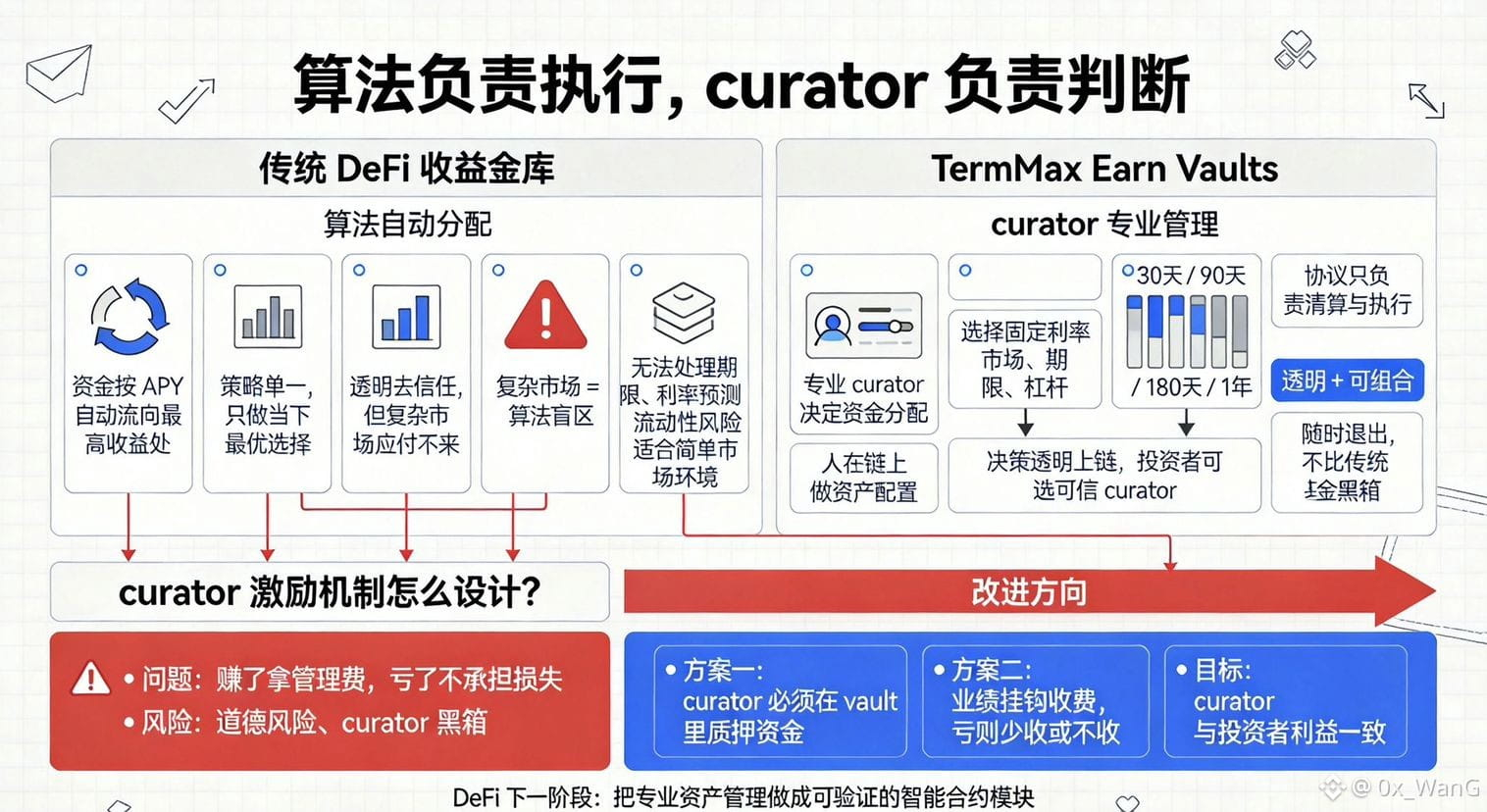
Most traditional DeFi yield vaults are algorithm-driven. The protocol automatically allocates funds to where yields are highest. The upside is transparency and trustlessness; the downside is that the strategy is singular, and it struggles in complex market environments. TermMax’s Earn vaults introduce a curator: professional managers decide how to allocate funds to which fixed-rate markets, for what terms, and with how much leverage. This turns it into humans doing asset allocation on-chain, while the automated protocol only handles execution.
I think the significance of this shift is underestimated. In DeFi’s early days, the emphasis was on removing intermediaries, and any human-involved component was seen as less “pure.” But the reality is that the more complex the market is, the more professional judgment is needed. Fixed-rate markets involve choosing terms, forecasting interest rates, liquidity management, and risk assessment—things that simple algorithms can’t easily handle. The introduction of curators is, in effect, an acknowledgement that DeFi needs professional asset management capabilities, and it packages that capability into verifiable, composable smart-contract modules.
So I believe the curator model could become the mainstream in DeFi’s next phase. This model doesn’t take DeFi back down the old path of centralized custody. Asset managers’ decisions are transparent on-chain. Investors can choose curators they trust, and they can exit at any time. This is more transparent than traditional funds, and more flexible than purely algorithmic protocols.
Of course, there are also problems: how should curator incentive mechanisms and responsibility boundaries be designed? If curators earn management fees when they profit, but don’t bear losses when they underperform, users will worry about moral hazard. I suggest TermMax should have curators stake part of their own capital in the vault as well, or design a performance-linked fee structure so that the interests of curators and investors are better aligned.
Brothers, would you be willing to hand your money to a transparent on-chain human curator for management, or do you trust a fully automated protocol more? Feel free to leave a comment and let’s discuss together.
Most traditional DeFi yield vaults are algorithm-driven. The protocol automatically allocates funds to where yields are highest. The upside is transparency and trustlessness; the downside is that the strategy is singular, and it struggles in complex market environments. TermMax’s Earn vaults introduce a curator: professional managers decide how to allocate funds to which fixed-rate markets, for what terms, and with how much leverage. This turns it into humans doing asset allocation on-chain, while the automated protocol only handles execution.
I think the significance of this shift is underestimated. In DeFi’s early days, the emphasis was on removing intermediaries, and any human-involved component was seen as less “pure.” But the reality is that the more complex the market is, the more professional judgment is needed. Fixed-rate markets involve choosing terms, forecasting interest rates, liquidity management, and risk assessment—things that simple algorithms can’t easily handle. The introduction of curators is, in effect, an acknowledgement that DeFi needs professional asset management capabilities, and it packages that capability into verifiable, composable smart-contract modules.
So I believe the curator model could become the mainstream in DeFi’s next phase. This model doesn’t take DeFi back down the old path of centralized custody. Asset managers’ decisions are transparent on-chain. Investors can choose curators they trust, and they can exit at any time. This is more transparent than traditional funds, and more flexible than purely algorithmic protocols.
Of course, there are also problems: how should curator incentive mechanisms and responsibility boundaries be designed? If curators earn management fees when they profit, but don’t bear losses when they underperform, users will worry about moral hazard. I suggest TermMax should have curators stake part of their own capital in the vault as well, or design a performance-linked fee structure so that the interests of curators and investors are better aligned.
Brothers, would you be willing to hand your money to a transparent on-chain human curator for management, or do you trust a fully automated protocol more? Feel free to leave a comment and let’s discuss together.