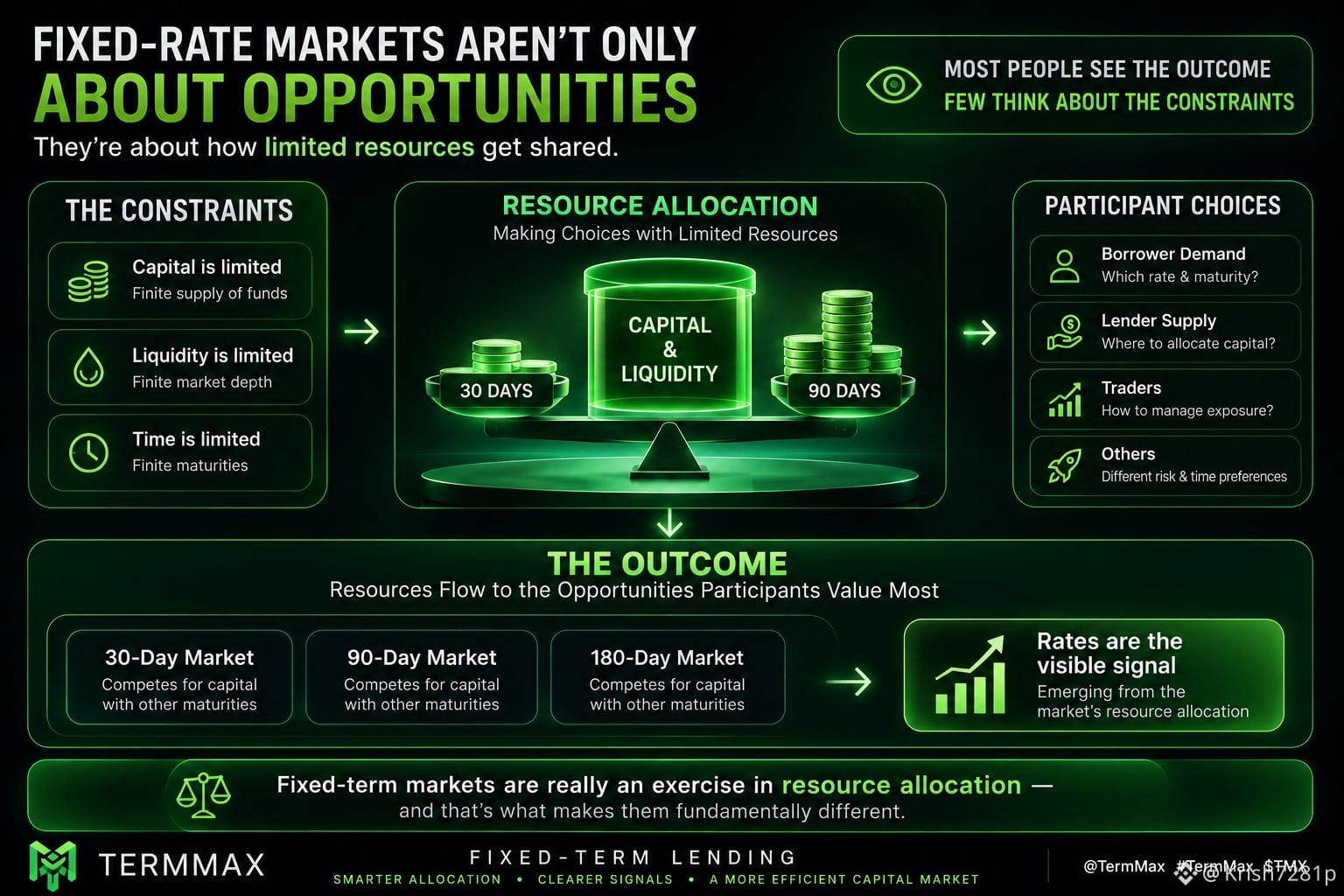
The more I read about @TermMax , the more I think people focus on outcomes while ignoring constraints.
Most discussions focus on what a user can do.
Borrow at a fixed rate.
Lend for a fixed return.
Trade around a maturity.
Use leverage.
But every financial system is ultimately shaped by its constraints.
Capital is limited.
Liquidity is limited.
Time is limited.
That's what makes fixed-term markets interesting to me.
Every loan is competing for a finite amount of capital over a finite period of time.
A market cannot offer unlimited liquidity at every maturity.
It cannot satisfy every borrower at every rate.
Choices have to be made.
That's why I think fixed-rate markets are really an exercise in resource allocation.
A 30-day market competes with a 90-day market.
A borrower competes with other borrowers.
Capital flows toward the opportunities participants value most.
The more I think about it, the more I believe the interesting part isn't the fixed rate itself.
It's how the market distributes scarce resources across different maturities and participants.
The rate is simply the visible signal that emerges from those decisions.
Most people see the outcome.
Very few think about the constraints creating that outcome.
Because building a market isn't only about offering opportunities.
It's about deciding how limited resources get shared.
And that's the part of @TermMax I'm paying the most attention to.
@TermMax #TermMax