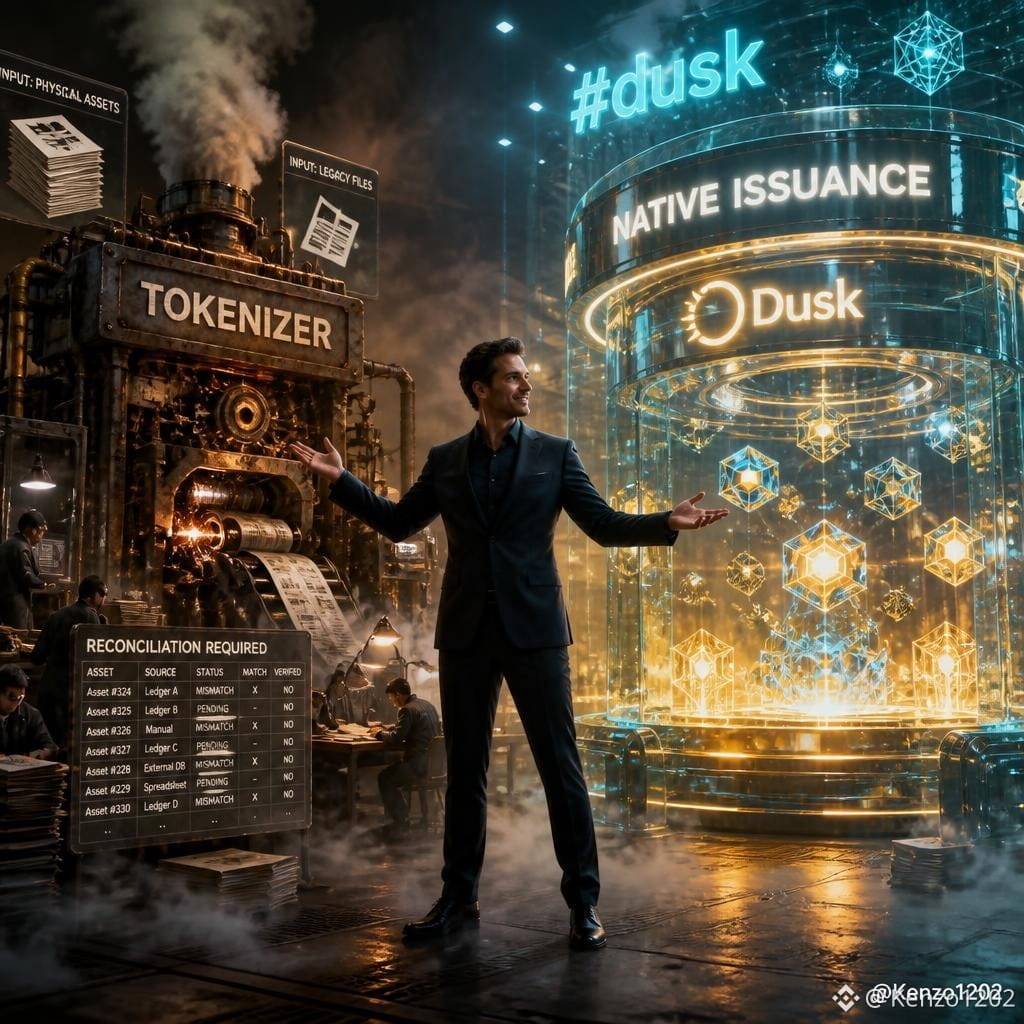
Native Issuance vs Tokenization The Key Difference 🏛️
Most RWA content today only uses two terms: "tokenized" and "non-tokenized" as if there were only one single boundary, and everything "on-chain" belongs to the same category.
But according to Dusk, there are actually three distinct layers, not two:
Layer 1: Digitalization Moving asset records from paper to digital systems. The asset lifecycle and intermediaries remain largely unchanged; it's just records shifting from paper to digital.
Layer 2: Tokenization Issuing a token that represents the asset, or represents a claim on the asset. Tokens can be programmable, but regulated assets still depend on custody, registration, and settlement processes off-chain.
Layer 3: Native Issuance Assets are created and managed entirely on-chain. Issuance, transfers, servicing, and settlement all revolve around the ledger, rather than using a token as a wrapper around a separate record-keeping system.
The key difference:
Tokenization: The token is a synthetic asset representing the underlying there is always an underlying asset somewhere.
Native Issuance: The asset is created on-chain no underlying asset is needed for reference.
The consequence:
Tokenization still requires reconciliation between two systems → still T+2 days for settlement.
Native Issuance can achieve deterministic finality directly on-chain → T+0, 24/7.
Dusk positions itself at the third layer not just wrapping existing assets, but redesigning the entire process of issuance, access control, disclosure, and settlement directly on-chain. With the DLT‑TSS license (in progress) through NPEX, Dusk has the full legal framework to make native issuance a reality.
The real question when looking at any RWA project:
"Is it at the digitalization layer, the tokenization layer, or has it truly reached the native issuance layer?"
@Dusk $DUSK #dusk $BTC
#dusk $DUSK @Dusk
Most RWA content today only uses two terms: "tokenized" and "non-tokenized" as if there were only one single boundary, and everything "on-chain" belongs to the same category.
But according to Dusk, there are actually three distinct layers, not two:
Layer 1: Digitalization Moving asset records from paper to digital systems. The asset lifecycle and intermediaries remain largely unchanged; it's just records shifting from paper to digital.
Layer 2: Tokenization Issuing a token that represents the asset, or represents a claim on the asset. Tokens can be programmable, but regulated assets still depend on custody, registration, and settlement processes off-chain.
Layer 3: Native Issuance Assets are created and managed entirely on-chain. Issuance, transfers, servicing, and settlement all revolve around the ledger, rather than using a token as a wrapper around a separate record-keeping system.
The key difference:
Tokenization: The token is a synthetic asset representing the underlying there is always an underlying asset somewhere.
Native Issuance: The asset is created on-chain no underlying asset is needed for reference.
The consequence:
Tokenization still requires reconciliation between two systems → still T+2 days for settlement.
Native Issuance can achieve deterministic finality directly on-chain → T+0, 24/7.
Dusk positions itself at the third layer not just wrapping existing assets, but redesigning the entire process of issuance, access control, disclosure, and settlement directly on-chain. With the DLT‑TSS license (in progress) through NPEX, Dusk has the full legal framework to make native issuance a reality.
The real question when looking at any RWA project:
"Is it at the digitalization layer, the tokenization layer, or has it truly reached the native issuance layer?"
@Dusk $DUSK #dusk $BTC
#dusk $DUSK @Dusk