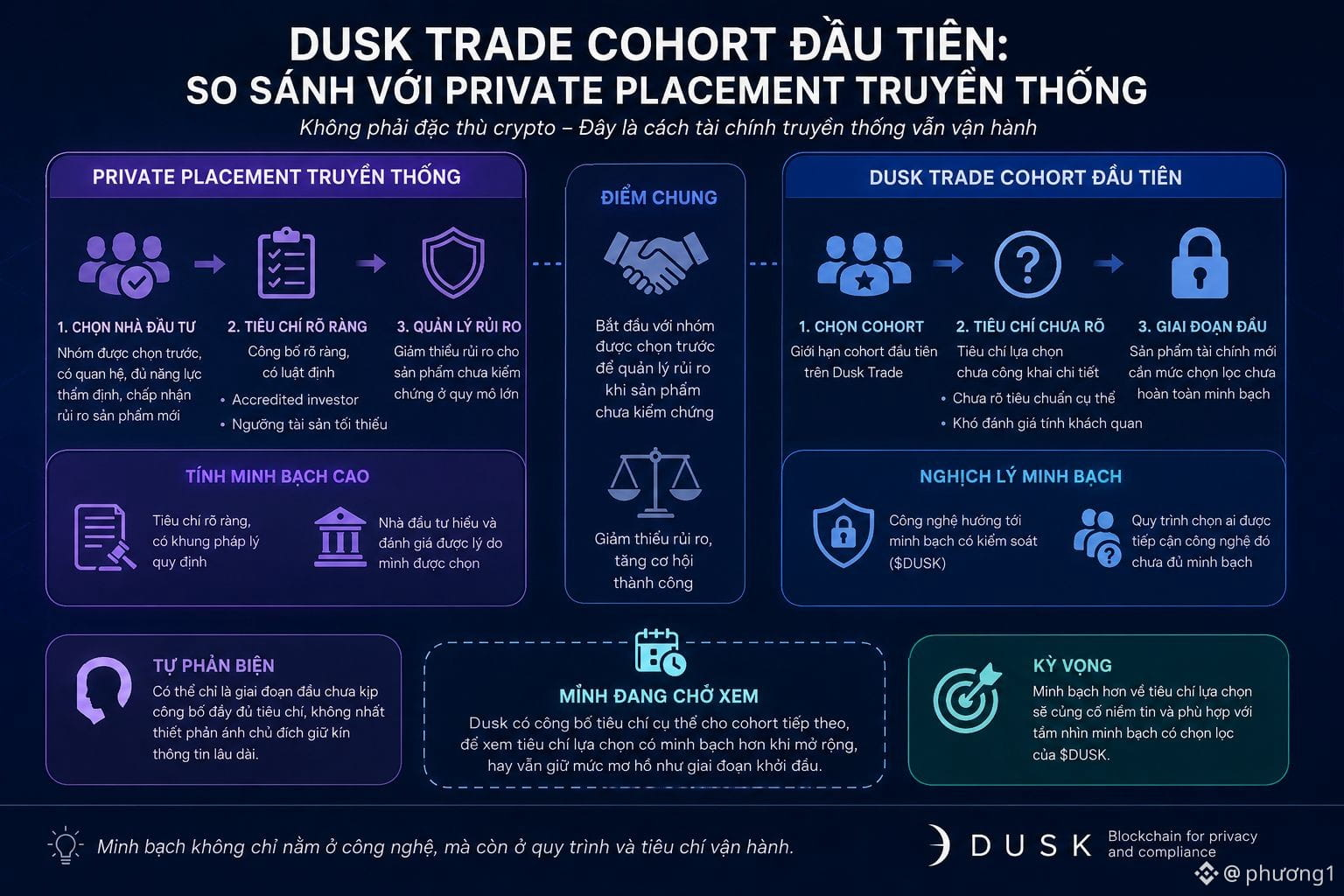
I realized something when comparing the “first cohort” structure of Dusk Trade with how traditional private placement rounds initially choose investors, rather than thinking this is something unique to crypto.
In traditional finance, private issuance almost always begins with a pre-selected group of investors—usually those with existing relationships, sufficient capacity to perform due diligence, and willingness to accept the risks of a new product. This isn’t arbitrary favoritism, but sensible risk management when the product hasn’t been validated at scale.
Seen this way, the way @Dusk limits the first cohort on Dusk Trade isn’t very different from how an IPO or a traditional private placement typically operates. But there’s one notable difference: in traditional finance, the criteria for selecting initial investors—such as accredited investor status, minimum asset thresholds—are usually clearly disclosed and regulated by law. Whereas with Dusk Trade’s first cohort.
This may not necessarily be a problem—early stages of any new financial product often require a level of filtering that isn’t fully transparent yet. But for a project that places emphasis on selectively transparent information like $DUSK , the lack of clarity around cohort selection criteria creates a small paradox: technology aiming for controlled transparency, but the process for who gets access to that technology isn’t transparent enough.
Self-reflection: it could just be that the early stage hasn’t had time to fully publish the criteria, and it doesn’t necessarily reflect a long-term intention to keep information hidden.
I’m waiting to see whether Dusk will publish specific criteria for the next cohort, to determine if the selection criteria become more transparent as it scales—or if they still remain as vague as at the beginning.
#dusk $BTC $ETH
In traditional finance, private issuance almost always begins with a pre-selected group of investors—usually those with existing relationships, sufficient capacity to perform due diligence, and willingness to accept the risks of a new product. This isn’t arbitrary favoritism, but sensible risk management when the product hasn’t been validated at scale.
Seen this way, the way @Dusk limits the first cohort on Dusk Trade isn’t very different from how an IPO or a traditional private placement typically operates. But there’s one notable difference: in traditional finance, the criteria for selecting initial investors—such as accredited investor status, minimum asset thresholds—are usually clearly disclosed and regulated by law. Whereas with Dusk Trade’s first cohort.
This may not necessarily be a problem—early stages of any new financial product often require a level of filtering that isn’t fully transparent yet. But for a project that places emphasis on selectively transparent information like $DUSK , the lack of clarity around cohort selection criteria creates a small paradox: technology aiming for controlled transparency, but the process for who gets access to that technology isn’t transparent enough.
Self-reflection: it could just be that the early stage hasn’t had time to fully publish the criteria, and it doesn’t necessarily reflect a long-term intention to keep information hidden.
I’m waiting to see whether Dusk will publish specific criteria for the next cohort, to determine if the selection criteria become more transparent as it scales—or if they still remain as vague as at the beginning.
#dusk $BTC $ETH