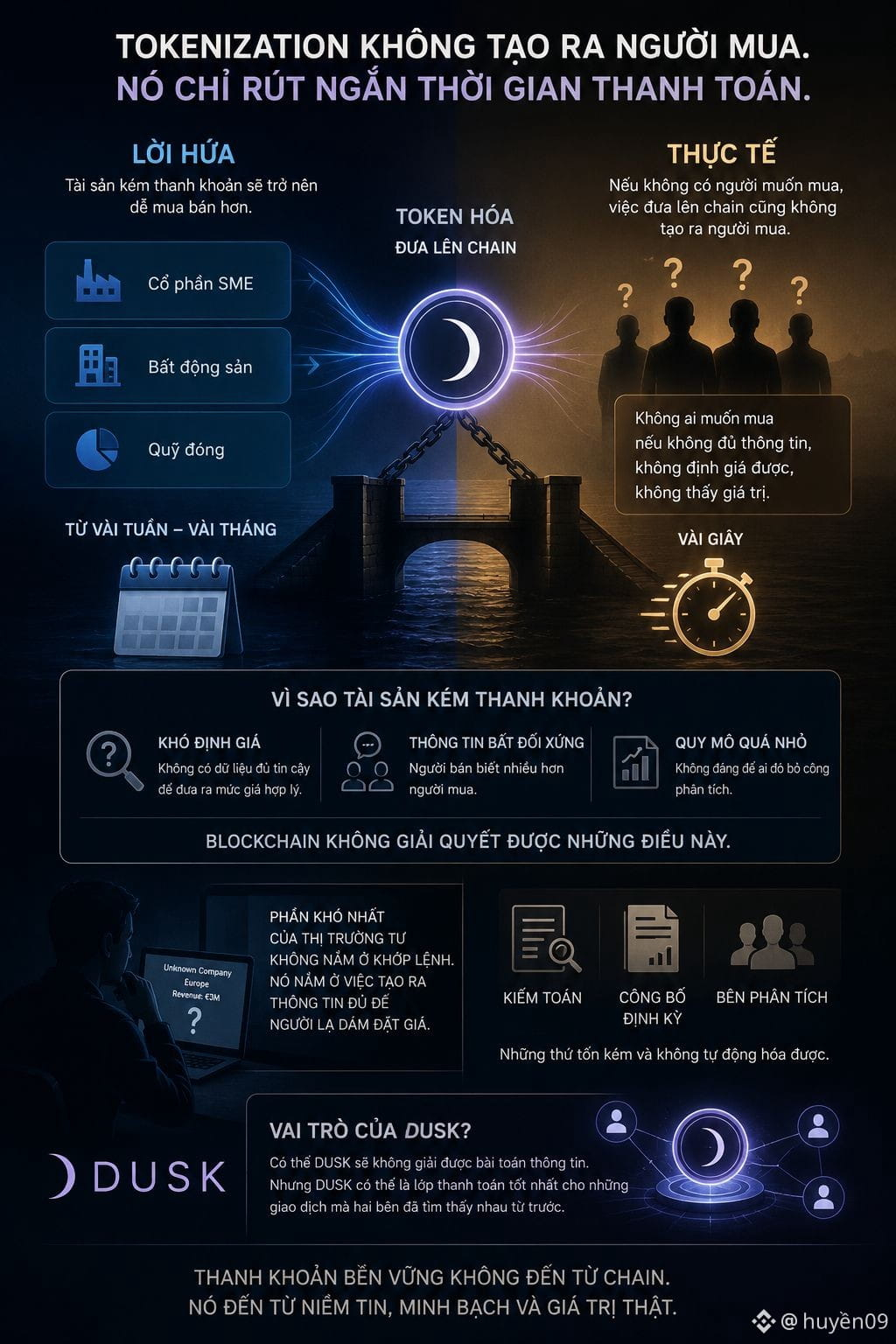
This week I looked into the secondary liquidity of @Dusk v and one detail made me pause. The whole promise of tokenization rests on a single claim: illiquid assets will become easier to buy and sell. SME shares, real estate, closed-end funds—capital that used to have to wait month by month to find a buyer—can now be traded in a matter of seconds.
But tokenization doesn’t create buyers. It only shortens settlement time. If a small business in the Netherlands has no one who wants to buy its shares, then having those shares on-chain doesn’t make any buyers appear.
What made me stop… the reason these assets have been illiquid was never mainly because the infrastructure was slow. It’s because they’re hard to value, information is asymmetric, and the scale is so small that it’s not worth anyone’s time to analyze. None of that is solved by blockchain.
A small anecdote: I tried to think how I would value the shares of a European company with a few million euros in revenue that I’ve never even heard of. Hmm… I have no way to do it. And if I can’t value it, then I’m not really a buyer—no matter how fast the trade executes.
So the hardest part of private markets isn’t matching orders. It’s creating enough information for strangers to be willing to place a price. That’s the job of auditors, periodic reporting, and analysts—things that are costly and can’t be fully automated.
I’m curious how $DUSK will solve this problem, or whether it’ll accept a more modest role: building a better settlement layer for transactions where the two parties have already found each other in the first place.
#dusk $BTC $ETH
But tokenization doesn’t create buyers. It only shortens settlement time. If a small business in the Netherlands has no one who wants to buy its shares, then having those shares on-chain doesn’t make any buyers appear.
What made me stop… the reason these assets have been illiquid was never mainly because the infrastructure was slow. It’s because they’re hard to value, information is asymmetric, and the scale is so small that it’s not worth anyone’s time to analyze. None of that is solved by blockchain.
A small anecdote: I tried to think how I would value the shares of a European company with a few million euros in revenue that I’ve never even heard of. Hmm… I have no way to do it. And if I can’t value it, then I’m not really a buyer—no matter how fast the trade executes.
So the hardest part of private markets isn’t matching orders. It’s creating enough information for strangers to be willing to place a price. That’s the job of auditors, periodic reporting, and analysts—things that are costly and can’t be fully automated.
I’m curious how $DUSK will solve this problem, or whether it’ll accept a more modest role: building a better settlement layer for transactions where the two parties have already found each other in the first place.
#dusk $BTC $ETH