I just read the ECB’s 2024 April macroprudential report for Europe, and a set of data made me stare for a few seconds. Among tokenized money market funds registered in the EU, there’s only one that is denominated in euros. My first reaction was, no way—why isn’t anyone putting euro assets on-chain? Digging further, I found that DUSK has already laid most of the groundwork.
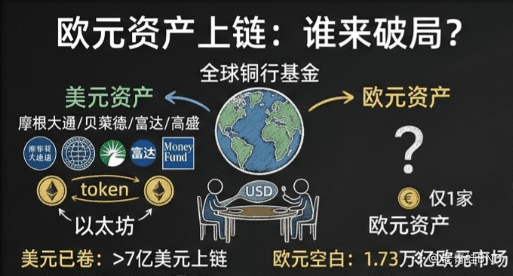
First, let’s look at what’s happening with USD. Ondo’s USDY plus OUSG has over $700 million in on-chain assets, and it has secured collateral by integrating more than 12 DeFi protocols. JPMorgan has moved the MONY fund onto Ethereum. BNY is working with Goldman on mirrored tokenization. BlackRock and Fidelity are all on the first batch of lists. Tokenizing dollar money market funds is no longer a new concept.
Now, Europe. Global money market funds total $8.8 trillion. Under European MMFR regulation, that’s €1.73 trillion in Europe alone. Yet for tokenized money market funds denominated in euros on-chain, you can count them on one hand. With such a big piece of meat, nobody’s reached for chopsticks.
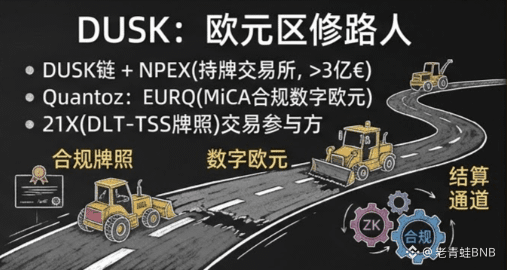
It’s not that there’s no demand—it’s that the road hasn’t been built. What DUSK does is exactly road construction. NPEX is a licensed exchange in the Netherlands, overseeing more than €300 million in assets, and it works with DUSK on security tokenization. Quantoz has issued a MiCA-compliant digital euro, EURQ, running on the DUSK chain. 21X obtained Europe’s first DLT-TSS license, and DUSK is its trading participant. From compliance licenses to settlement rails to the digital euro—everything that should be prepared has basically been prepared. Now it just depends on when euro fund products can truly be brought onto the table.
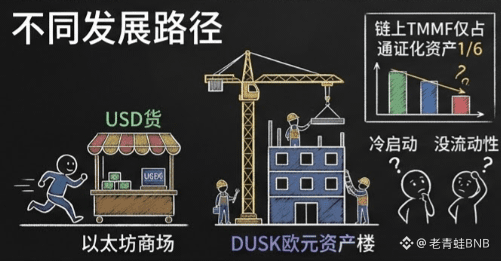
For example, Ondo is like renting storefronts in the Ethereum market to sell dollars. DUSK wants to build its own building—a place dedicated to housing euro assets.
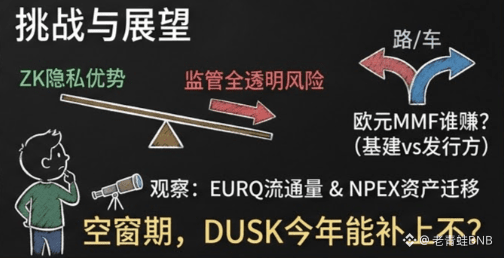
But the pitfalls aren’t few. The total market cap of on-chain TMMFs is only about one-sixth of tokenized assets on public chains. Without liquidity institutions, no one comes; without institutions, there’s no liquidity. DUSK differentiates with ZK privacy, and if European regulators suddenly say, “No, everything must be transparent,” the advantage is basically wiped out. There’s another point: DUSK is in the business of building roads, not driving. Once euro MMFs actually start running, who earns the money—does infrastructure get paid, or does the issuer? Nobody can say for sure.
The dollar funds are already on the table. Who will serve the euro assets onto the plate? I’ll keep watching the circulating supply of EURQ and the progress of asset migration by NPEX. Do you think this gap period—can DUSK fill it this year? #dusk $DUSK @Dusk
First, let’s look at what’s happening with USD. Ondo’s USDY plus OUSG has over $700 million in on-chain assets, and it has secured collateral by integrating more than 12 DeFi protocols. JPMorgan has moved the MONY fund onto Ethereum. BNY is working with Goldman on mirrored tokenization. BlackRock and Fidelity are all on the first batch of lists. Tokenizing dollar money market funds is no longer a new concept.
Now, Europe. Global money market funds total $8.8 trillion. Under European MMFR regulation, that’s €1.73 trillion in Europe alone. Yet for tokenized money market funds denominated in euros on-chain, you can count them on one hand. With such a big piece of meat, nobody’s reached for chopsticks.
It’s not that there’s no demand—it’s that the road hasn’t been built. What DUSK does is exactly road construction. NPEX is a licensed exchange in the Netherlands, overseeing more than €300 million in assets, and it works with DUSK on security tokenization. Quantoz has issued a MiCA-compliant digital euro, EURQ, running on the DUSK chain. 21X obtained Europe’s first DLT-TSS license, and DUSK is its trading participant. From compliance licenses to settlement rails to the digital euro—everything that should be prepared has basically been prepared. Now it just depends on when euro fund products can truly be brought onto the table.
For example, Ondo is like renting storefronts in the Ethereum market to sell dollars. DUSK wants to build its own building—a place dedicated to housing euro assets.
But the pitfalls aren’t few. The total market cap of on-chain TMMFs is only about one-sixth of tokenized assets on public chains. Without liquidity institutions, no one comes; without institutions, there’s no liquidity. DUSK differentiates with ZK privacy, and if European regulators suddenly say, “No, everything must be transparent,” the advantage is basically wiped out. There’s another point: DUSK is in the business of building roads, not driving. Once euro MMFs actually start running, who earns the money—does infrastructure get paid, or does the issuer? Nobody can say for sure.
The dollar funds are already on the table. Who will serve the euro assets onto the plate? I’ll keep watching the circulating supply of EURQ and the progress of asset migration by NPEX. Do you think this gap period—can DUSK fill it this year? #dusk $DUSK @Dusk