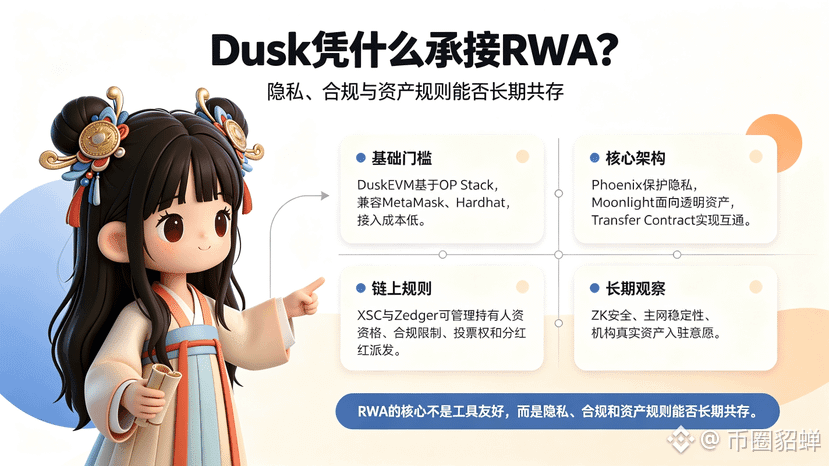
Many people ask whether a single chain can support RWA—first you look at whether it is EVM-compatible or not, and whether the development tools are complete or not. In fact, those are the easiest parts to solve. DuskEVM itself follows the OP Stack approach, and is compatible with standard tools like MetaMask and Hardhat, so the integration cost isn’t high. What I’m more concerned about is the next part: whether the protocol can simultaneously satisfy two needs that pull against each other. The two trading parties don’t want to disclose sensitive asset information, but regulators must still verify that the transaction is compliant.
Dusk resolves this contradiction by building two separate models and connecting them. Phoenix uses zero-knowledge proofs to verify transaction validity while protecting sensitive transaction information; Moonlight corresponds to asset scenarios that must be transparent. The two models interoperate through a Transfer Contract on the same settlement layer, so assets don’t have to be forced to choose between one or the other. In my view, the value of this design isn’t just the combination of “privacy plus transparency,” but turning selective disclosure into a protocol-layer default capability.
After continuing to research Dusk’s XSC and Zedger, I focus more on how the securities lifecycle itself is managed by the protocol. Holder eligibility, compliance restrictions, voting rights, dividend distribution—rules that originally relied on intermediaries and legal processes can, in theory, be written into on-chain logic to run continuously, reducing repeated manual verification. DuskDS is responsible for consensus and finality, ensuring that these state transitions are completed according to the network’s rules.
But even if the toolchain is mature and the architecture is sound, those are only necessary conditions. I think what truly needs to be observed is the engineering security of the zero-knowledge proof system, the long-term stability of mainnet operations, and whether institutions are willing to put real assets into such an environment for verification. Returning to the original question—whether a chain can take on RWA—the final judgment isn’t whether the development tools are friendly, but whether the protocol can allow privacy, compliance, and asset rules to coexist in the long run. This is also the key reason I keep paying attention to $DUSK .
#dusk $DUSK @Dusk
Dusk resolves this contradiction by building two separate models and connecting them. Phoenix uses zero-knowledge proofs to verify transaction validity while protecting sensitive transaction information; Moonlight corresponds to asset scenarios that must be transparent. The two models interoperate through a Transfer Contract on the same settlement layer, so assets don’t have to be forced to choose between one or the other. In my view, the value of this design isn’t just the combination of “privacy plus transparency,” but turning selective disclosure into a protocol-layer default capability.
After continuing to research Dusk’s XSC and Zedger, I focus more on how the securities lifecycle itself is managed by the protocol. Holder eligibility, compliance restrictions, voting rights, dividend distribution—rules that originally relied on intermediaries and legal processes can, in theory, be written into on-chain logic to run continuously, reducing repeated manual verification. DuskDS is responsible for consensus and finality, ensuring that these state transitions are completed according to the network’s rules.
But even if the toolchain is mature and the architecture is sound, those are only necessary conditions. I think what truly needs to be observed is the engineering security of the zero-knowledge proof system, the long-term stability of mainnet operations, and whether institutions are willing to put real assets into such an environment for verification. Returning to the original question—whether a chain can take on RWA—the final judgment isn’t whether the development tools are friendly, but whether the protocol can allow privacy, compliance, and asset rules to coexist in the long run. This is also the key reason I keep paying attention to $DUSK .
#dusk $DUSK @Dusk