
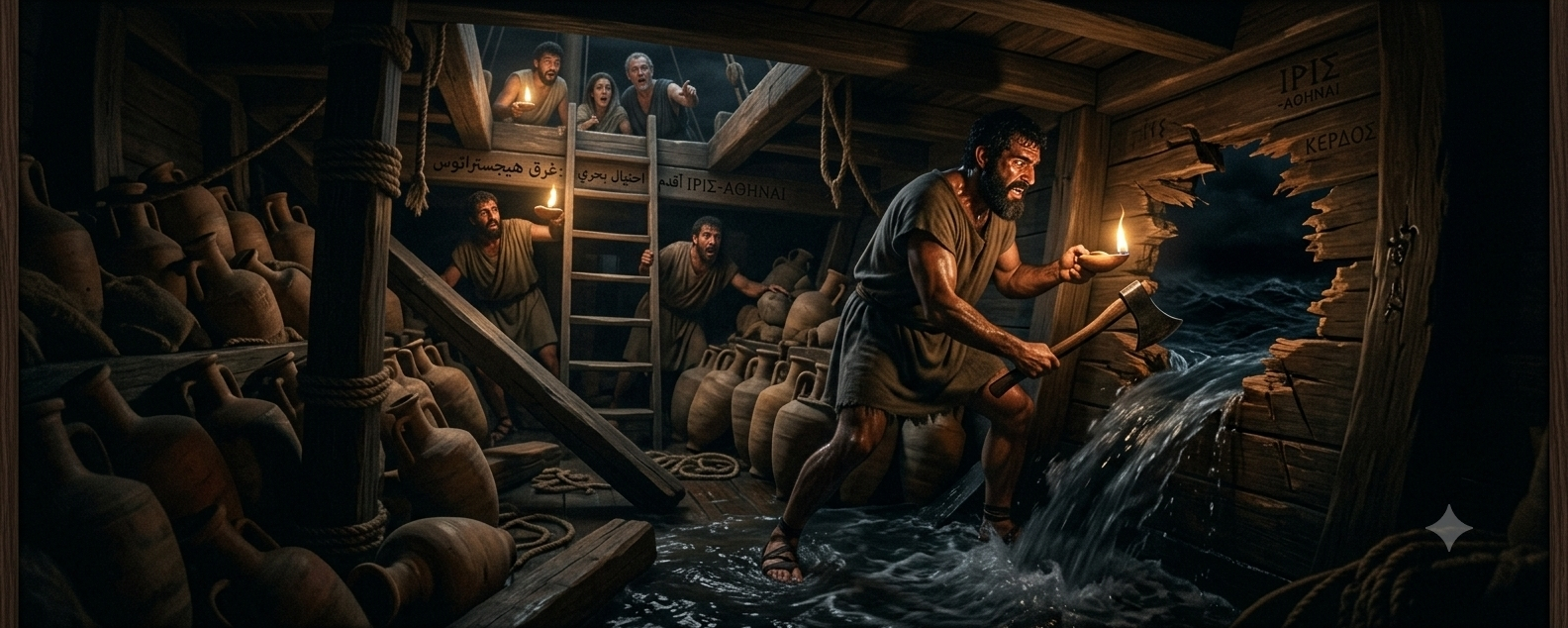
On a warm night in the summer of 300 BC, the waves slowly lapped against the sides of a Greek cargo ship, which rocked in the Mediterranean Sea, heading toward Athens. Aboard the ship, the danger was not in a fierce storm or pirates lurking in the dark—it was danger that lay within the ship itself... carrying an axe with the tools of the crime.
"Hegestratus," the sailor and the Scythian con artist, stood at the bottom of the ship in the dark. His breath rose in puffs, and the smell of damp wood filled his lungs. In his hand he held a heavy axe, and in his mind he had a diabolical plan—if it succeeded, it would make he and his partner "Zenothemes" among the richest of the ancient age.
Financial loophole: the sea loan
The plan was not born on the spot; it relied on exploiting the earliest financial insurance tool in history: "the sea loan" (Bottomry).
The concept was simple and clever:
The merchant receives massive financing to buy goods and build a ship.
If the cargo arrives safely, the principal is returned with unreal profits.
But if the ship sinks at sea... the debt is entirely canceled!
For Hegestratus and his partner, this was not just a risk-management tool, but a free loophole for rapid wealth.
The two partners borrowed huge sums from Athenian merchants to finance a heavy cargo of grain (corn). But they were fraudsters: they secretly sold the cargo in the first port, then filled the ship with sand to make it look heavy and loaded with goods. The plan was to sink the ship in mid-voyage and claim that the goods had gone down to the depths of the sea, so they could keep the loan money and the money from the goods they had sold!
The critical moment: a shock in the darkness
In the middle of the night, Hegestratus slipped down below. He began striking a wooden support with all his strength. A blow... it cracked... another blow... and the water started to pour in.
But fear makes you rush, and the sound rising from the bottom of the wooden planks was not the roar of crashing waves—it was repeated, calculated strikes.
The ship’s passengers and crew woke to the unsettling sound. One of the sailors went down to investigate, holding a small brazier—only to find Hegestratus caught in the act, with the axe, and water flooding his knees!
A state of terror and panic prevailed. The sailor screamed, calling to the crew; in a pivotal moment, Hegestratus realized that his order had been exposed, and that the punishment in Athens would be nothing but direct death.
A dramatic ending
Hegestratus dropped the axe and ran like mad onto the deck, where shocked passengers gawked. The only lifeboat was wobbling on the side of the ship. He hurled himself into the pitch-darkness, trying to reach it, but the wrong calculated jump and the panic made him miss the target...
Hegestratus fell into the dark sea. The water and the heavy equipment he wore pulled him downward, and he drowned at the deepest point of the Mediterranean Sea, becoming the first victim of his planned crime.
The crew and passengers managed to pump out water and seal the gap, and the ship, barely holding together, reached the port of Athens. There, his partner "Zenothemes" was arrested, and the case was referred to the Athenian courts, where the famous Athenian orator Demosthenes immortalized the incident in his legal records.
The investment lesson:
For 2,300 years up to the age of "blockchain" and today’s digital currencies, technology changes, and assets evolve... but psychological loopholes and financial fraud always rely on the same ingredients: greed and the search for loopholes in financial contracts.
#CryptoHistory #Eductional #scam #BinanceSquareFamily #story