
Last night I was scrolling through tokenization discussions and kept seeing the same idea: moving large assets onchain is mainly a technical migration problem. That sounded reasonable, but when I looked deeper into Dusk’s €300M+ institutional focus, something did not line up.
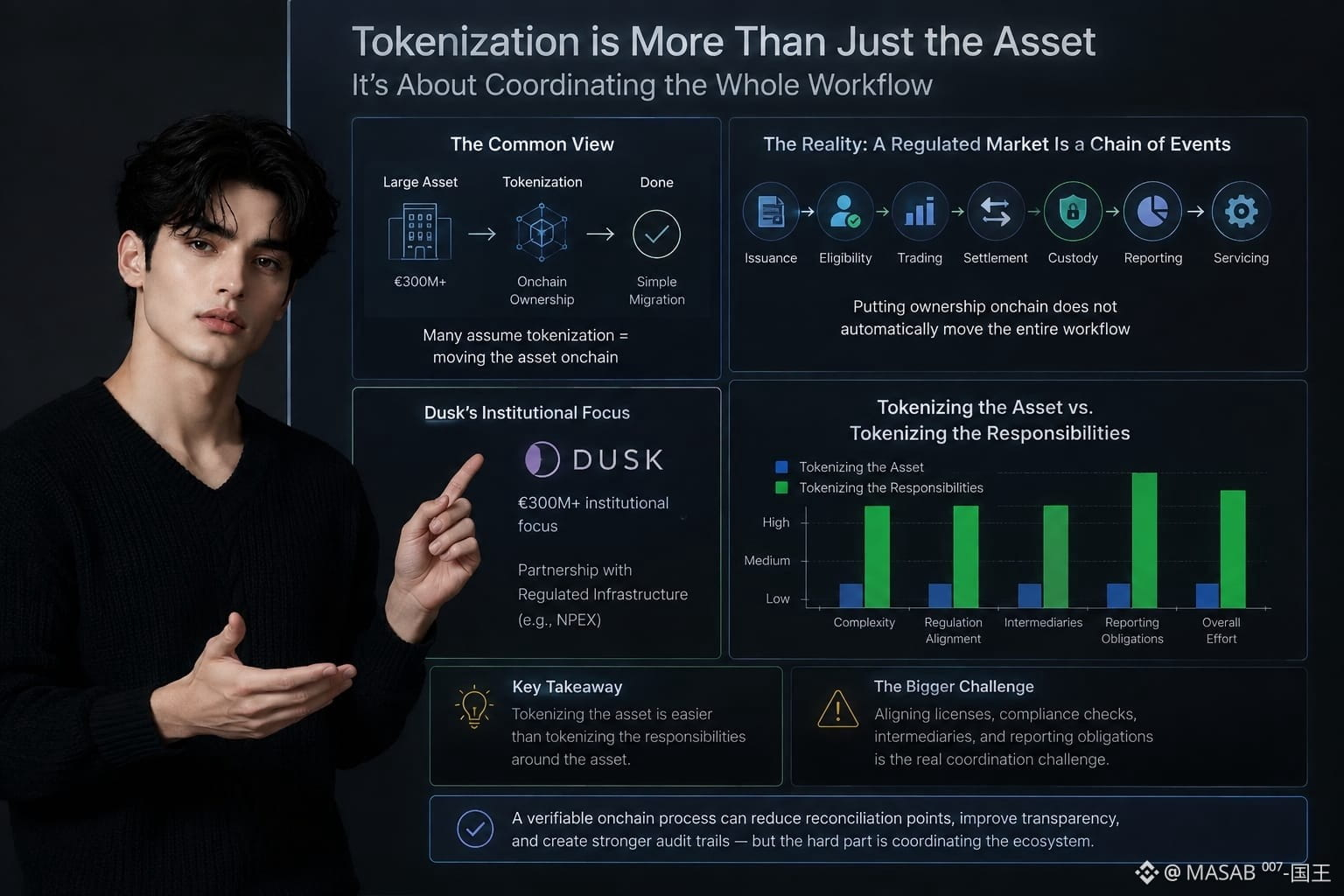
The asset itself is only one piece. A regulated market is a chain of events: issuance, eligibility, trading, settlement, custody, reporting, and servicing. Putting ownership records onchain does not automatically move the entire workflow.
An ordinary reader might assume tokenization means replacing the old system with a blockchain transaction. But Dusk’s connection with regulated infrastructure such as NPEX highlights a different challenge: coordinating the functions around the asset.
The distinction I keep coming back to is this:
“Tokenizing the asset is easier than tokenizing the responsibilities around the asset.”
That does not reduce the value of Dusk. A verifiable onchain process can reduce reconciliation points, improve transparency, and create stronger audit trails.
But I wondered if the hard part was actually the blockchain layer. Maybe the bigger challenge is aligning licenses, compliance checks, intermediaries, and reporting obligations.
I am not sure the market fully measures that coordination problem yet. The documentation tab is still open on my screen, and now I look at “onchain assets” a little differently.
@Dusk $DUSK #dusk
The asset itself is only one piece. A regulated market is a chain of events: issuance, eligibility, trading, settlement, custody, reporting, and servicing. Putting ownership records onchain does not automatically move the entire workflow.
An ordinary reader might assume tokenization means replacing the old system with a blockchain transaction. But Dusk’s connection with regulated infrastructure such as NPEX highlights a different challenge: coordinating the functions around the asset.
The distinction I keep coming back to is this:
“Tokenizing the asset is easier than tokenizing the responsibilities around the asset.”
That does not reduce the value of Dusk. A verifiable onchain process can reduce reconciliation points, improve transparency, and create stronger audit trails.
But I wondered if the hard part was actually the blockchain layer. Maybe the bigger challenge is aligning licenses, compliance checks, intermediaries, and reporting obligations.
I am not sure the market fully measures that coordination problem yet. The documentation tab is still open on my screen, and now I look at “onchain assets” a little differently.
@Dusk $DUSK #dusk