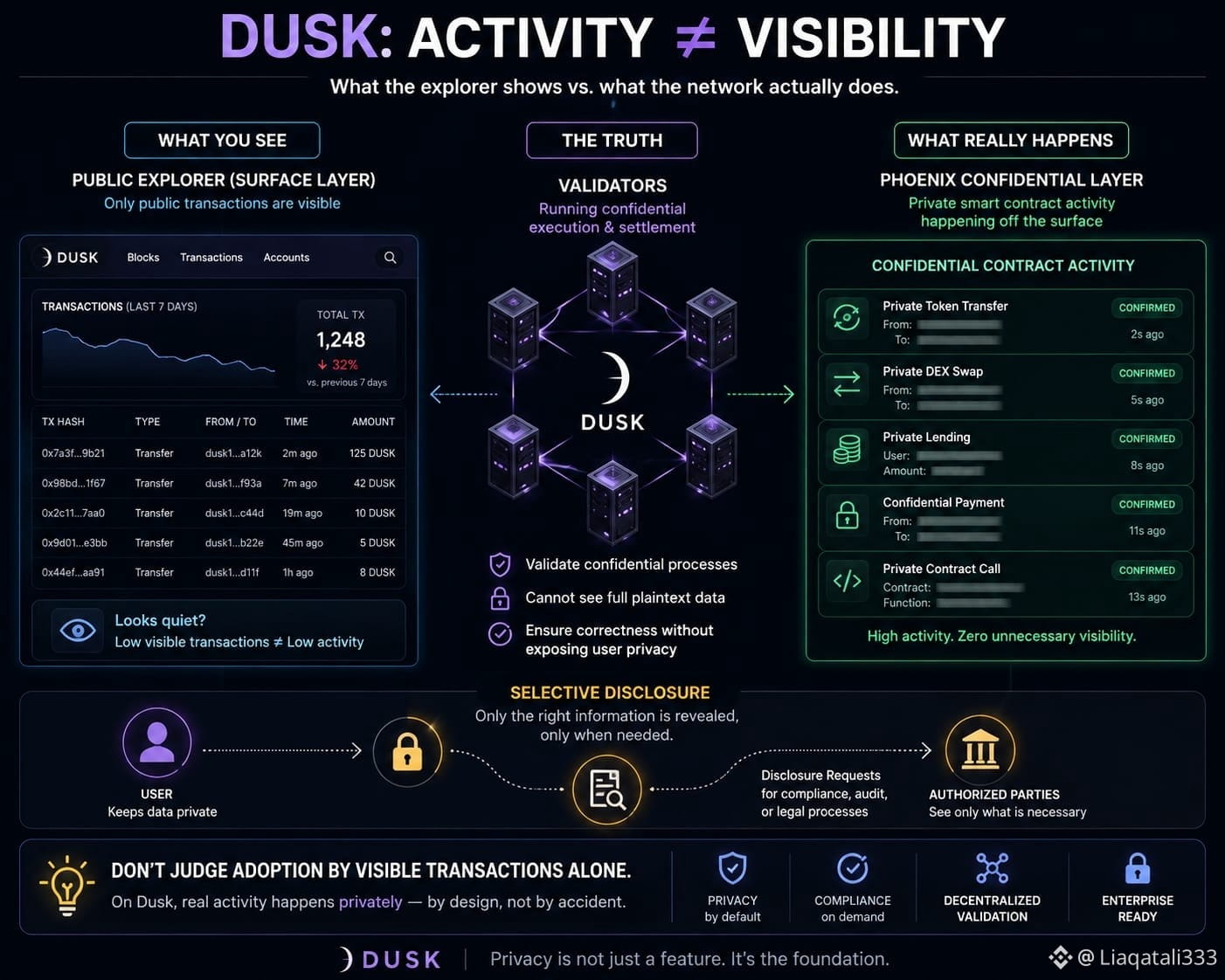
my friend asked me explain me about dusk coin and can start explaining @Dusk explorer for validator uptime patterns and assumed a drop in visible transaction count last week meant demand had softened. At first glance the network looked quieter than the week before, and I almost moved on.
Digging further, I noticed the dip wasn't in activity, it was in what my counting method could actually see. Confidential contract calls routed through Phoenix don't surface the same way ordinary transfers do, so a chain doing meaningful work can still look idle from the outside if you're only reading public flow.
That distinction changed how I think about this project. Activity and visibility are not the same thing here, and treating raw throughput as a proxy for adoption misses the point of what's being built. A lot of the actual settlement logic happens without ever showing its shape on the surface, by design rather than by accident.$DUSK
What I can't resolve yet is how operators price risk when they're validating processes they can't fully inspect. Selective disclosure protects the end user, but it also asks node operators to trust logic they can't line-by-line audit in real time. I don't know yet how that tension settles as volume grows.
Going forward I'm watching validator participation rates rather than headline transaction counts, along with how often disclosure requests actually get triggered versus sitting unused. Recurring authorization activity would tell me more about genuine institutional use than any single spike ever could.
I still don't know if this kind of quiet, low-visibility infrastructure scales the same way open chains do, or if confidentiality eventually becomes its own ceiling. That's the part I keep turning over without an answer.#dusk $AVAAI
$VELVET
Digging further, I noticed the dip wasn't in activity, it was in what my counting method could actually see. Confidential contract calls routed through Phoenix don't surface the same way ordinary transfers do, so a chain doing meaningful work can still look idle from the outside if you're only reading public flow.
That distinction changed how I think about this project. Activity and visibility are not the same thing here, and treating raw throughput as a proxy for adoption misses the point of what's being built. A lot of the actual settlement logic happens without ever showing its shape on the surface, by design rather than by accident.$DUSK
What I can't resolve yet is how operators price risk when they're validating processes they can't fully inspect. Selective disclosure protects the end user, but it also asks node operators to trust logic they can't line-by-line audit in real time. I don't know yet how that tension settles as volume grows.
Going forward I'm watching validator participation rates rather than headline transaction counts, along with how often disclosure requests actually get triggered versus sitting unused. Recurring authorization activity would tell me more about genuine institutional use than any single spike ever could.
I still don't know if this kind of quiet, low-visibility infrastructure scales the same way open chains do, or if confidentiality eventually becomes its own ceiling. That's the part I keep turning over without an answer.#dusk $AVAAI
$VELVET