#termmax @TermMax
I went back through the TermMax documentation last night with one initial interpretation: its fixed rate came mainly from locking a loan until maturity. The mechanics changed that view.
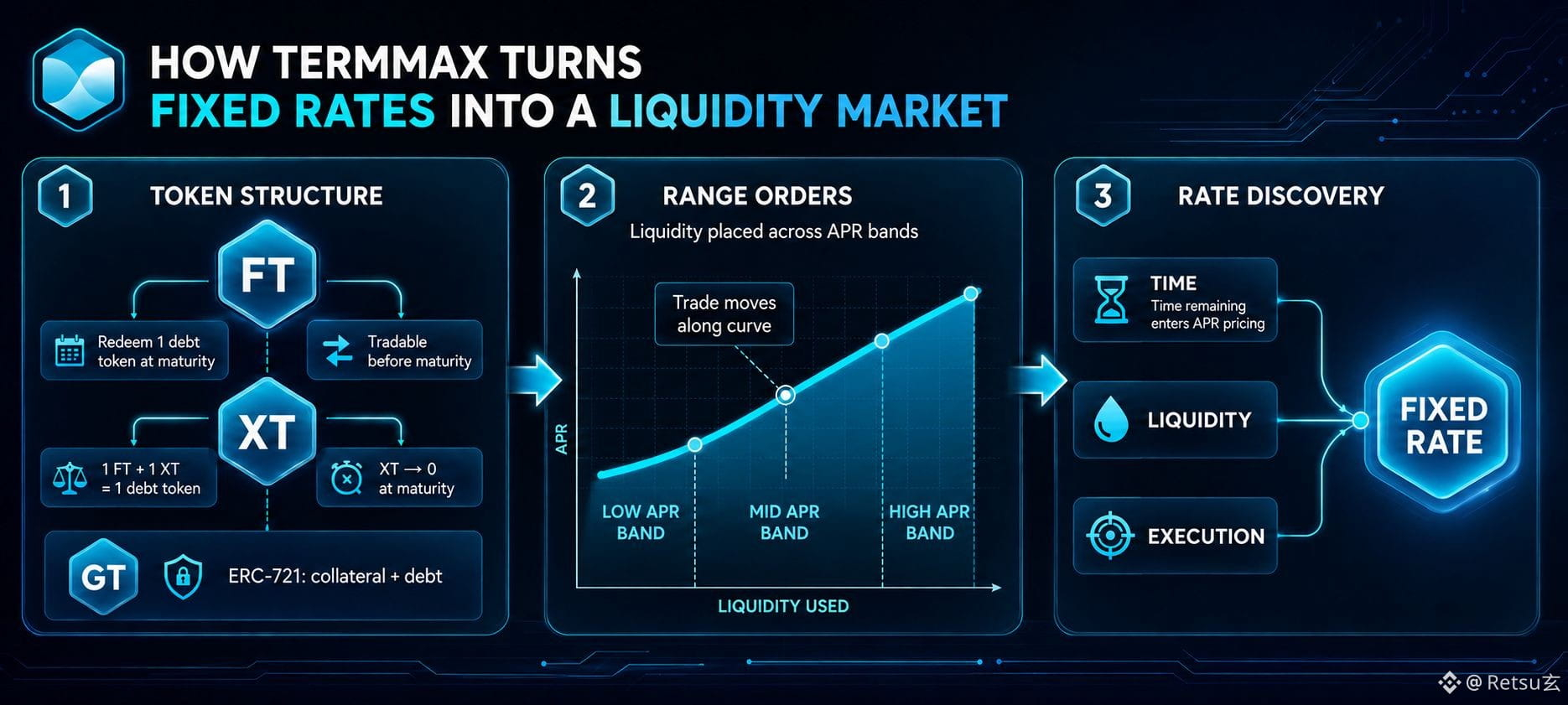
FT is a fungible ERC-20 claim redeemable for one debt token at maturity. XT is its fungible complement: 1 FT plus 1 XT equals one debt token, and XT goes to zero at maturity. GT is an ERC-721 position recording an individual loan’s collateral and debt. FT can also be sold before maturity at the rate and liquidity available then.
A range order is a series of continuous orders configured by a setter or curator. Its segmented pricing curve places liquidity across APR ranges, so the rate a taker receives changes as trades move through the curve.
That made me look at it differently.
The V2 order contract feeds days remaining until maturity into its APR calculation with the curve’s virtual reserves. My interpretation is that TermMax does more than lock a rate: it creates a market where time, liquidity placement, and execution shape how that rate is discovered.
How will FT exits execute when liquidity thins and sellers arrive together? How concentrated can orders become in one curve segment, and how distributed is control over curve and risk parameters? I also want to see how oracle dependence and liquidation behave under stress.
I want to watch this in practice.
I went back through the TermMax documentation last night with one initial interpretation: its fixed rate came mainly from locking a loan until maturity. The mechanics changed that view.
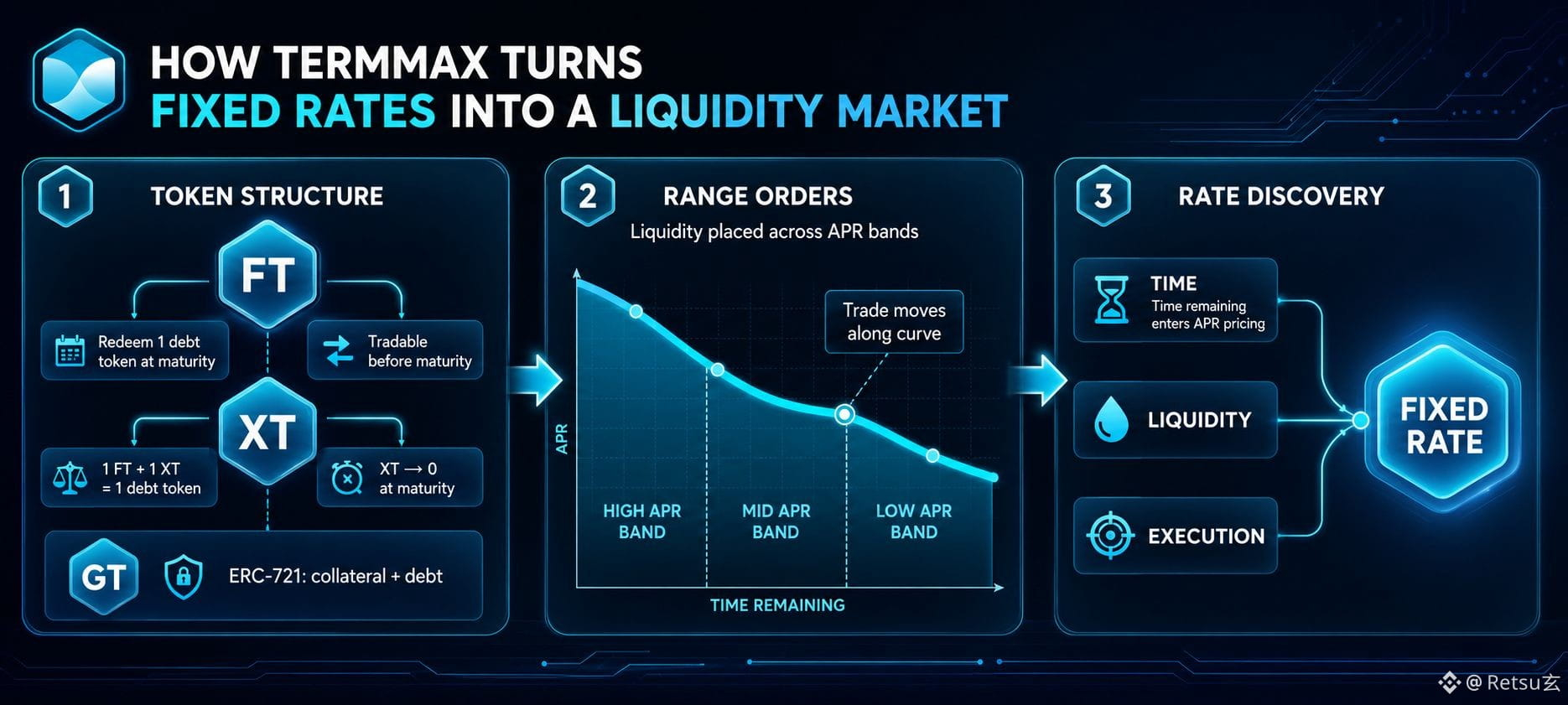
FT is a fungible ERC-20 claim redeemable for one debt token at maturity. XT is its fungible complement: 1 FT plus 1 XT equals one debt token, and XT goes to zero at maturity. GT is an ERC-721 position recording an individual loan’s collateral and debt. FT can also be sold before maturity at the rate and liquidity available then.
A range order is a series of continuous orders configured by a setter or curator. Its segmented pricing curve places liquidity across APR ranges, so the rate a taker receives changes as trades move through the curve.
That made me look at it differently.
The V2 order contract feeds days remaining until maturity into its APR calculation with the curve’s virtual reserves. My interpretation is that TermMax does more than lock a rate: it creates a market where time, liquidity placement, and execution shape how that rate is discovered.
How will FT exits execute when liquidity thins and sellers arrive together? How concentrated can orders become in one curve segment, and how distributed is control over curve and risk parameters? I also want to see how oracle dependence and liquidation behave under stress.
I want to watch this in practice.