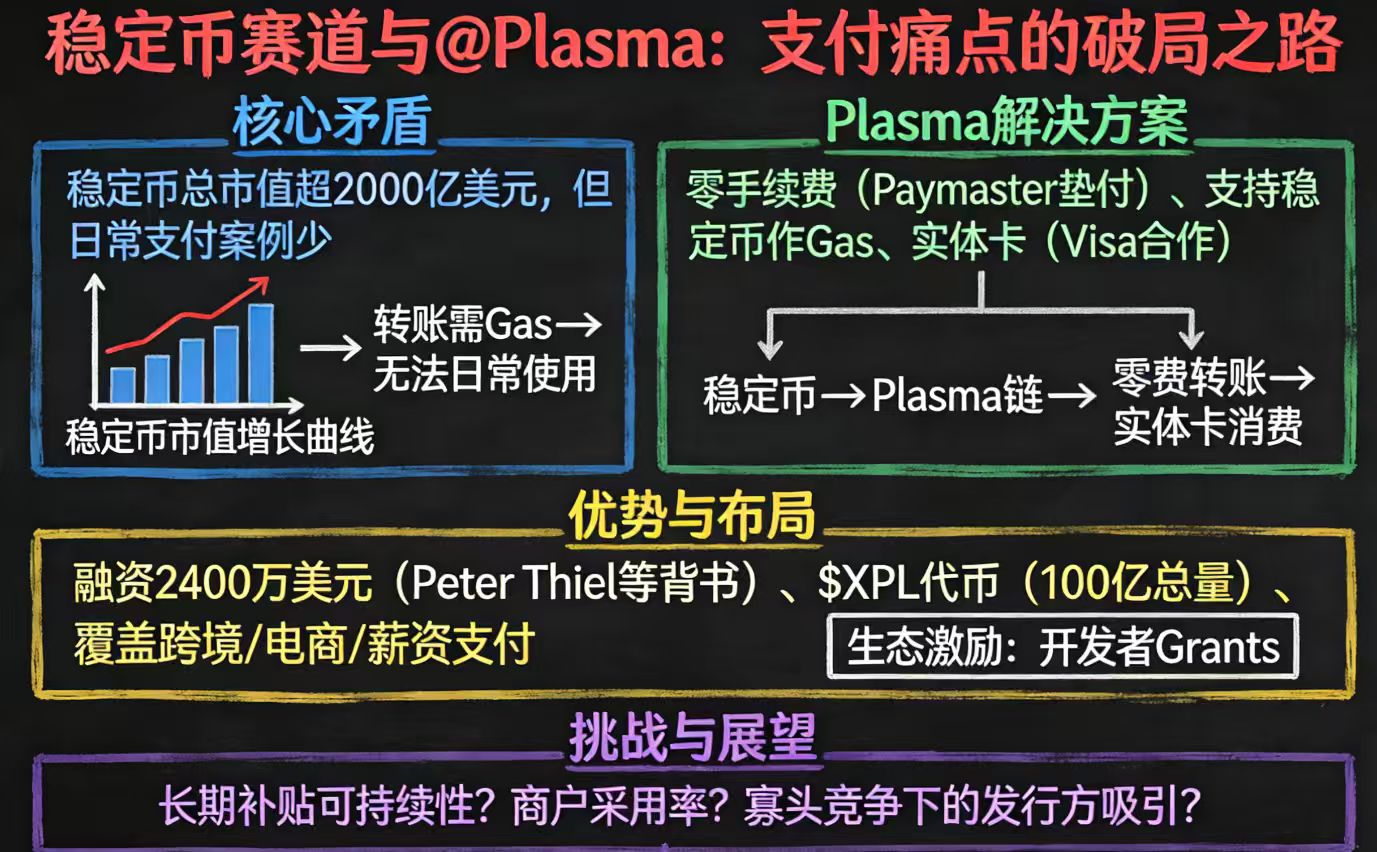
After深入研究稳定币赛道与@Plasma, I genuinely feel a contradiction: the total market value of stablecoins has surpassed 200 billion dollars, and as the asset closest to real-world applications in the crypto world, while the market value has soared, there are very few cases that have truly entered the daily payments of the public. After testing countless stablecoin transfers, I found that the core obstacle is not technical complexity, but rather the seemingly small yet deadly Gas barrier.
I believe many people have experienced this dilemma: USDT is sitting in the wallet, wanting to transfer it to family or use it for consumption, but due to the lack of the native tokens of the corresponding chain, the transfer cannot even be initiated. This unnecessary friction has trapped stablecoins in a cage of 'toys within a circle', making it difficult to penetrate real scenarios like offline consumption and cross-border remittances. Even though the annual transaction volume of stablecoins has already reached hundreds of trillions of dollars, they have never truly served the public.
The emergence of @Plasma is precisely the surgical strike on this pain point. It does not follow the trend of pursuing high yields in DeFi narratives, nor does it attempt to become an all-encompassing Layer 1, but rather soberly positions itself as a 'stablecoin settlement layer'—this focus is particularly rare in the current landscape of public chains that aim for grandeur.
Based on a fully EVM-compatible high-performance public chain, Plasma's core innovation is a complete reconstruction of the Gas mechanism. Tests have shown that the built-in Paymaster is pre-funded by the foundation, enabling simple stablecoin transfers to achieve zero fees, and it supports Custom Gas Tokens. Whitelisted stablecoins like USDT and USDC can be directly used as Gas, significantly shortening transaction paths. This means that as long as there are stablecoins in the wallet, one can directly transfer and consume without worrying about buying ETH or BNB to cover Gas.
What’s even more remarkable is that this zero-fee model is not just a short-term subsidy gimmick, but a systematic optimization: complex smart contract calls still require payment, and the built-in anti-bot mechanism can effectively avoid invalid transactions overwhelming the network, balancing user experience and network security.
What truly shows me the mainstream potential of stablecoins is that it turns abstract accounts into product-level functions—Plasma One is equivalent to an on-chain digital bank account, where users can directly hold stablecoin balances. Moreover, through deep cooperation with Visa, it issues physical cards, allowing seamless on-chain settlement for offline card consumption, whether it's for overseas subways, specialty restaurant expenses, or routine offline payments; this is the core bridge for stablecoins to move towards mainstream adoption.
Plasma's ambition goes far beyond free transfers; it aims at the trillion-dollar global payment market, including cross-border remittances, e-commerce settlements, salary payments, and even daily micro-payments in emerging markets are all part of its layout. Currently, the project has attracted $24 million in financing, with well-known institutions like Peter Thiel and Framework Ventures coming in to endorse it. The native token $XPL has a total supply of 10 billion, and its circulating supply is still low, currently in the early ecological incentive stage, allowing developers to quickly build dedicated DApps for stablecoins through Grants, with considerable ecological growth potential.
Of course, rationally speaking, the challenges are equally non-negligible. The zero-fee model heavily relies on foundation subsidies, and its long-term sustainability still needs to be observed through the real merchant adoption rate and transaction volume increase; furthermore, the current stablecoin market is dominated by oligopolies like Circle and Tether. As an infrastructure layer, how Plasma attracts more issuers onto the chain to form a positive feedback loop will also greatly test the team's execution capabilities.
Overall, @Plasma represents a pragmatic new approach in the blockchain payment track: not aiming for grandeur, but focusing on a single pain point and deeply penetrating the user base. In the current context where general chains like Base and Solana are competing for TPS, this specialized stablecoin path may instead carve out a differentiated advantage.
If it can truly run a closed loop on the merchant side and become a blockchain payment option beyond Visa and PayPal, then the leap of stablecoins from 'investment assets' to 'circulating currency' may迎来 a critical turning point. In the future, competition in payment infrastructure has never been a TPS数字 game, but rather who can truly achieve 'seamless use'. @Plasma has already taken a solid step forward; how do you view this specialized stablecoin track?