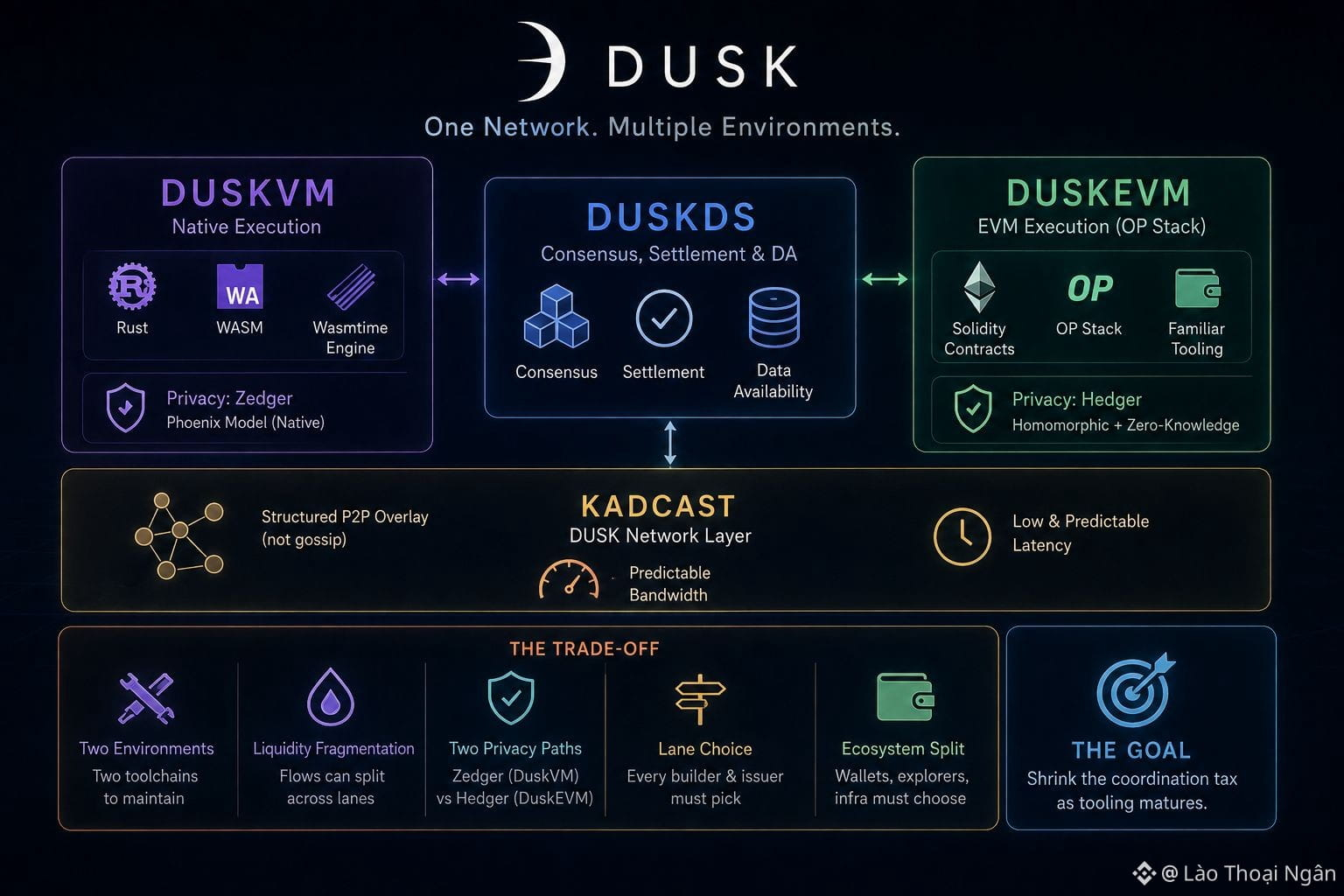
Modular is one of the most comfortable words in this industry, and Dusk Network uses it a lot. DuskDS handles consensus, settlement, and data availability. DuskVM runs Rust and WASM contracts directly on the base layer through a Wasmtime engine. DuskEVM is a separate OP Stack execution environment where Solidity contracts settle back through DuskDS, with DUSK as the gas token. On paper this sounds like the best of both worlds, a native environment for teams wanting direct access to Dusk's privacy primitives, and a familiar EVM environment for everyone else.
I want to sit with the trade off for a second instead of repeating the pitch. Two execution environments mean two sets of tooling, two places liquidity can pool separately, and two different privacy paths, Zedger on DuskVM and Hedger on DuskEVM, built on different cryptographic approaches. A builder choosing DuskEVM for familiarity gets Solidity support, but reaches for Hedger's homomorphic encryption and zero knowledge combination rather than the native Phoenix model most of the deep privacy literature on Dusk describes.
None of this makes the architecture wrong. Separating settlement from execution is a defensible bet, and plenty of chains split state across rollups for similar reasons. But calling it purely additive undersells the cost. Every issuer now has to pick a lane, and every wallet or explorer built by the community has to decide which side, or both, it supports.
Underneath both environments sits Kadcast, Dusk Network's own peer to peer layer, a structured overlay instead of the gossip based propagation most chains default to, built specifically to keep bandwidth and latency predictable as the network grows. That shared piece is the strongest argument this is one coordinated system, not two chains wearing the same name. Still, a shared network layer does not merge two developer ecosystems by itself. Modularity is a real decision with a real coordination tax attached, not a free upgrade.
@Dusk #dusk $DUSK $BTW $ACE