The more trouble Dusk runs into, the more I care about who holds the power to restore networking
Reading Dusk’s consensus section, I don’t think the “normal” mechanism is the main thing to worry about. What’s interesting is what happens when the network repeatedly fails to reach quorum.
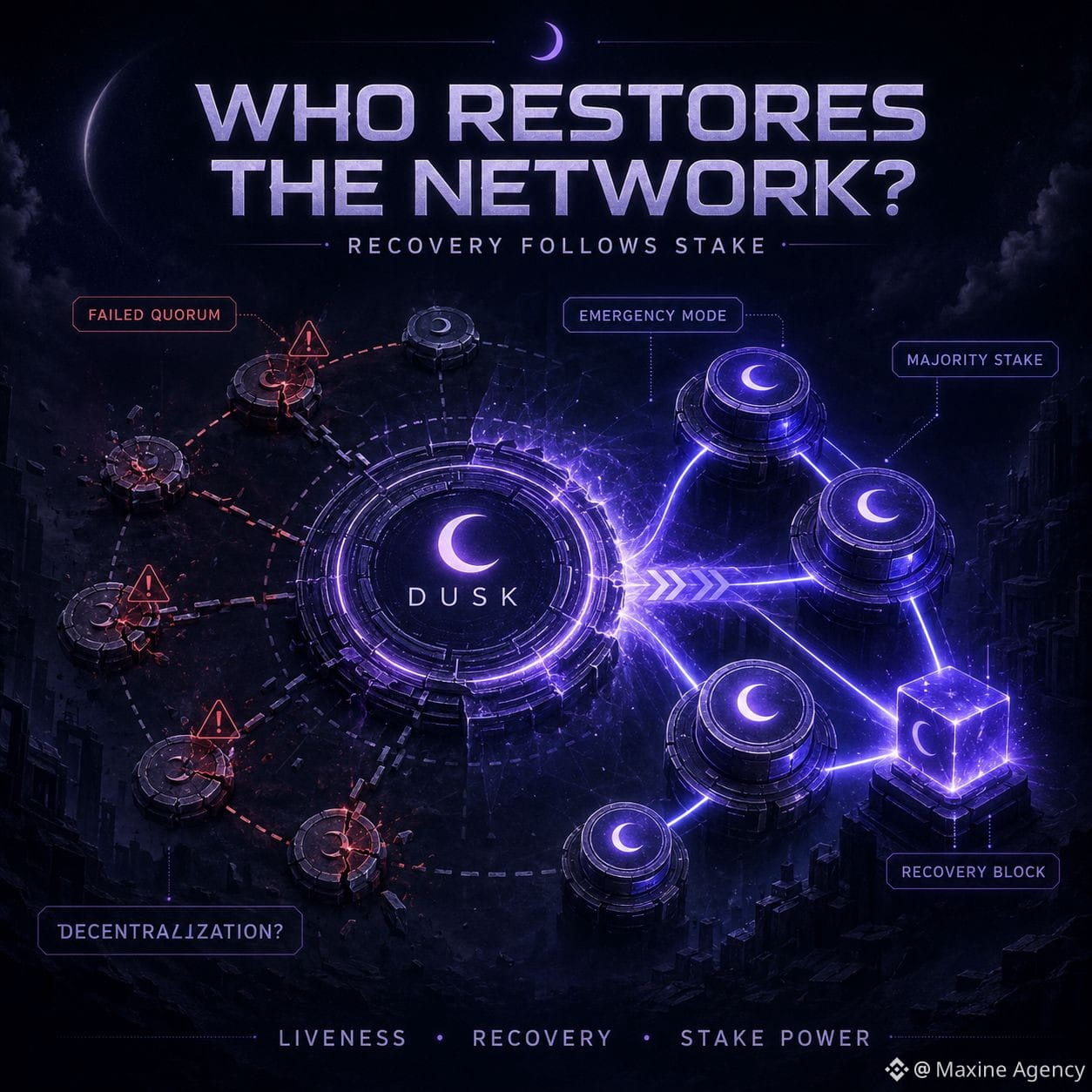
After 16 failed iterations, Succinct Attestation switches to emergency mode. The timeout for each step is removed, allowing multiple iterations to be opened concurrently to increase the chance of finding a valid block. If multiple candidates reach consensus, the block from the lower-numbered iteration gets priority.
This design helps the network avoid getting stuck just because some provisioners are slow or disconnected. But it also makes me pay attention to another boundary: when network conditions worsen, recovery ability becomes more clearly dependent on the distribution of stake.
In the final approach, an emergency block is only created when the group of provisioners asks it to take the majority of the network’s total stake. Meanwhile, to directly participate in consensus, a provisioner currently needs a minimum stake of 1,000 DUSK.
So for me, staking isn’t only a way to earn rewards. It also determines who carries more weight when the system needs to get out of an abnormal state.
In my view, the important test for Dusk isn’t a day when the network runs smoothly. It’s when congestion increases, some nodes fall behind, and committees keep changing—can the network recover without concentrating decision-making power into a single large stake group.
A recovery mechanism can be technically very solid.
But if the ability to save the network becomes increasingly concentrated by stake, then decentralization is the most important thing to measure carefully.
@Dusk $DUSK #dusk
$ONDO $BTC
Reading Dusk’s consensus section, I don’t think the “normal” mechanism is the main thing to worry about. What’s interesting is what happens when the network repeatedly fails to reach quorum.
After 16 failed iterations, Succinct Attestation switches to emergency mode. The timeout for each step is removed, allowing multiple iterations to be opened concurrently to increase the chance of finding a valid block. If multiple candidates reach consensus, the block from the lower-numbered iteration gets priority.
This design helps the network avoid getting stuck just because some provisioners are slow or disconnected. But it also makes me pay attention to another boundary: when network conditions worsen, recovery ability becomes more clearly dependent on the distribution of stake.
In the final approach, an emergency block is only created when the group of provisioners asks it to take the majority of the network’s total stake. Meanwhile, to directly participate in consensus, a provisioner currently needs a minimum stake of 1,000 DUSK.
So for me, staking isn’t only a way to earn rewards. It also determines who carries more weight when the system needs to get out of an abnormal state.
In my view, the important test for Dusk isn’t a day when the network runs smoothly. It’s when congestion increases, some nodes fall behind, and committees keep changing—can the network recover without concentrating decision-making power into a single large stake group.
A recovery mechanism can be technically very solid.
But if the ability to save the network becomes increasingly concentrated by stake, then decentralization is the most important thing to measure carefully.
@Dusk $DUSK #dusk
$ONDO $BTC