
In the @TermMax document, there’s a passage about “one-click leverage” and the GT token. After reading it, I can’t shake the feeling that something is off.
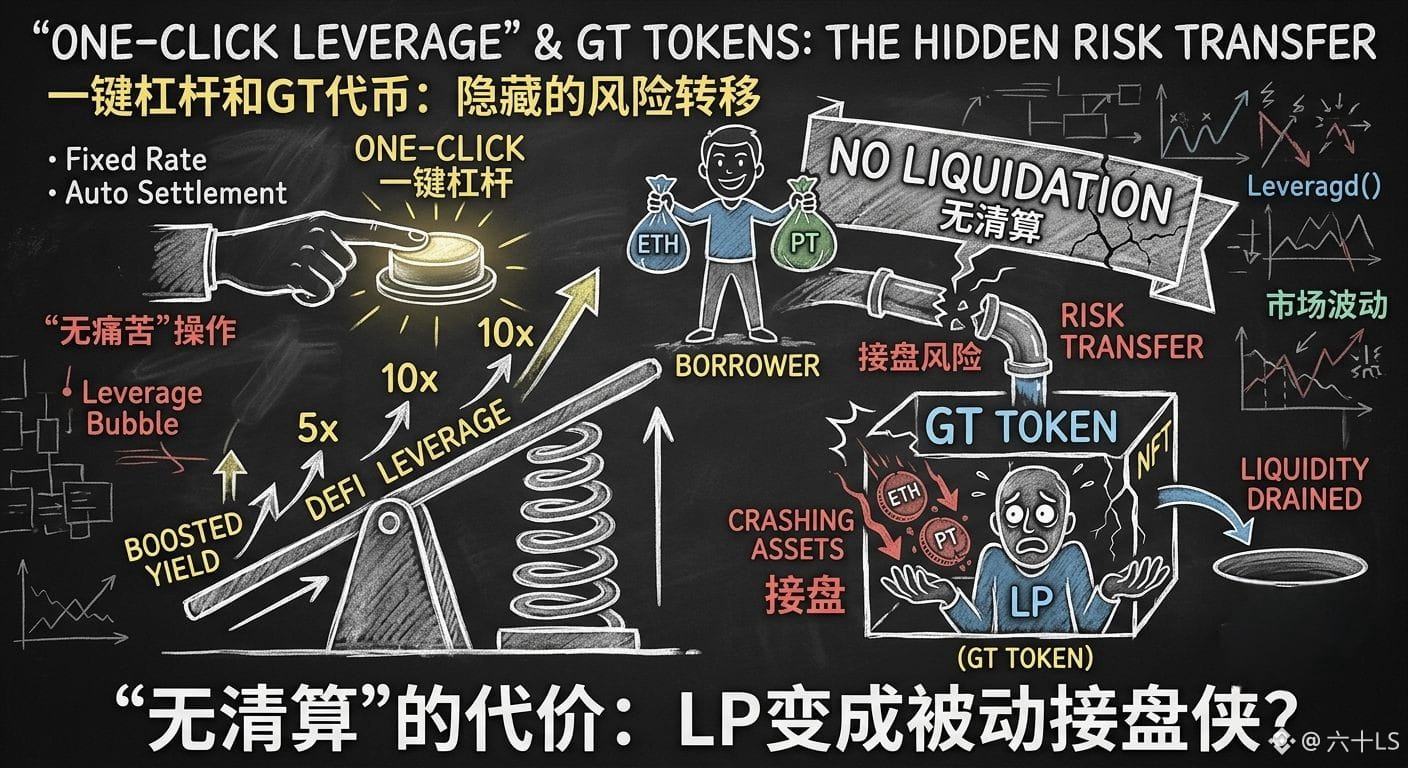
Let me reconstruct the scenario. You drop some ETH or PT into the pool, click a button, and the smart contract automatically takes out a loan, buys more yield-bearing assets, then re-collateralizes and borrows again—pushing the leverage directly to 5x or even 10x. The documentation is beautifully written: fixed interest rates throughout, no liquidation risk, and automatic settlement at maturity. While amplifying the收益, it also locks in the costs in advance. It sounds like someone took the complex machinery of traditional loop lending and wrapped it up into a one-click operation.
But the issue is that this “no liquidation” isn’t magic—it just relocates the risk. In essence, GT packages your collateral and debt into an NFT. The whole leverage relies on the over-collateralization inside it. When the market is calm, it’s probably fine. But if the underlying asset price suddenly crashes, or if there’s an oracle delay, and the value of the collateral in GT falls below the threshold, the system won’t force liquidation like Aave does. Instead, it goes through physical settlement—handing the collateral directly over to the LP.
LPs in DeFi aren’t a charity. They put money in for steady fixed returns, not to suddenly become holders of a token that has just suffered a brutal drop. The documentation emphasizes “limited losses” and “no liquidation,” but it doesn’t really mention the LP-side risk of being the one who gets stuck holding the assets. If the incoming assets have poor liquidity, or if there’s a problem with a cross-chain bridge, LPs may find it hard to liquidate or exit.
In traditional finance, when banks run leveraged lending, the risk is backed by things like risk reserves, margin call mechanisms, and central counterparty clearing. TermMax’s AMM pool doesn’t have these buffers—it relies purely on the contract rules to “tough it out.”
Even more subtly, one-click leverage lowers the operational barrier, attracting many users who want to chase higher yields. These users often aren’t very sensitive to volatility in the underlying assets. Once leverage is turned on, overexposure happens easily. Then when the market actually starts moving, as soon as physical settlement kicks in, liquidity instantly shifts from “you can borrow” to “you only get stuck holding the bag.” The fixed interest rate is still there, but available leverage capacity may already be gone.
My takeaway: the mechanism design does simplify complex looping strategies, and it does avoid the harshness of traditional liquidation. But behind “no liquidation,” the risk is simply moved from the borrower to the LP and the physical settlement process. The documentation describes one-click leverage like a pain-free operation, but it doesn’t explain clearly the game on the receiving side. #termmax
Let me reconstruct the scenario. You drop some ETH or PT into the pool, click a button, and the smart contract automatically takes out a loan, buys more yield-bearing assets, then re-collateralizes and borrows again—pushing the leverage directly to 5x or even 10x. The documentation is beautifully written: fixed interest rates throughout, no liquidation risk, and automatic settlement at maturity. While amplifying the收益, it also locks in the costs in advance. It sounds like someone took the complex machinery of traditional loop lending and wrapped it up into a one-click operation.
But the issue is that this “no liquidation” isn’t magic—it just relocates the risk. In essence, GT packages your collateral and debt into an NFT. The whole leverage relies on the over-collateralization inside it. When the market is calm, it’s probably fine. But if the underlying asset price suddenly crashes, or if there’s an oracle delay, and the value of the collateral in GT falls below the threshold, the system won’t force liquidation like Aave does. Instead, it goes through physical settlement—handing the collateral directly over to the LP.
LPs in DeFi aren’t a charity. They put money in for steady fixed returns, not to suddenly become holders of a token that has just suffered a brutal drop. The documentation emphasizes “limited losses” and “no liquidation,” but it doesn’t really mention the LP-side risk of being the one who gets stuck holding the assets. If the incoming assets have poor liquidity, or if there’s a problem with a cross-chain bridge, LPs may find it hard to liquidate or exit.
In traditional finance, when banks run leveraged lending, the risk is backed by things like risk reserves, margin call mechanisms, and central counterparty clearing. TermMax’s AMM pool doesn’t have these buffers—it relies purely on the contract rules to “tough it out.”
Even more subtly, one-click leverage lowers the operational barrier, attracting many users who want to chase higher yields. These users often aren’t very sensitive to volatility in the underlying assets. Once leverage is turned on, overexposure happens easily. Then when the market actually starts moving, as soon as physical settlement kicks in, liquidity instantly shifts from “you can borrow” to “you only get stuck holding the bag.” The fixed interest rate is still there, but available leverage capacity may already be gone.
My takeaway: the mechanism design does simplify complex looping strategies, and it does avoid the harshness of traditional liquidation. But behind “no liquidation,” the risk is simply moved from the borrower to the LP and the physical settlement process. The documentation describes one-click leverage like a pain-free operation, but it doesn’t explain clearly the game on the receiving side. #termmax