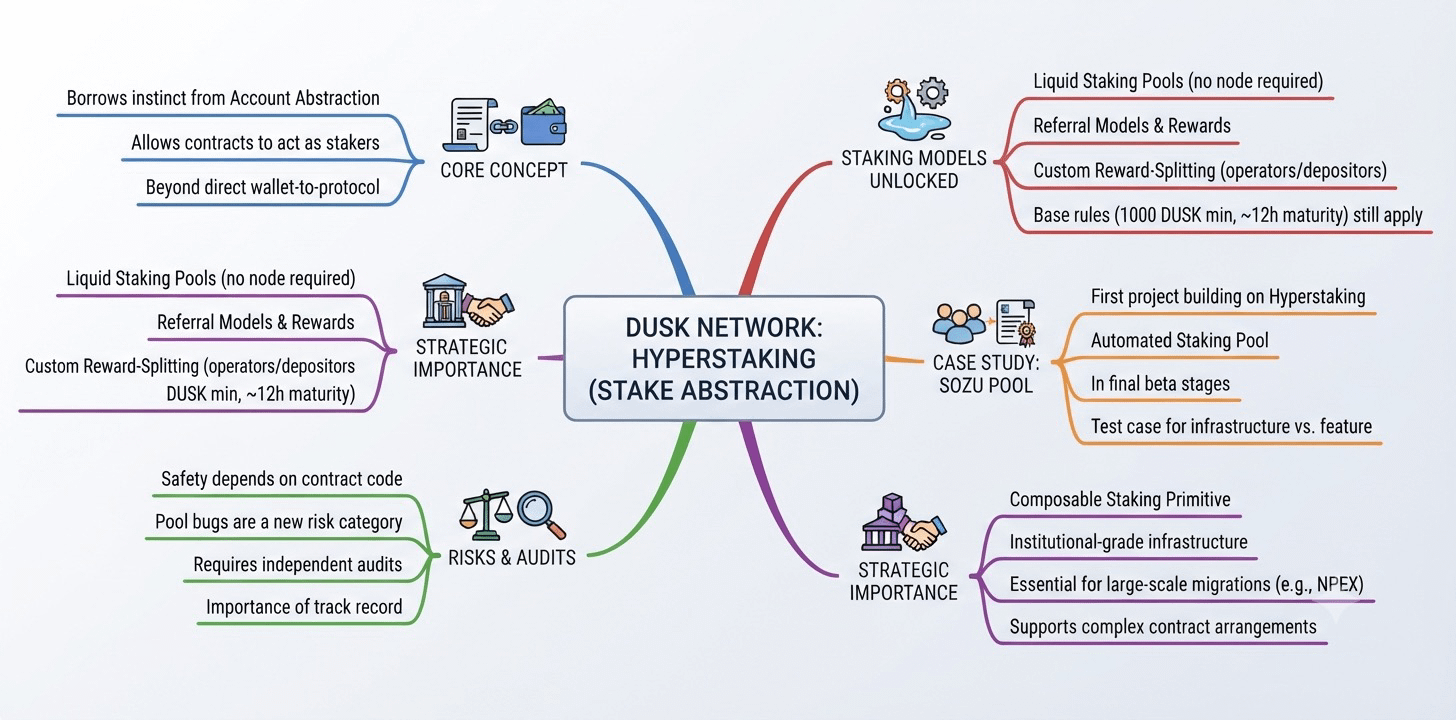
Account abstraction changed how people think about wallets on Ethereum, letting contracts do things only externally owned accounts could do before. Dusk Network borrowed that instinct and pointed it at staking, and the result, Hyperstaking, opens up staking models a plain wallet-to-protocol interaction never could.
Normally, staking is a direct relationship: a wallet locks DUSK, a node runs, rewards flow back to that wallet. Hyperstaking unlocks liquid staking pools where users never run their own node, referral models rewarding people for bringing in new stakers, and custom reward-splitting between operators and depositors. The 1,000 DUSK minimum and roughly 12-hour maturity still apply to contracts exactly as to individuals.
Sozu is the first project actually building on this, running an automated staking pool currently in its final beta stages, letting users stake DUSK through a contract without touching node infrastructure themselves. That's the real test case for whether Hyperstaking becomes infrastructure other people build businesses on, rather than a feature that exists mostly in documentation.
Abstracting staking behind a contract means the safety of a user's funds now depends on that contract's code, not only on Dusk Network's base protocol. A bug in a Hyperstaking pool is a different risk category than a bug in the core staking contract, one only fully understood after real audits and after these contracts have held meaningful value for a while.
Composable staking like this is exactly the kind of financial infrastructure Dusk Network will need more of if plans like the 300-million-euro-plus NPEX asset migration actually materialize, since institutions tend to need contract-level arrangements, not just individual wallets.
Programmable staking is a genuinely useful primitive. I'd want any Hyperstaking pool audited independently before trusting it with serious size.
@Dusk line $DUSK #dusk