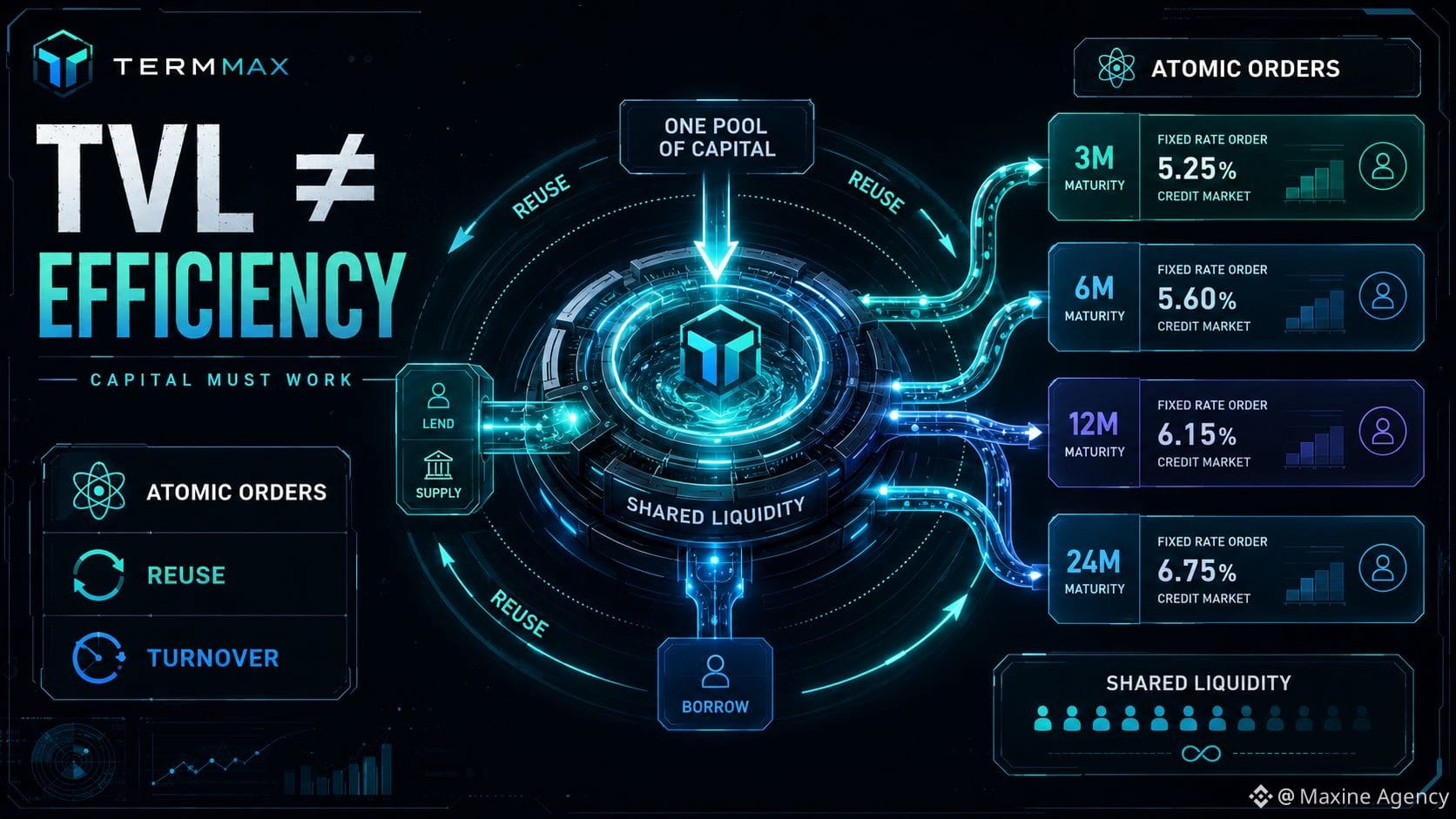
TVL is big, but it may not fully reflect TermMax’s capital efficiency
What I find interesting about DeFi is that liquidity can look very “thick” on a dashboard, but in reality it often just sits there for quite a while between executions. The capital is still present—it’s just not always located exactly where borrowing demand exists.
TermMax’s Atomic Orders caught my attention because it addresses this point.
Instead of splitting liquidity into multiple portions for each market or each maturity, a single pool of capital can serve many different orders. If this mechanism works efficiently, one dollar of liquidity doesn’t just show up once in TVL—it can also be reused across multiple credit opportunities.
So I think TVL alone isn’t enough to evaluate TermMax.
A protocol can have a high TVL, but if most of the capital is waiting around, it’s not necessarily more effective than a smaller system with higher capital turnover. With Atomic Orders, what I want to look at is the speed at which capital is matched, how many times it can be reused, and how much credit volume each dollar of liquidity actually supports.
But shared liquidity also has a point that needs to be checked.
Many markets may appear deeper when they share the same liquidity source. However, if borrowing demand spikes strongly across multiple places at the same time, the real limit of how much liquidity is available will become visible. Capital may be allocated more efficiently, but it doesn’t become infinite.
In my view, this is the metric worth paying attention to in TermMax.
Not only how much money the protocol can keep, but how many times each dollar of capital can “work” before the system starts hitting its liquidity limits.
@TermMax #TermMax
$SKYAI $BTC $BNB
What I find interesting about DeFi is that liquidity can look very “thick” on a dashboard, but in reality it often just sits there for quite a while between executions. The capital is still present—it’s just not always located exactly where borrowing demand exists.
TermMax’s Atomic Orders caught my attention because it addresses this point.
Instead of splitting liquidity into multiple portions for each market or each maturity, a single pool of capital can serve many different orders. If this mechanism works efficiently, one dollar of liquidity doesn’t just show up once in TVL—it can also be reused across multiple credit opportunities.
So I think TVL alone isn’t enough to evaluate TermMax.
A protocol can have a high TVL, but if most of the capital is waiting around, it’s not necessarily more effective than a smaller system with higher capital turnover. With Atomic Orders, what I want to look at is the speed at which capital is matched, how many times it can be reused, and how much credit volume each dollar of liquidity actually supports.
But shared liquidity also has a point that needs to be checked.
Many markets may appear deeper when they share the same liquidity source. However, if borrowing demand spikes strongly across multiple places at the same time, the real limit of how much liquidity is available will become visible. Capital may be allocated more efficiently, but it doesn’t become infinite.
In my view, this is the metric worth paying attention to in TermMax.
Not only how much money the protocol can keep, but how many times each dollar of capital can “work” before the system starts hitting its liquidity limits.
@TermMax #TermMax
$SKYAI $BTC $BNB