@Dusk #dusk Been digging deeper into DUSK’s consensus design, and one thing keeps standing out.
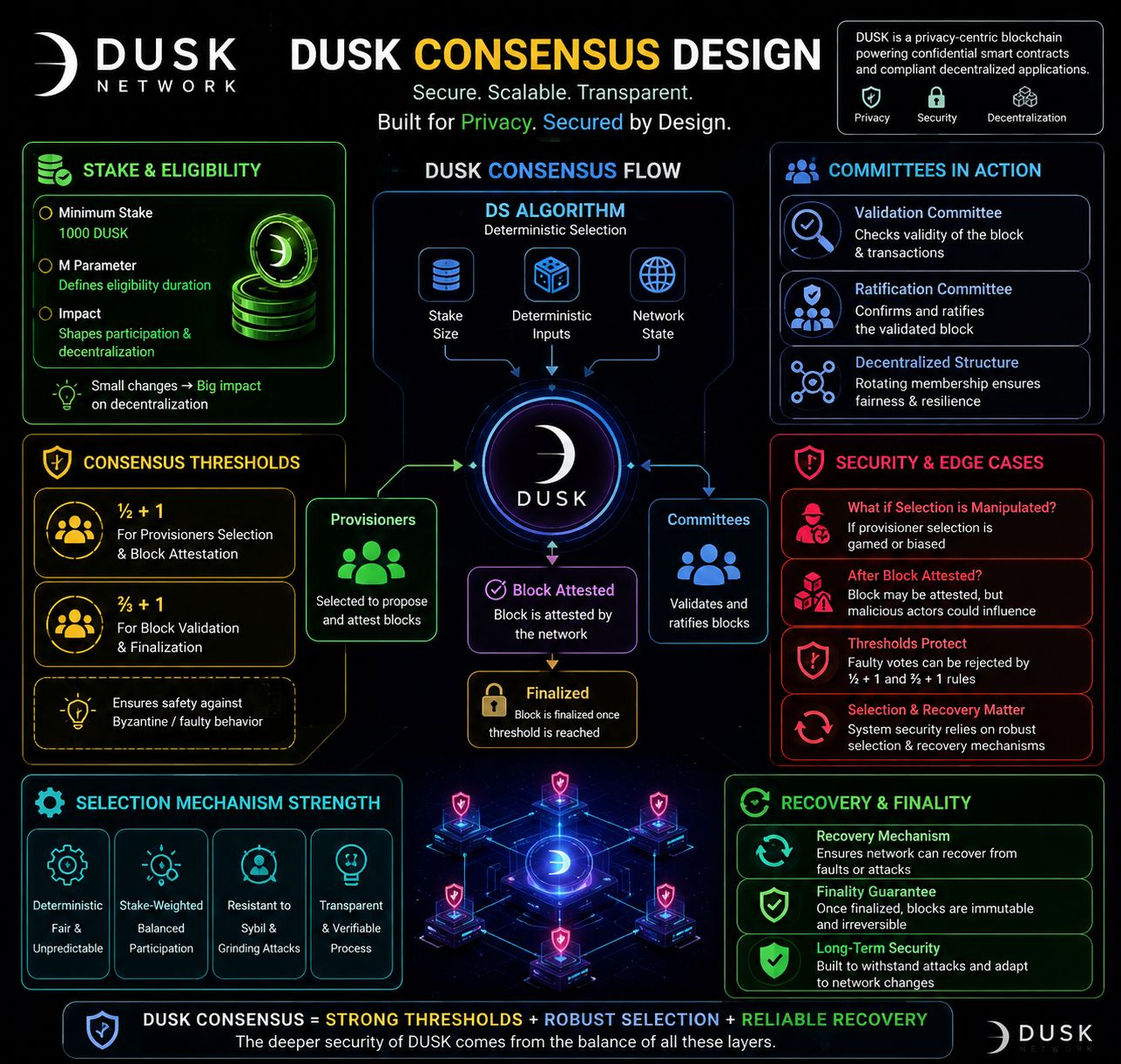
The security story isn’t just about the ½ + 1 and ⅔ + 1 thresholds. The 1000 DUSK minimum and the M parameter also shape who can realistically participate and how long their stake stays eligible.
That means small changes to those rules could have a bigger decentralization impact than the headline numbers suggest.
The DS algorithm itself is interesting too: stake size is combined with deterministic inputs to select provisioners, while committees handle validation and ratification.
What I’m still thinking about is the edge case: if the selection process were ever manipulated or gamed, what happens after the block has already been attested?
Consensus thresholds protect against faulty votes, but the strength of the whole system also depends on how robust the selection mechanism and recovery process are.
That’s where I think the deeper security discussion around DUSK starts.
$BOME
$DUSK
$ONG
The security story isn’t just about the ½ + 1 and ⅔ + 1 thresholds. The 1000 DUSK minimum and the M parameter also shape who can realistically participate and how long their stake stays eligible.
That means small changes to those rules could have a bigger decentralization impact than the headline numbers suggest.
The DS algorithm itself is interesting too: stake size is combined with deterministic inputs to select provisioners, while committees handle validation and ratification.
What I’m still thinking about is the edge case: if the selection process were ever manipulated or gamed, what happens after the block has already been attested?
Consensus thresholds protect against faulty votes, but the strength of the whole system also depends on how robust the selection mechanism and recovery process are.
That’s where I think the deeper security discussion around DUSK starts.
$BOME
$DUSK
$ONG