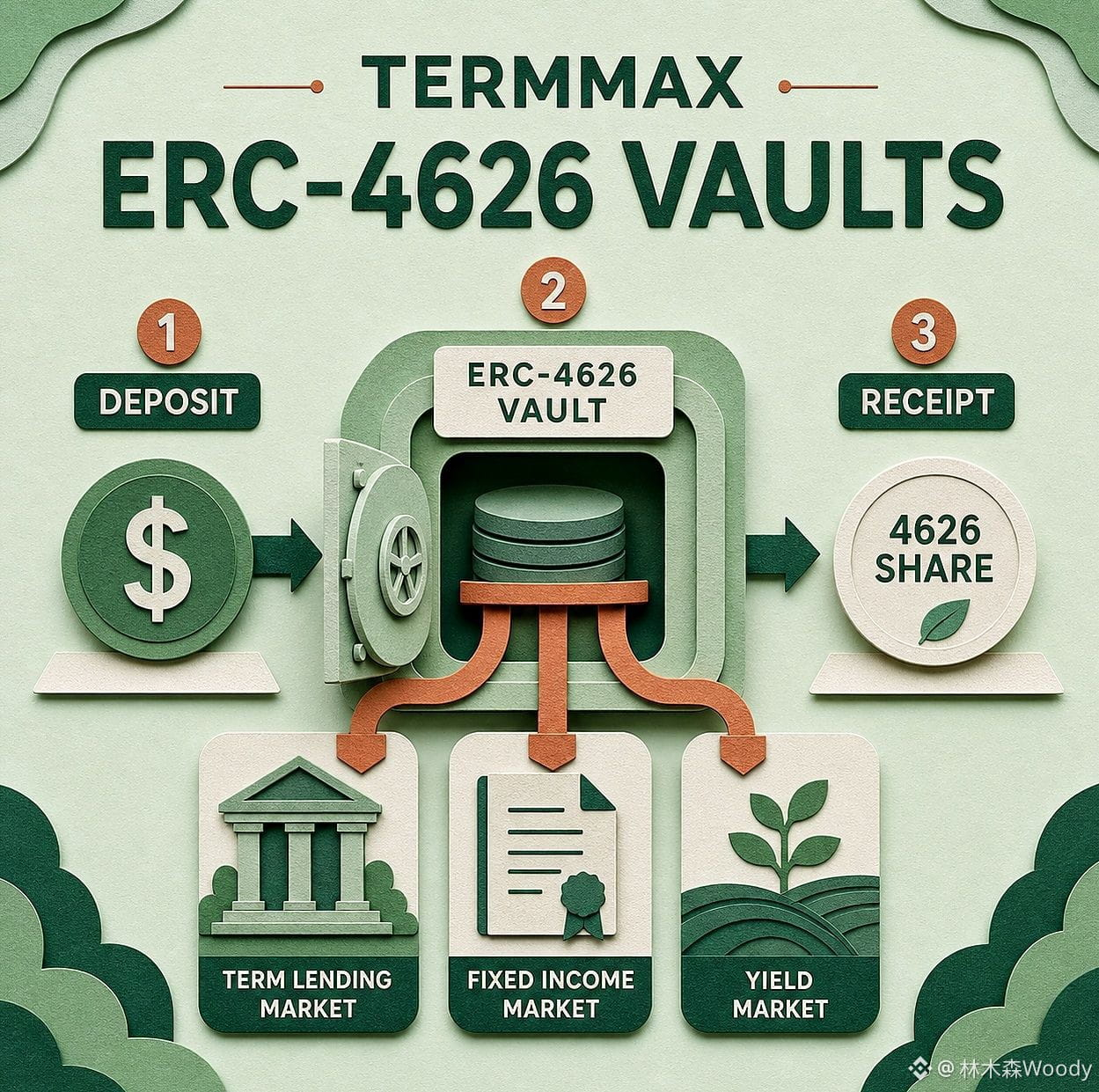
After reading the V2 launch notes for @TermMax , I went to review how it works in V1. The hassle with fixed-rate contracts may not be that there’s no quote—it’s that the money is split across different orders, markets, and chain pages. Seeing an interest rate doesn’t mean the full amount can be filled at that rate.
In V1, the curator’s range orders and the user’s limit orders are displayed separately. If you want to borrow a slightly larger sum, you have to compare orders one by one, and also absorb the price changes caused by each depth segment. The rate can be called “fixed,” but your entry cost may not be clear at a glance.
V2 changes exactly this layer. Unified orders read both the curator’s range orders and the user’s limit orders, then combine them into a single execution path. Users see one quote, sign once, and the system completes the combination using liquidity within the same market. Limit orders are also opened up across each market: lenders post the lowest acceptable interest rate, and borrowers post the highest rate they’re willing to pay—so they don’t have to hard-fill the current price in thin liquidity.
It doesn’t make the interest rate more fixed; it exposes the friction in the order book. Think of it like a counter listing a price—what really matters is whether the quantity you want can be obtained at a price close to it. V2 is responsible for piecing together orders and then outputting an executable path.
But there’s one boundary you can’t just erase. The official description is that cross-chain markets and vaults are shown, filtered, and compared within a single interface. It doesn’t say that funds on different chains are physically merged into one pool. Depth on Ethereum won’t automatically cross over just because you can see it from the Base page. On-chain liquidity, Gas costs, the waiting time for limit orders, and the actual executable volume still each account for themselves.
Another thing to watch is how large orders perform. A smoother path doesn’t mean every size can be filled at the homepage rate. What’s worth focusing on is the quote gap between different amounts, the waiting time for limit orders, and how many sources are combined in a single transaction. These reflect execution quality more than simply “supporting how many chains.”
So the value of #TermMax V2 isn’t that the page is simpler—it’s that it separates “rate certainty” from “execution certainty.” The former is defined by FT and the maturity date; the latter still needs to be proven by depth. The interface can map the route clearly, but whether there are enough “cars” along the way depends on real filled executions.
$BOME $BTC
In V1, the curator’s range orders and the user’s limit orders are displayed separately. If you want to borrow a slightly larger sum, you have to compare orders one by one, and also absorb the price changes caused by each depth segment. The rate can be called “fixed,” but your entry cost may not be clear at a glance.
V2 changes exactly this layer. Unified orders read both the curator’s range orders and the user’s limit orders, then combine them into a single execution path. Users see one quote, sign once, and the system completes the combination using liquidity within the same market. Limit orders are also opened up across each market: lenders post the lowest acceptable interest rate, and borrowers post the highest rate they’re willing to pay—so they don’t have to hard-fill the current price in thin liquidity.
It doesn’t make the interest rate more fixed; it exposes the friction in the order book. Think of it like a counter listing a price—what really matters is whether the quantity you want can be obtained at a price close to it. V2 is responsible for piecing together orders and then outputting an executable path.
But there’s one boundary you can’t just erase. The official description is that cross-chain markets and vaults are shown, filtered, and compared within a single interface. It doesn’t say that funds on different chains are physically merged into one pool. Depth on Ethereum won’t automatically cross over just because you can see it from the Base page. On-chain liquidity, Gas costs, the waiting time for limit orders, and the actual executable volume still each account for themselves.
Another thing to watch is how large orders perform. A smoother path doesn’t mean every size can be filled at the homepage rate. What’s worth focusing on is the quote gap between different amounts, the waiting time for limit orders, and how many sources are combined in a single transaction. These reflect execution quality more than simply “supporting how many chains.”
So the value of #TermMax V2 isn’t that the page is simpler—it’s that it separates “rate certainty” from “execution certainty.” The former is defined by FT and the maturity date; the latter still needs to be proven by depth. The interface can map the route clearly, but whether there are enough “cars” along the way depends on real filled executions.
$BOME $BTC