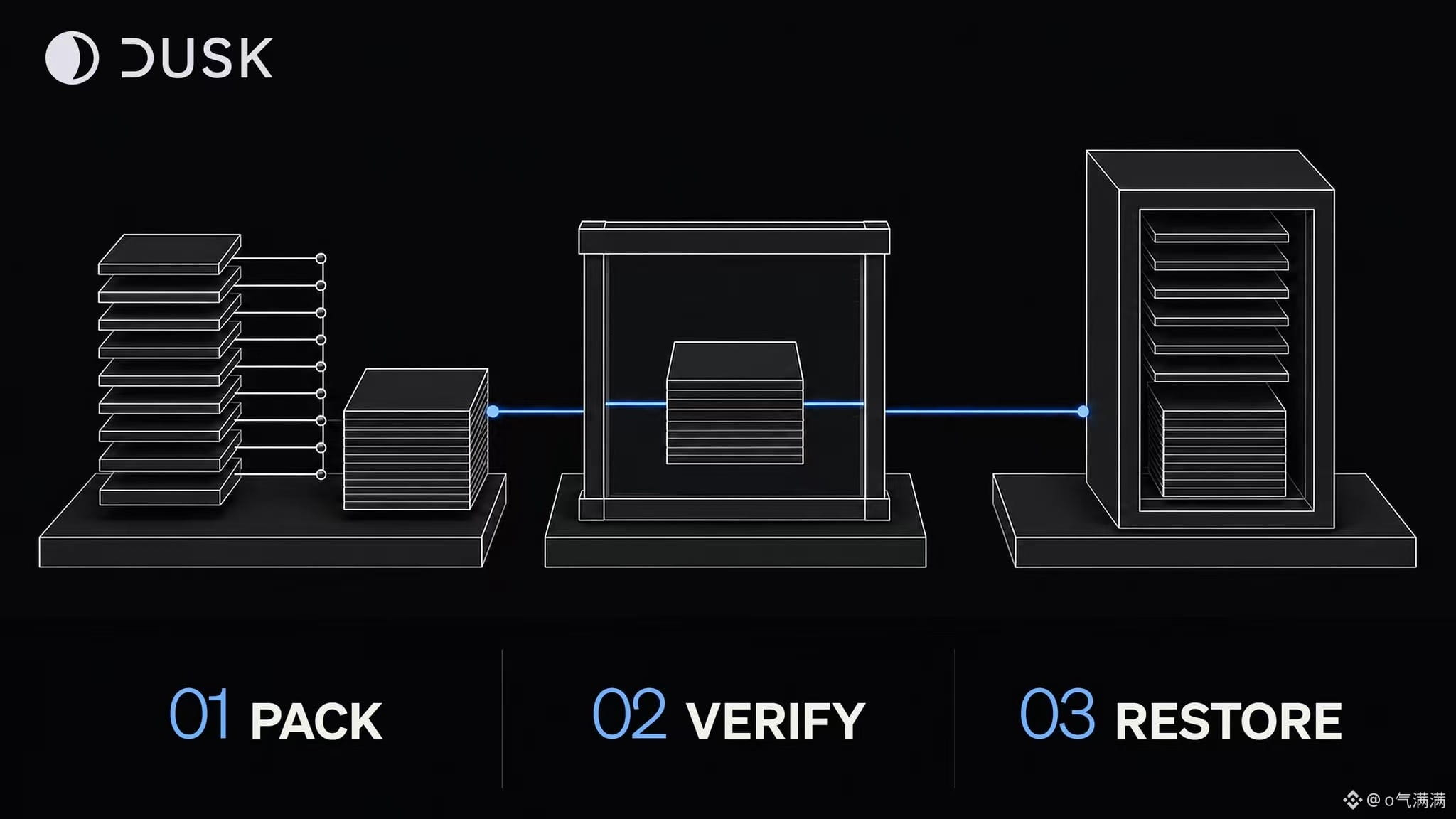
It sounds a little funny. When I first heard about running a node, the old pictures that popped into my head were a server room buzzing away and that whole “prize for winning” setup. It wasn’t until I finished reading through all the Dusk documentation that I realized this is completely different from what I’d imagined. It’s not a bunch of people scrambling to produce blocks. Instead, they split the work into three parts: each party handles their own piece, and nobody can replace anyone else. @Dusk
The Provisioner is the role closest to “block production.” To get on the job, you have to put up at least 1,000 DUSK as a deposit, and the machine has to stay online every day. When someone proposes a new block, it’s based on a lottery: whoever gets selected is responsible for packaging it, and voting also requires participation from them. Since real money is locked up inside, if anything goes wrong they’ll be penalized—so they’re more careful than anyone about whether the ledger is clean and in order. The Archive looks the most relaxed. It doesn’t stake coins and doesn’t get involved in consensus; its job is simply to store the already finalized history completely, and it has to include indexes too. Most of the time no one thinks about it, but when people need to look up old records or perform an audit, everyone has to go to it. The Prover is even more purely technical: all the zero-knowledge proofs behind privacy transactions are computed by it. It consumes a lot of compute power—if it can’t compute the proofs, the transaction can’t be finalized. #dusk $DUSK
Put these three roles together and it all makes sense: someone watches the rules, someone preserves the history, and someone computes the proofs. Missing any one link doesn’t work. It’s more stable than everyone rushing to fight over the right to record transactions. The main network has been running for a while now, and these roles are already working in real environments, but the whole system is still gradually adjusting and settling in. I used to equate nodes with mining too, for a time, but thinking back, it really was a bit presumptuous. When you first heard about Dusk nodes, did you think the same way? $BTC
The Provisioner is the role closest to “block production.” To get on the job, you have to put up at least 1,000 DUSK as a deposit, and the machine has to stay online every day. When someone proposes a new block, it’s based on a lottery: whoever gets selected is responsible for packaging it, and voting also requires participation from them. Since real money is locked up inside, if anything goes wrong they’ll be penalized—so they’re more careful than anyone about whether the ledger is clean and in order. The Archive looks the most relaxed. It doesn’t stake coins and doesn’t get involved in consensus; its job is simply to store the already finalized history completely, and it has to include indexes too. Most of the time no one thinks about it, but when people need to look up old records or perform an audit, everyone has to go to it. The Prover is even more purely technical: all the zero-knowledge proofs behind privacy transactions are computed by it. It consumes a lot of compute power—if it can’t compute the proofs, the transaction can’t be finalized. #dusk $DUSK
Put these three roles together and it all makes sense: someone watches the rules, someone preserves the history, and someone computes the proofs. Missing any one link doesn’t work. It’s more stable than everyone rushing to fight over the right to record transactions. The main network has been running for a while now, and these roles are already working in real environments, but the whole system is still gradually adjusting and settling in. I used to equate nodes with mining too, for a time, but thinking back, it really was a bit presumptuous. When you first heard about Dusk nodes, did you think the same way? $BTC