I nearly filed TermMax Dual Investment under “high APY vaults.” That would’ve been a lazy read.
When you deposit USDT, you’re providing liquidity to put buyers. In plain English, you’re taking the other side of an option. If the token finishes below the strike at maturity, your USDT can be converted into that token at the strike price, and you keep the premium.
Take a simple case.
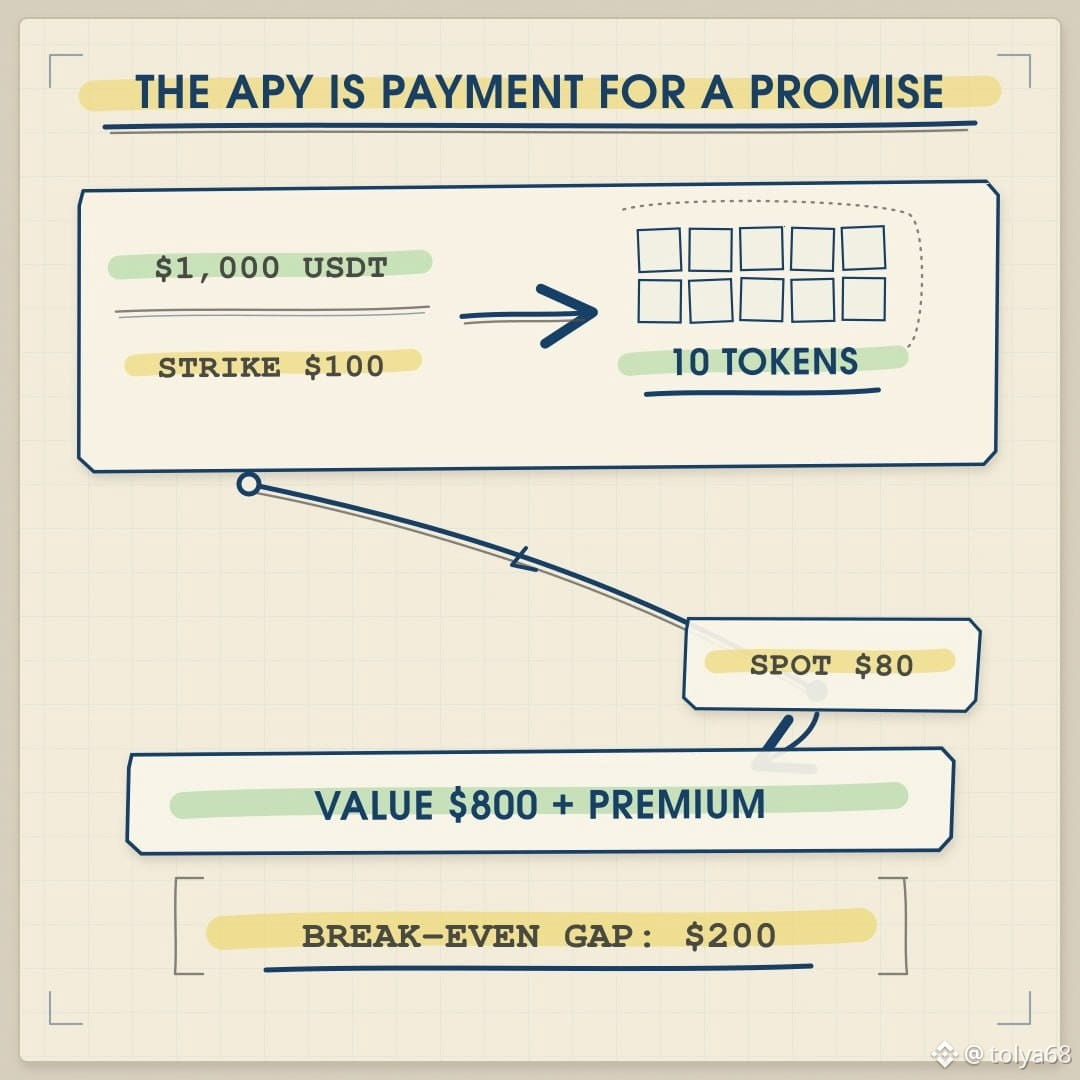
You deposit $1,000 USDT into a vault with a $100 strike. The token finishes at $80. Your $1,000 converts into 10 tokens, now worth $800, plus the premium.
Before considering points, fees, or any future rebound, that premium has to cover a $200 gap just to restore the original $1,000 of value.
That doesn’t make the product bad. It makes the trade more honest once it’s described correctly. You’re not being paid simply for parking USDT. You’re being paid for promising to buy the token at a predetermined price if the market falls through it.
The sentence I’d test before depositing is: “I’d still be happy owning this token at $100 even after it trades at $80.”
If that stops being true during the drop, the headline APY was probably doing too much of the thinking.
For me, the useful numbers aren’t only APY and maturity. They’re strike, premium, break-even price, and what asset I may actually hold at settlement.
@TermMax #TermMax
When you deposit USDT, you’re providing liquidity to put buyers. In plain English, you’re taking the other side of an option. If the token finishes below the strike at maturity, your USDT can be converted into that token at the strike price, and you keep the premium.
Take a simple case.
You deposit $1,000 USDT into a vault with a $100 strike. The token finishes at $80. Your $1,000 converts into 10 tokens, now worth $800, plus the premium.
Before considering points, fees, or any future rebound, that premium has to cover a $200 gap just to restore the original $1,000 of value.
That doesn’t make the product bad. It makes the trade more honest once it’s described correctly. You’re not being paid simply for parking USDT. You’re being paid for promising to buy the token at a predetermined price if the market falls through it.
The sentence I’d test before depositing is: “I’d still be happy owning this token at $100 even after it trades at $80.”
If that stops being true during the drop, the headline APY was probably doing too much of the thinking.
For me, the useful numbers aren’t only APY and maturity. They’re strike, premium, break-even price, and what asset I may actually hold at settlement.
@TermMax #TermMax