


On its debut, Unitree Technology set a record for first-day gains in new-share subscriptions under the comprehensive registration-based system; yet on the next day it plunged 18.7%, with its market value shrinking by more than 160 billion yuan from the peak. On the same day, founder Wang Xingxing admitted that the biggest bottleneck for embodied intelligence is still its generalization capability, and deployment in home and production scenarios still requires two to five years. JPMorgan believed that the sector’s valuation would shift from a “scarcity premium” to delivery capability, while Nomura was bullish on growth but emphasized that repeat industrial orders are key. The market is moving from “buying the story” to “seeing delivery.”
The frenzy of Unitree Technology’s debut quickly cooled down.
On August 20, the next day after this company—dubbed the “first humanoid robotics stock”—went public, it closed at 687 yuan per share, down 18.7%, with its market value falling to 277.9 billion yuan. The day before, the company opened with a surge of 629.44%, and the share price briefly touched 1,100 yuan, with its market value jumping to 444.9 billion yuan. In just one day, its market value shrank by more than 160 billion yuan from the intraday high.
Amid sharp fluctuations in the stock price, founder Wang Xingxing admitted at the 2026 World Robotics Conference that the biggest bottleneck for embodied intelligence is still generalization capability. It will still take time for robots to truly enter homes and daily production and living. At the fastest, it may take two or three years; at the slowest, it may take five to ten years.
At the same time, JPMorgan believes that Unitree’s listing will reset the valuation logic for the humanoid robotics sector. Capital will move from the prior “scarcity premium” to actual shipments, multi-customer replication, and profitability. Nomura Securities also initiated coverage of Unitree and gave a “Buy” rating for the first time, but it also pointed out that whether industrial customers can generate repeat orders is the key to whether demand can truly scale up.
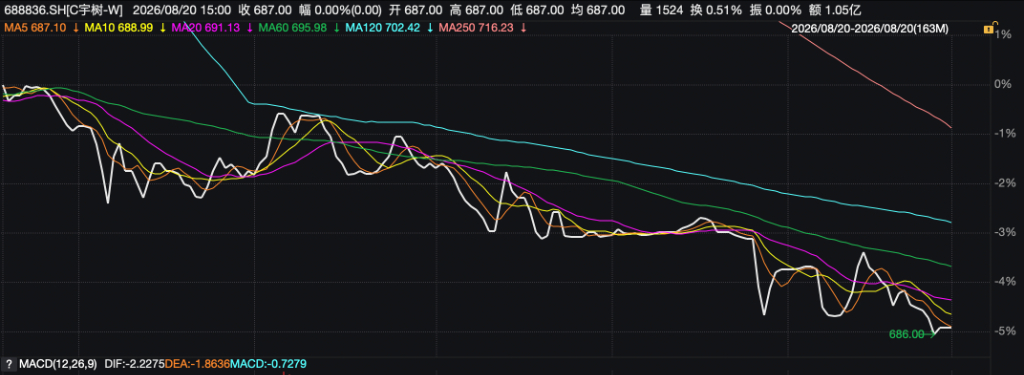
An opening P/E ratio above 800x—once the “scarcity frenzy” is over, valuation pressure emerges
Unitree Technology’s first day of listing on August 19 was extremely hot. The company opened at 1,100 yuan per share, up 629.44% from the发行价 of 150.80 yuan. Based on the opening price, investors who received one lot (500 shares) saw an unrealized gain of about 474,600 yuan, setting a new record for IPO lottery gains since the full registration-based system began.
Behind the opening price of 1,100 yuan are the combined effects of the company’s scarcity, float size, and market sentiment. Multiple investment-banking professionals believe that Unitree Technology’s “uniqueness” is an important factor supporting its high valuation. As the first A-share listed company with embodied-intelligence robots as its core business, Unitree previously had no comparable robot-body companies listed on the capital market. The scarcity of the asset amplifies market frenzy and pursuit.
Beyond emotions, valuation pressure also cannot be overlooked. Unitree Technology’s issued price-to-earnings (P/E) ratio has reached 219.23x, far higher than the industry average; based on an opening price of 1,100 yuan on the first day, the dynamic P/E ratio once exceeded 800x.
As sentiment gradually cooled after the first day of listing, the market began to shift from “scarcity premium” to re-examining the delivery power behind the valuation. Whether high valuation can ultimately be digested through robot shipments, commercialization landing, and profit growth will become the core test after Unitree’s listing.
Wang Xingxing: Generalization for embodied intelligence remains the biggest bottleneck
On August 20, Wang Xingxing, founder and chairman of Unitree Technology, delivered a keynote speech at the 2026 World Robotics Conference.
Wang Xingxing said that the core issue currently facing embodied intelligence is still generalization capability. At this stage, robots can achieve high task success rates in sufficiently trained fixed scenarios, but once objects or the environment are changed, task performance declines noticeably. How to enable robots to understand instructions in unfamiliar environments and complete tasks stably remains the key challenge the industry needs to tackle next.
In Wang Xingxing’s view, if after robots enter any unfamiliar environment, they can autonomously complete about 80% of tasks using only voice or language instructions, it can be considered as embodied intelligence crossing the industrialization threshold.
As for the timeframe to achieve this goal, he believes it can be achieved in as fast as two to three years, and at the slowest may take five to ten years. “The next few years are inevitably solvable issues,” said Wang Xingxing.
On the technical roadmap, Unitree Technology is developing end-to-end models and world models, and pushing robots to continuously self-evolve. It accelerates model iteration and improves robot capabilities by forming a closed loop through simulation training, real-world deployment, and data feedback.
JPMorgan: Valuation shifts from “scarcity” to delivery capability
JPMorgan believes that Unitree’s IPO is an important valuation-reset event for the humanoid robotics industry.
Previously, due to a lack of pure listed assets, more funds conducted “agency trading” through industry-chain companies, and scarcity itself became a source of the valuation premium. After Unitree’s listing, the market has a more direct pricing anchor.
The firm expects that in the next 1 to 6 months, the humanoid robotics sector may enter a valuation digestion period, with capital shifting from “who has scarcity” to rewarding companies that truly have shipment records, multi-customer replication capability, and improved gross-margin pathways.
JPMorgan also noted that humanoid robots and large models have clear differences. Robots need to be manufactured, transported, deployed, and maintained, and they also involve safety responsibilities. Therefore, the real key in the industry is not a single “ChatGPT moment,” but whether multi-customer commercialization, large-scale delivery, and continuous learning can be achieved.
As more companies such as AgiBot, Figure AI, and Agility Robotics move forward with listings or capital market transactions, the scarcity premium in the humanoid robotics sector will gradually decline.
Nomura is optimistic about rapid growth, with repeat orders being key
Nomura Securities initiated coverage of Unitree Technology on August 19 for the first time and gave a “Buy” rating, saying the company has moved from a “technology demonstration company” to a “scale delivery company.” Data show that in 2025, Unitree’s humanoid robot shipment volume exceeded 5,500 units, ranking first globally. Its main business gross margin is about 60%, and the gross margin for humanoid robots is 63.2%.
Nomura expects Unitree’s revenue to reach 2.687 billion yuan, 5.396 billion yuan, and 13.184 billion yuan in 2026, 2027, and 2028, respectively, corresponding to year-on-year growth of 58%, 101%, and 144%. The three-year compound growth rate is 122%.
However, Nomura also points out that currently Unitree’s demand mainly comes from scientific research, education, entertainment, and government procurement, while industrial and commercial applications account for a relatively limited share. Whether industrial customers can form stable repeat orders in the future will determine whether demand for humanoid robots can truly move from a theme-driven rally to large-scale ramp-up.
For Unitree Technology, which experienced a surge on its first day of listing followed by a plunge on the next day, the market is shifting from “buying the story” to “watching delivery.” Valuation may still see fluctuations in the short term, but if the company can continue expanding shipments, win more industrial customers, and form repeat orders, its long-term value will still need to be validated through commercialization progress.
Risk warning and disclaimer terms
The market has risks; investment is需谨慎. This article does not constitute personal investment advice, and it does not consider individual users’ specific investment objectives, financial situations, or needs. Users should consider whether any opinions, viewpoints, or conclusions in this article align with their specific circumstances. Invest at your own risk and responsibility.