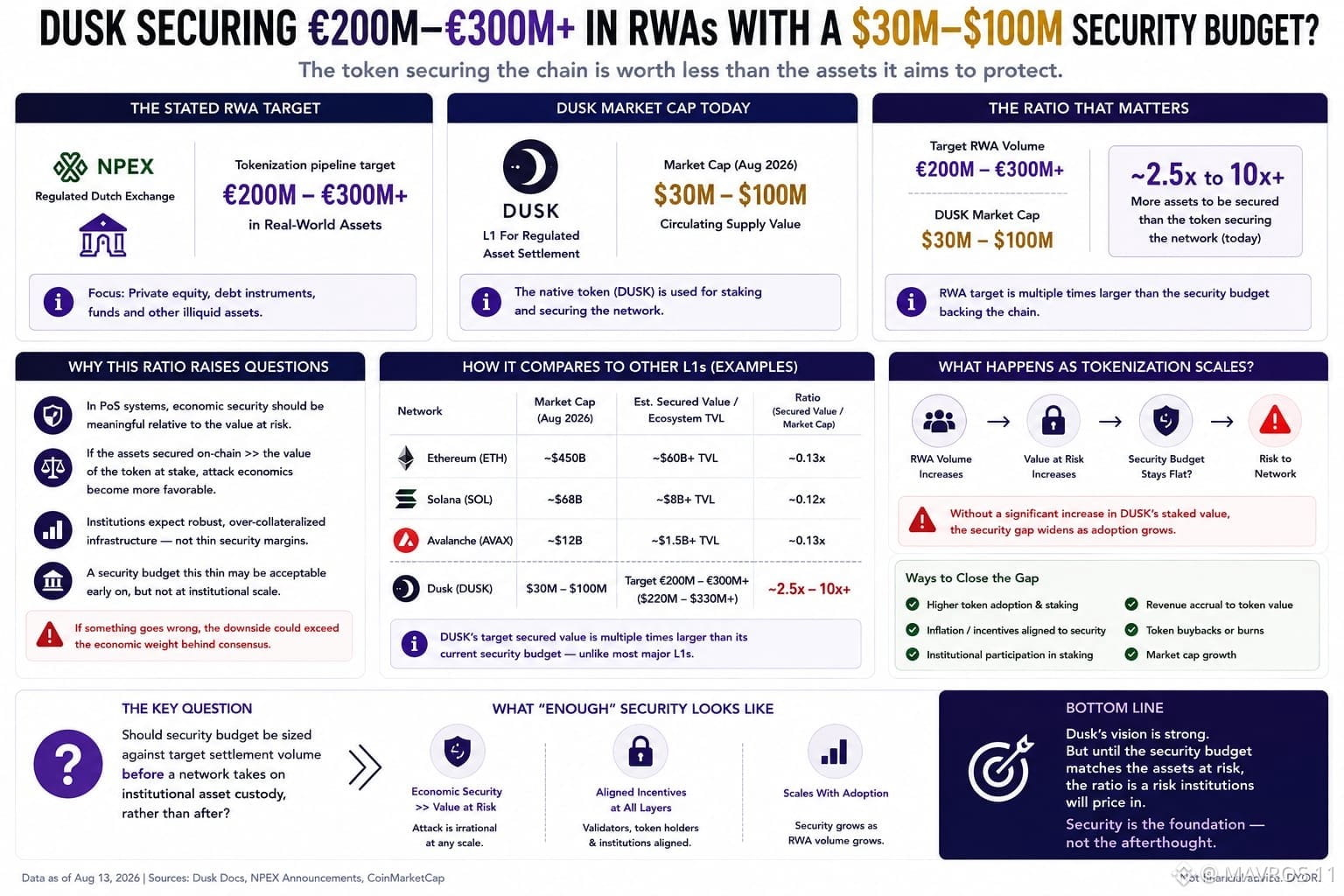
The number worth sitting with: @Dusk 's partnership with NPEX targets tokenizing somewhere between €200M and €300M in real-world assets. dusk's own market cap, depending on which day you check, sits somewhere between $30M and $100M.
That's a strange ratio for a Layer-1 whose native token is supposed to secure the network processing those assets. In most PoS systems, the value of assets settling on-chain and the value securing consensus are at least loosely correlated — enough stake needs to be at risk to make attacking the network economically irrational relative to what's flowing through it. Here, the stated RWA tokenization target is multiple times larger than the entire circulating value of the token meant to back the chain's security.
To be fair, this isn't unusual in early-stage RWA infrastructure — the tokenized-asset side is expected to scale independently of the token's speculative market cap, and plenty of L1s carry security budgets that look thin relative to eventual settlement volume. But it does raise a real question about incentive alignment at scale: if NPEX's tokenization actually reaches its stated target, does DUSK's current stake-securing value even come close to matching the assets it's responsible for protecting, or does that gap just get quietly ignored as long as nothing goes wrong?
Should security budget ever be sized against target settlement volume before a network takes on institutional asset custody, rather than after?$DUSK #dusk
That's a strange ratio for a Layer-1 whose native token is supposed to secure the network processing those assets. In most PoS systems, the value of assets settling on-chain and the value securing consensus are at least loosely correlated — enough stake needs to be at risk to make attacking the network economically irrational relative to what's flowing through it. Here, the stated RWA tokenization target is multiple times larger than the entire circulating value of the token meant to back the chain's security.
To be fair, this isn't unusual in early-stage RWA infrastructure — the tokenized-asset side is expected to scale independently of the token's speculative market cap, and plenty of L1s carry security budgets that look thin relative to eventual settlement volume. But it does raise a real question about incentive alignment at scale: if NPEX's tokenization actually reaches its stated target, does DUSK's current stake-securing value even come close to matching the assets it's responsible for protecting, or does that gap just get quietly ignored as long as nothing goes wrong?
Should security budget ever be sized against target settlement volume before a network takes on institutional asset custody, rather than after?$DUSK #dusk