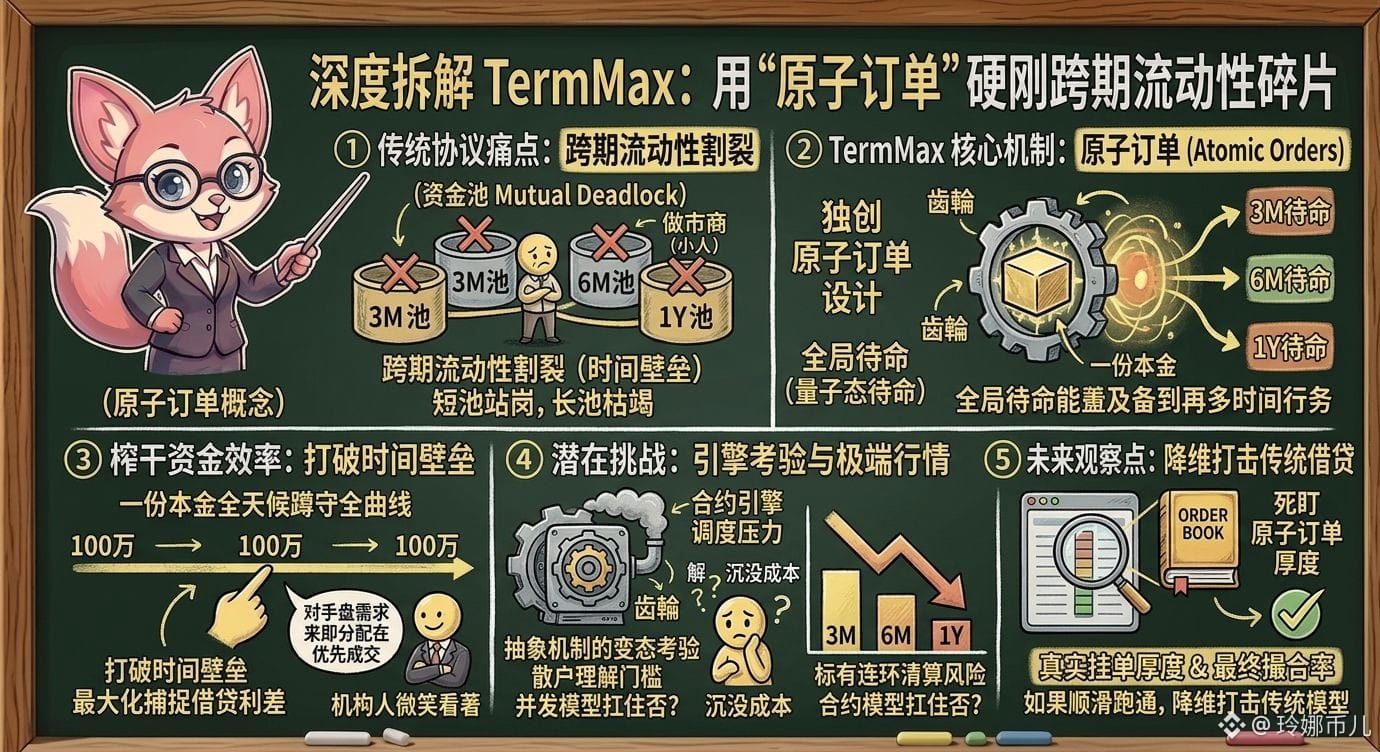
#termmax I’ve recently been going through the pain points caused by liquidity fragmentation across different tenors on the chain, and, as a bonus, I pulled apart TermMax @TermMax ’s underlying architecture and chewed on it in detail.
Once you dig into the underlying layer, you find that its approach to cross-period liquidity is completely different from mainstream playbooks. With its original design of “Atomic Orders,” it manages to make a single pool of funds simultaneously “stand by” across all tenor markets. $BOME
In traditional fixed-rate protocols, if the maturity dates differ, the capital pools end up effectively deadlocked and fragmented. Market makers often end up idling in short pools while long pools become liquidity-starved. TermMax’s atomic order mechanism is essentially putting capital into a globally covered “quantum state”—one principal amount is laid out across the entire time curve. The moment an order-book counterparty demand appears first in a given tenor, that side gets priority for matching. This seamless scheduling that breaks through time barriers pushes the capital utilization efficiency for each trade to the absolute limit.
However, the more abstract the underlying mechanism is, the more brutal the scheduling demands placed on the contract engine become. For ordinary retail users, they basically can’t reason about the complex sunk costs involved. And once you hit an extreme pin-prick market scenario where liquidity squeezes occur across multiple tenor markets at the same time, whether this concurrency model can hold up through complex cascading settlements remains an open question.
Still, having large capital constantly run around between pools of different tenors and re-balance frequently is simply not realistic. What institutions want is frictionless global depth. So it creates this atomic-level standby order, allowing professional market makers to stop guessing which tenor’s demand is currently the hottest. One principal can guard the full curve around the clock, maximizing the ability to capture lending/borrowing interest spreads. I feel this path—hardening against liquidity fragmentation through the underlying architecture—is far more practical than those Ponzi-like games that rely on endlessly minting tokens to subsidize depth across each tenor. $NEIRO
Cross-tenor liquidity has always been a tough nut to crack in the fixed-income space. Instead of listening to the noise from endless calls in the community, I’d recommend closely watching the real order-book depth of atomic orders across TermMax’s tenor markets and their eventual matching rates. Only when this concurrency engine can truly run smoothly under large-scale capital loads will it be a genuine dimensionality reduction attack on traditional lending models.
Once you dig into the underlying layer, you find that its approach to cross-period liquidity is completely different from mainstream playbooks. With its original design of “Atomic Orders,” it manages to make a single pool of funds simultaneously “stand by” across all tenor markets. $BOME
In traditional fixed-rate protocols, if the maturity dates differ, the capital pools end up effectively deadlocked and fragmented. Market makers often end up idling in short pools while long pools become liquidity-starved. TermMax’s atomic order mechanism is essentially putting capital into a globally covered “quantum state”—one principal amount is laid out across the entire time curve. The moment an order-book counterparty demand appears first in a given tenor, that side gets priority for matching. This seamless scheduling that breaks through time barriers pushes the capital utilization efficiency for each trade to the absolute limit.
However, the more abstract the underlying mechanism is, the more brutal the scheduling demands placed on the contract engine become. For ordinary retail users, they basically can’t reason about the complex sunk costs involved. And once you hit an extreme pin-prick market scenario where liquidity squeezes occur across multiple tenor markets at the same time, whether this concurrency model can hold up through complex cascading settlements remains an open question.
Still, having large capital constantly run around between pools of different tenors and re-balance frequently is simply not realistic. What institutions want is frictionless global depth. So it creates this atomic-level standby order, allowing professional market makers to stop guessing which tenor’s demand is currently the hottest. One principal can guard the full curve around the clock, maximizing the ability to capture lending/borrowing interest spreads. I feel this path—hardening against liquidity fragmentation through the underlying architecture—is far more practical than those Ponzi-like games that rely on endlessly minting tokens to subsidize depth across each tenor. $NEIRO
Cross-tenor liquidity has always been a tough nut to crack in the fixed-income space. Instead of listening to the noise from endless calls in the community, I’d recommend closely watching the real order-book depth of atomic orders across TermMax’s tenor markets and their eventual matching rates. Only when this concurrency engine can truly run smoothly under large-scale capital loads will it be a genuine dimensionality reduction attack on traditional lending models.