

(Source: Investors Network - Thinking Finance)

[On-site investigation] Directly step into the front line of the company—observe production lines, ask about capital, and break down financial reports to gain insight into genuine growth.
“The founding bird’s key contributor departs.”
Inside Anta Sports Products Limited (02020.HK, hereinafter “Anta Sports” or “the Company”), it may be that the company is reviewing the various reforms of the past three years.
The event traces back to Xu Yang, CEO of Anta’s main brand. A company veteran who once helped build Arcteryx’s glory stepped down in a low-key manner, but the various experimental changes he left behind within the company over the past three years still persist in the form of store assets.
Ultimately, the market has formed multiple labels for the company: a trillion-yuan market cap, overseas acquisitions, and a machine for generating hype products in the luxury-sports space. But invisibly, this also becomes pressure—especially when the company shows a trend of slowing high growth. Even a personnel change can spark headlines.
01
Xu Yang’s bold attempts
In 2023, Xu Yang officially took over as CEO of Anta’s main brand. Within the Anta system, the brand coverage includes Anta, FILA, Amer Sports (Arcteryx, Salomon, and Wilson’s parent company), Descente, KOLON, Jack Wolfskin, and more. Since joining the company in 2006, Xu Yang has served as General Manager of the Basketball Business Unit and General Manager of Arcteryx Greater China, among other roles, successively.
The “breakout” performance of Arcteryx has been widely recognized. Because of this, Ding Shizhong, Chairman of the company’s board, specifically called Xu Yang back to serve as the负责人 in charge of the main brand. The market speculated that this reassignment might mean the company would replicate Arcteryx’s direct retail and high-end retail experience within Anta’s main brand.
But subsequent developments proved the market wrong. Xu Yang still defined Anta’s main brand as a mass-market brand, while believing there is a problem of the “same look across thousands of stores.” In an interview with (China Entrepreneur), Xu Yang put forward two core viewpoints. First, the quantitative targets that the outside world later came to know well: over three years, Anta’s main brand’s domestic sales will strive to exceed Nike. Second, a line that the outside world at the time did not understand—“Anta is too big. I want to make Anta smaller.”
Actually, what Xu Yang wanted to do was to turn Anta’s main brand from “big” into “small.” What he meant was to break the existing organizational structure, as a way to support and implement the experimental store strategy.
During that time, the previously unified main brand was split into multiple virtual category teams covering basketball, running, outdoor, cross-training, and more. Meanwhile, two independent business units—Super Anta and Anta SV—were newly created, corresponding to new formats such as sports supermarkets and trend sneaker stores. Each had its own merchandise, retail, and store expansion teams, and reported directly to Xu Yang.
In short, Super Anta and Anta SV, within the system led by Xu Yang, are experimental stores—new explorations that also break the “one thousand stores look the same” pattern, and a new weapon to attempt to surpass Nike.
To this end, Anta’s main brand splits its online and offline product offerings: e-commerce only focuses on baseline volume-driving items, while offline stores offer full-category products exclusively, so as to prevent low-price online pressure from squeezing offline profits. Meanwhile, Xu Yang brought in Arcteryx’s direct retail experience—large-store staffing, members, store productivity (sales per square meter), and other factors are assessed separately.
Once everything was in place, experimental stores began “crossing the river by feeling the stones.” Taking Super Anta as an example: after opening trial stores in three cities in 2024, it started rolling out nationwide in 2025. From concept to implementation, the market finally saw Xu Yang’s ideas in a more concrete, scenario-based way.
Whether this “try-it-first” strategy would work drew different opinions within the company and in the market. But at that time, Xu Yang also had new ideas for retail formats: Anta City.
In the second half of 2024, the project of “Anta City” was officially approved for internal establishment. Unlike Super Anta stores, the new format is positioned as a “city sports clubhouse.” It includes “selling merchandise + indoor basketball courts + community socializing + light meals.” It set standards including a 3,000-square-meter scale, an in-store self-built sports venue, stall-style displays, the introduction of light-meal coffee, community operations, and more.
However, one question began to surface clearly: is Anta City an iteration of Super Anta and Anta SV? Or, more bluntly, were the two existing experimental retail stores too weak in store sales per square meter, unable to support the goal of surpassing Nike within three years?
In June 2026, NBA star Kyrie Irving’s China tour stop in Shanghai took place, and Xu Yang appeared at the construction site of Anta City’s store. At the time, no one expected this would be Xu Yang’s last public appearance as CEO of Anta’s main brand.
In July 2026, the company disclosed in a way described as an “internal notice + media release” that Xu Yang resigned as CEO of Anta’s main brand for family reasons. The Group has approved the resignation and will assign him to another role. Lai Shixian, an Executive Director and Co-CEO of the Group, will take over in his place.
If Xu Yang resigned, what would become of the experimental stores he led?
02
Legacy assets
To answer the question about Xu Yang’s experimental assets, first look at two sets of data.
In 2025, Anta’s main brand sales were RMB 34.754 billion, up 3.7% year over year, accounting for 43.3% of the company’s revenue. In the same period, Nike’s Greater China revenue was USD 6.585 billion (about RMB 46.9 billion). Before Xu Yang stepped down, Super Anta and Anta SV each had about 120 and 41 stores, respectively.
In other words, Anta’s main brand did not catch up to Nike. Moreover, according to the plan, in 2025 Super Anta was supposed to open 160 new stores, but the current scale clearly has not met the target.
Where did the problem lie? Earlier market speculation appears to have been confirmed: Xu Yang’s two experimental stores could not support the growth momentum. Moreover, the company quickly adjusted its internal organizational structure based on that.
According to a confirmation by Jiemian News, business units such as Super Anta and Anta SV were abolished and merged into the Product Department and the Outdoor category business unit, respectively. At the same time, Super Anta will pause rapid store expansion, maintain its current scale, and continue operating.
As for the final experimental asset—where Anta City would go next. Before Xu Yang stepped down, two pilot stores were confirmed to be opened in Shanghai’s West Bank and Shenyang’s Tiexi Wanda Plaza, among others. In July 2026, the West Bank store opened. This location was also where Xu Yang made his last public appearance as CEO of the main brand.
To find out, (Investor Network) visited Anta City in Shanghai’s West Bank store to see for itself.
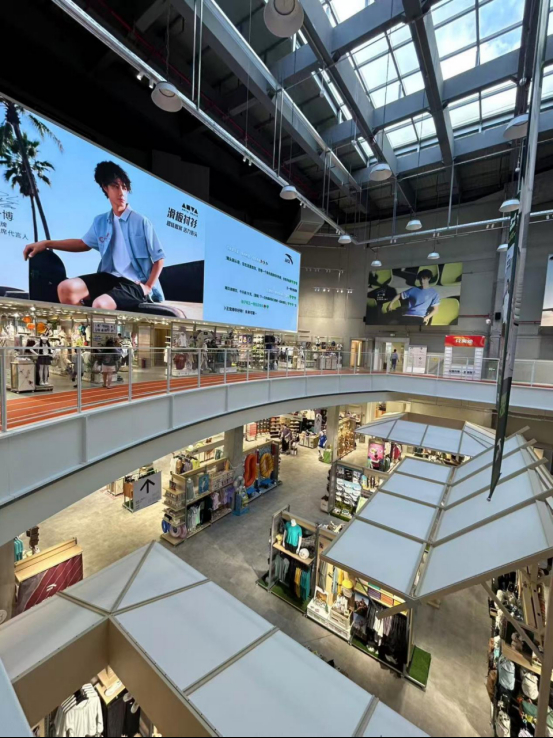
From outside, you can see that Anta City is huge in scale. Inside, it is divided into two levels.

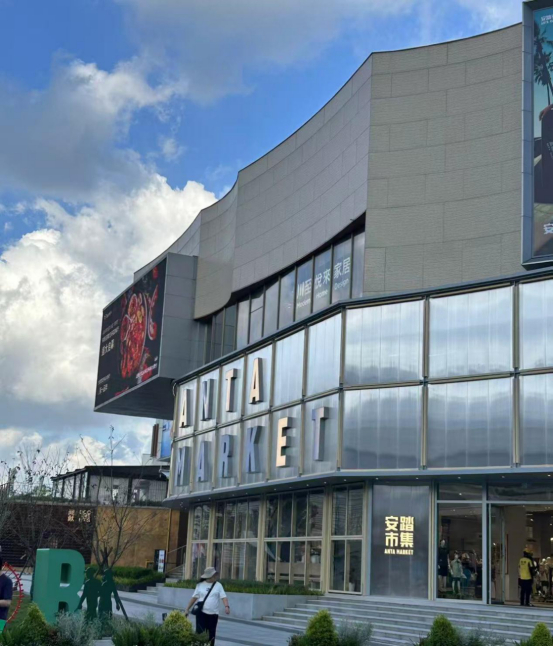
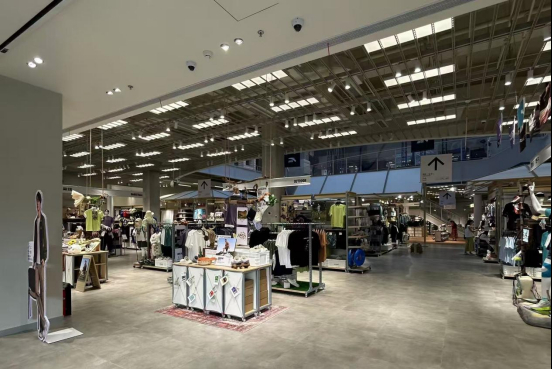
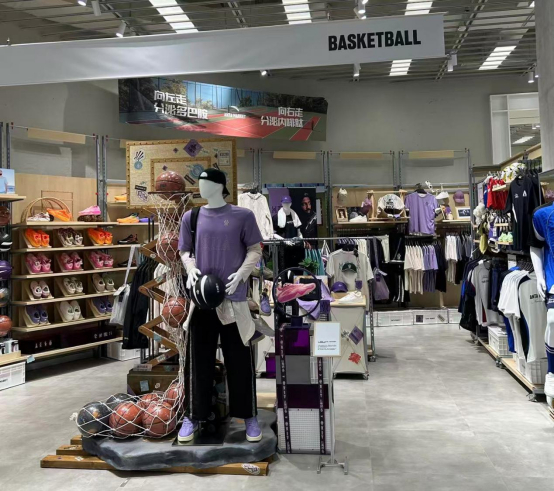
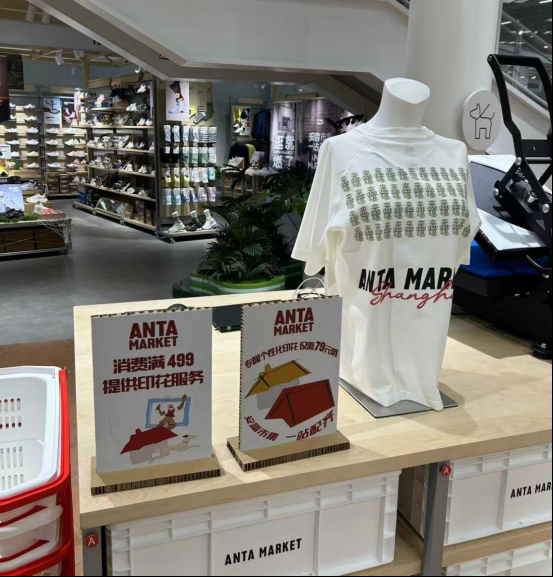
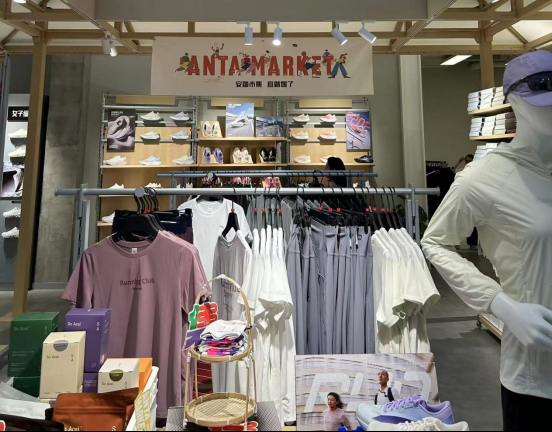
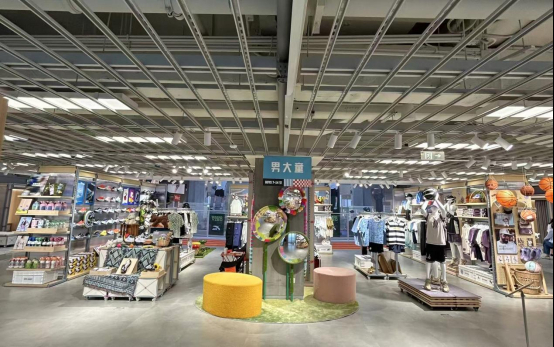
Looking at it overall, Anta City has a large space, many employees, and a full range of products. The concept of a sports space makes people think of McDonald’s children’s play area—here, it is an enlarged, sports-oriented version.
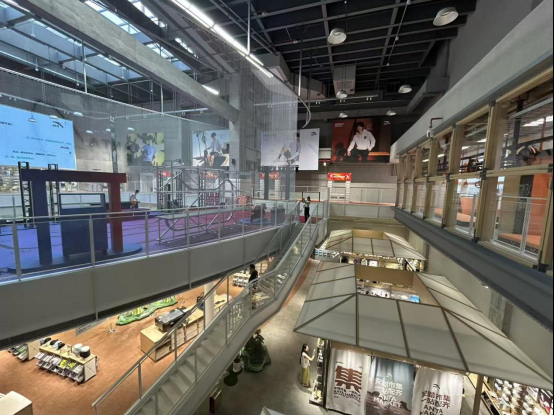
In any case, Xu Yang failed to replicate Arcteryx’s brilliance within Anta’s main brand. Looking back, the market has many views on Xu Yang’s three-year experimental transformation.
First, the new-format concept represented by Super Anta has not truly “run successfully.” These direct-operated stores have high rent and high investment. They benchmark Decathlon, but lack Decathlon’s full matrix of sports accessories, resulting in weak growth.
Second, consumer awareness is muddled. Think about it: if multiple Anta-brand stores appear in the same mall, ordinary users may not be able to tell the difference between SV, Super Anta, Champion stores, and regular stores.
Third, store formats are tiered, but product differentiation is insufficient. Whether stores are positioned differently or not, it doesn’t change the high overlap between products and mass-category offerings.
03
Overseas expansion narrative
If we step out of Anta’s domestic main-brand market, there are two key narratives that Anta Sports has left with the market in recent years. One is the relentless momentum in acquiring overseas brands. The other is the rapid rollout of opening stores overseas.
Among these, the overseas-expansion narrative is relatively implicit. In 2022, the company established a Southeast Asia International Business Unit at the company level and began building a regional headquarters in Singapore. It should be noted that this unit was not under Xu Yang’s jurisdiction.
In 2023, Anta’s main brand opened flagship stores in Singapore and Bangkok, officially landing its overseas expansion in a real scenario. In fact, localization strategy has always been implemented in overseas expansion. Considering local customer characteristics, the company did not simply export domestic merchandise. Instead, it developed fabrics suitable for Southeast Asia’s high temperatures and lightweight running shoes. At the store level, the Southeast Asia market did not copy the complex domestic system; it was simply divided into city flagship stores and standard satellite stores.
As of 2025, Anta’s main brand has a total of 241 overseas stores, the vast majority of which are concentrated in Southeast Asia. In the same period, the company’s overseas revenue reached RMB 850 million, up 70% year over year.
Compared with the company’s revenue of over RMB 80 billion, although overseas revenue is a small share, the company still announced a new plan. Over the next three years, Anta’s main brand (excluding FILA, Descente, and KOLON, among others) will open 1,000 stores in Southeast Asia.
From the company level, in 2025 the revenue of FILA and other brands (Descente, KOLON, MAIA ACTIVE, Jack Wolfskin, etc.) was RMB 28.469 billion and RMB 16.996 billion, respectively, with year-on-year growth of 6.9% and 59.2%. Among them, Descente first broke the RMB 10 billion mark. This brand is overseen by Ding Shaoxiang, the son of Ding Shizhong.
Regarding Amer Sports (Asics?—context suggests Amer Sports / Amer Sports is the company name), although the company holds nearly 40% equity, under the equity method accounting for affiliated companies, the performance is not consolidated into results. In 2025, Amer Sports’ revenue was USD 6.566 billion; the Greater China region was USD 1.862 billion, up 43.4% year over year. By segment, technical apparel (with Arcteryx as the main brand), mountain outdoor (Salomon), and sports balls/rackets (including Wilson) generated revenue of USD 2.856 billion, USD 2.404 billion, and USD 1.307 billion, respectively—up 30%, 31%, and 13%, respectively.
In the final analysis, Xu Yang’s departure carries two meanings. What the market sees is that domestic sales have not yet surpassed Nike. What the company feels is that reforms at experimental stores are underway. No matter what, over the past three years the company has accumulated new experience. At this stage, the company may be in the process of reviewing and summarizing; what happens next will determine the future of domestic sports brands.
(This article is for reference only and does not constitute investment advice. There are risks in the market, so investments require caution.)
END
Contact information
◆
Content collaboration · siweicaijing@tzzw.cn
Official website · www.investorchina.cn
Join us: tzzbhr@tzzw.cn