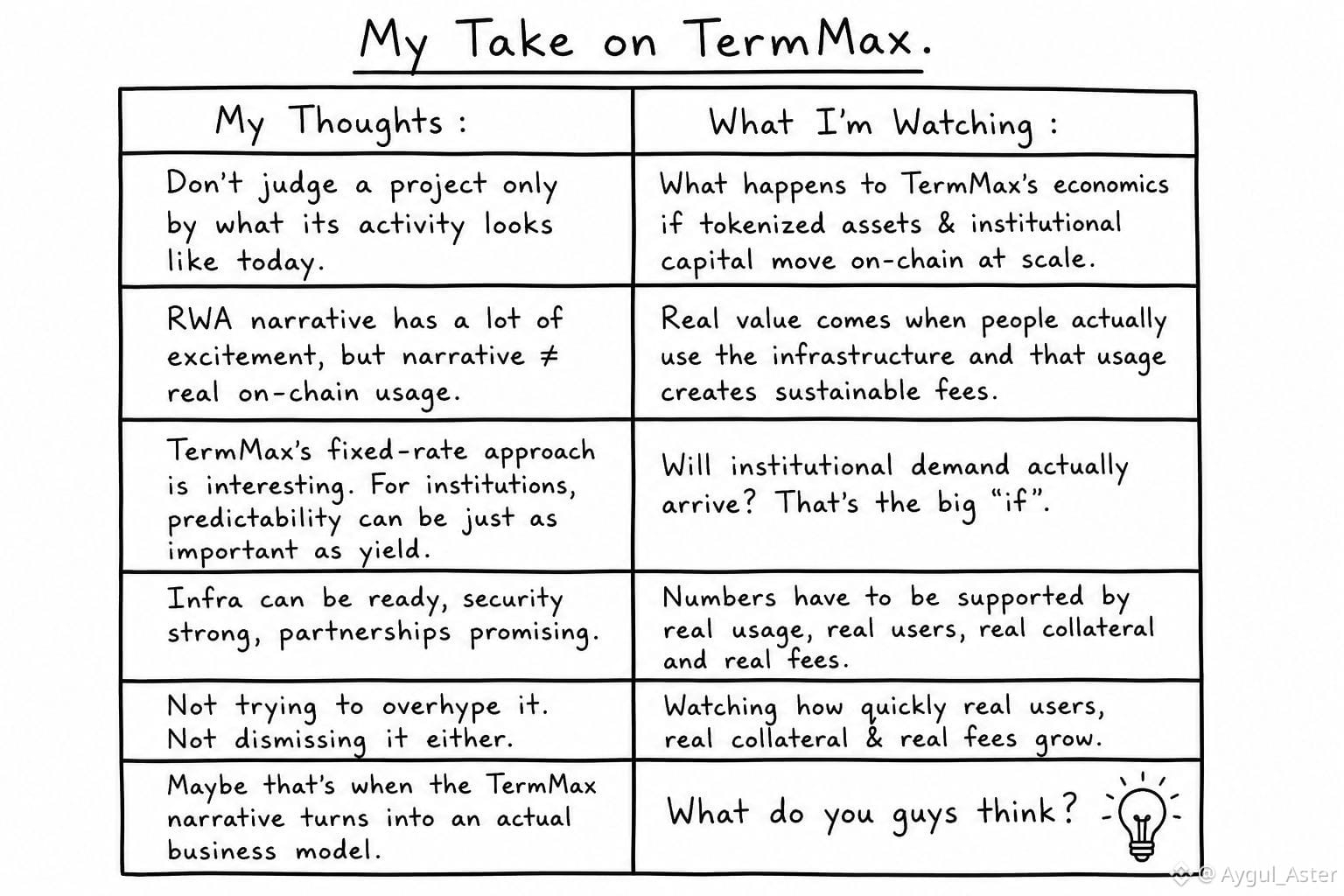
One thing I keep thinking about while looking into TermMax is that maybe we shouldn’t judge a project only by what its activity looks like today. The bigger question for me is what happens to TermMax’s economics if tokenized assets and institutional capital actually start moving on-chain at scale.
There’s a lot of excitement around the RWA narrative right now, but I think there’s a big difference between having a strong narrative and having real on-chain usage. It’s easy for a protocol to get attention because of the story around it, but the real value starts showing when people actually use the infrastructure and that usage creates sustainable fees.
That’s also why I find TermMax’s fixed-rate approach interesting. For institutions, I don’t think it’s always about chasing the highest yield. Predictability can be just as important. If an institution knows what its borrowing or lending terms look like beforehand, planning capital becomes much easier.
But there’s still a big “if” here: will that institutional demand actually arrive?
For me, that’s probably the most interesting test for TermMax. The infrastructure can be ready, the security layer can be strong, and partnerships can look promising, but eventually the numbers have to be supported by real usage.
I’m not trying to overhype it, but I also don’t want to dismiss it just because current activity isn’t huge. What I’ll be watching is how quickly real users, real collateral, and real fees start growing.
Maybe that’s when the TermMax narrative starts turning into an actual business model. What do you guys think?
#termmax @TermMax
There’s a lot of excitement around the RWA narrative right now, but I think there’s a big difference between having a strong narrative and having real on-chain usage. It’s easy for a protocol to get attention because of the story around it, but the real value starts showing when people actually use the infrastructure and that usage creates sustainable fees.
That’s also why I find TermMax’s fixed-rate approach interesting. For institutions, I don’t think it’s always about chasing the highest yield. Predictability can be just as important. If an institution knows what its borrowing or lending terms look like beforehand, planning capital becomes much easier.
But there’s still a big “if” here: will that institutional demand actually arrive?
For me, that’s probably the most interesting test for TermMax. The infrastructure can be ready, the security layer can be strong, and partnerships can look promising, but eventually the numbers have to be supported by real usage.
I’m not trying to overhype it, but I also don’t want to dismiss it just because current activity isn’t huge. What I’ll be watching is how quickly real users, real collateral, and real fees start growing.
Maybe that’s when the TermMax narrative starts turning into an actual business model. What do you guys think?
#termmax @TermMax