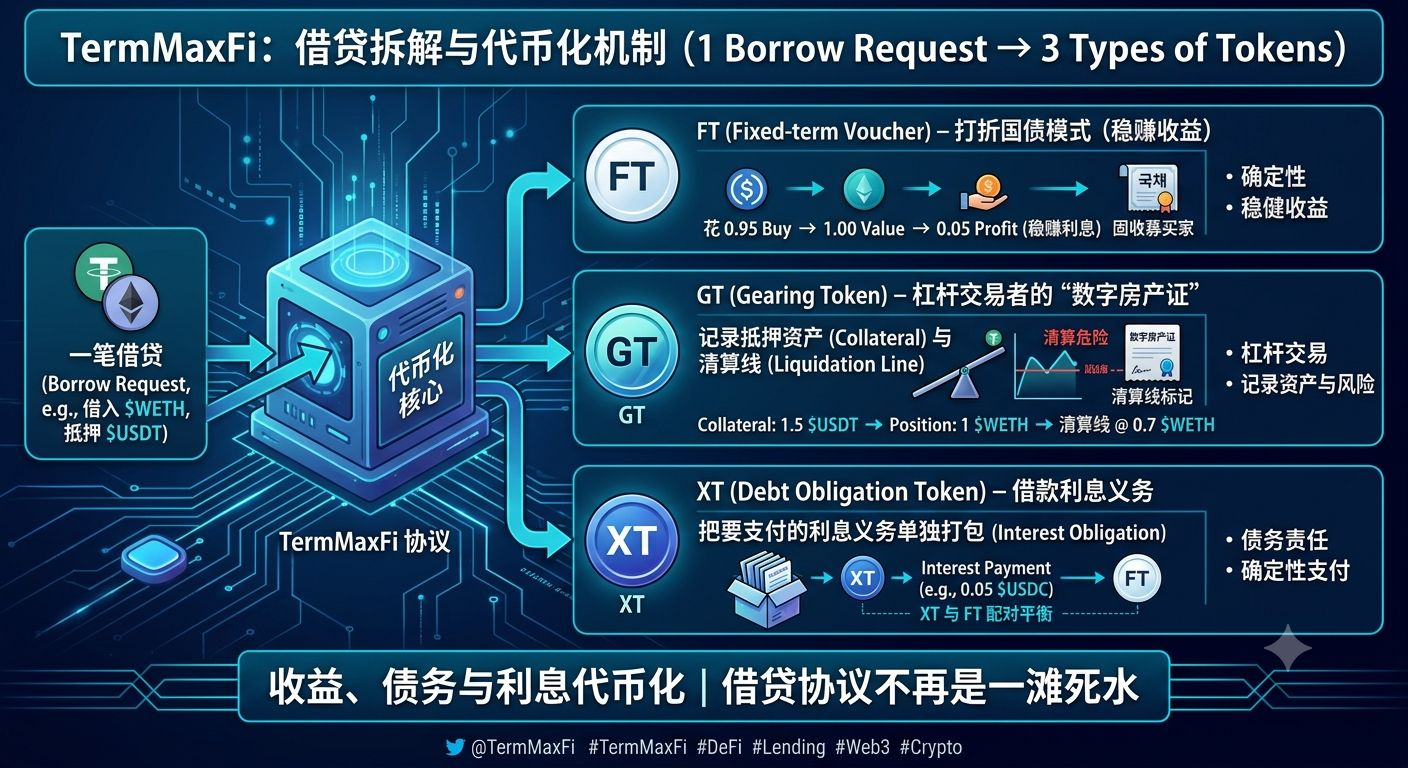
Many brothers think the mechanism of @TermMax TermMaxFi is complicated. In fact, it just splits a single lending/borrowing into 3 types of tokens, so each party gets what it needs:
• Those who want fixed income get FT: it’s like buying discounted government bonds—pay 0.95 for every 1 unit of face value, redeem for the full 1 unit at maturity, and the price difference in the middle is guaranteed profit interest;
• Those who want to trade with leverage get GT: it’s like a “digital property deed” for your leveraged position, recording your collateral assets and liquidation line;
• Borrowers pay interest using the corresponding XT: it packages the interest payment obligations separately and pairs them to balance with FT.
Once returns, debts, and interest obligations are all tokenized and separated, the lending protocol is no longer a stagnant pool. This clear certainty is exactly the underlying logic that big capital and institutions value most
#termmax
• Those who want fixed income get FT: it’s like buying discounted government bonds—pay 0.95 for every 1 unit of face value, redeem for the full 1 unit at maturity, and the price difference in the middle is guaranteed profit interest;
• Those who want to trade with leverage get GT: it’s like a “digital property deed” for your leveraged position, recording your collateral assets and liquidation line;
• Borrowers pay interest using the corresponding XT: it packages the interest payment obligations separately and pairs them to balance with FT.
Once returns, debts, and interest obligations are all tokenized and separated, the lending protocol is no longer a stagnant pool. This clear certainty is exactly the underlying logic that big capital and institutions value most
#termmax