A TermMax market maker can become a borrower and a lender inside the same market.
At first, that sounded like two positions canceling each other out.
They don’t.
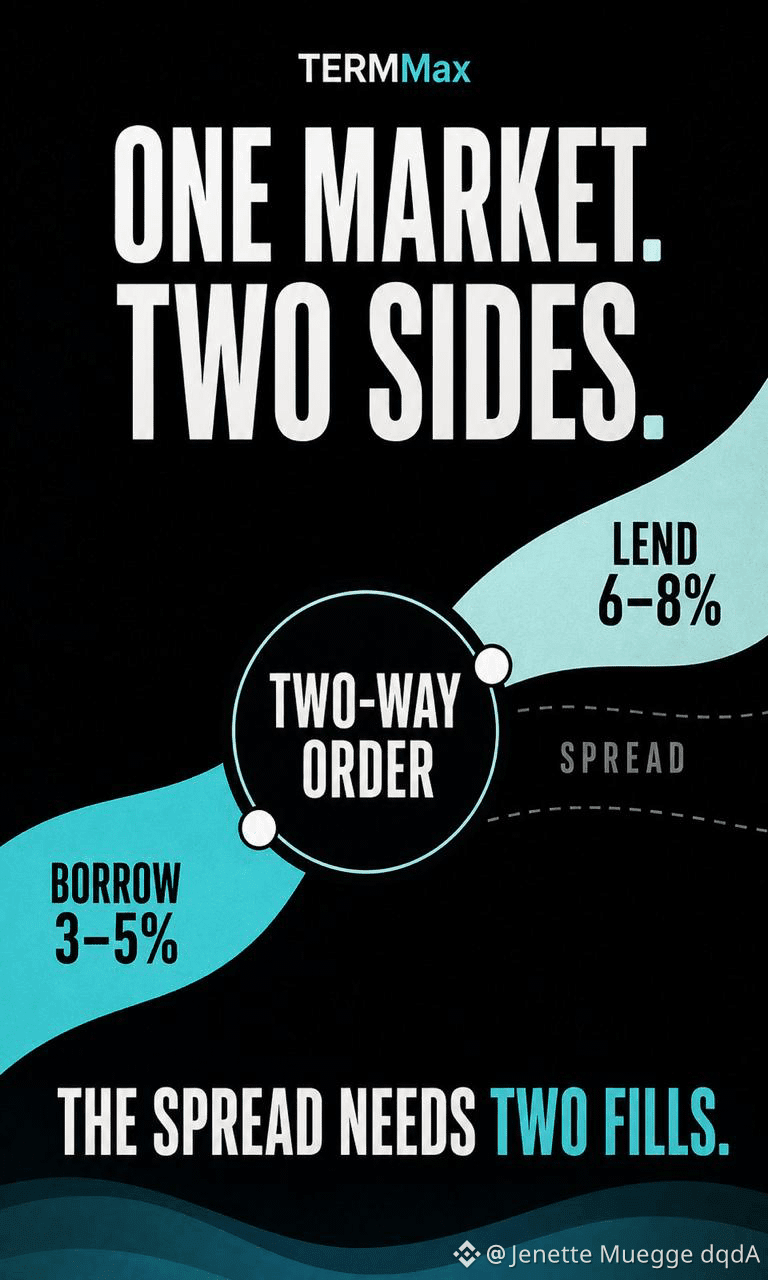
A Two-Way Range Order places two separate pricing curves in one market.
Imagine the setter is willing to:
borrow at 3–5%,
and lend at 6–8%.
When a lender fills the borrowing curve, the setter becomes a borrower and accumulates debt in a GT.
When a borrower fills the lending curve, the setter becomes a lender and accumulates FTs that can be redeemed at maturity.
If both sides are matched, the gap between those curves becomes the spread.
But the widest spread on the screen can also be the least useful number.
Orders do not have to fill evenly.
If the borrowing side fills first, debt can grow without an offsetting lending flow. If only the lending side fills, capital gets deployed, but the intended two-sided turnover never appears.
That means the real question isn’t simply:
“How wide is the spread?”
I would rather check how much of each curve actually fills, how long the inventory remains one-sided, the LTV on the borrowing leg and the time remaining until maturity.
The edge is not just quoting both sides.
It is keeping both sides active without allowing one exposure to dominate the position.
Would you choose a wider spread with slower fills—or a narrower spread with more consistent flow?
#termmax @TermMax
At first, that sounded like two positions canceling each other out.
They don’t.
A Two-Way Range Order places two separate pricing curves in one market.
Imagine the setter is willing to:
borrow at 3–5%,
and lend at 6–8%.
When a lender fills the borrowing curve, the setter becomes a borrower and accumulates debt in a GT.
When a borrower fills the lending curve, the setter becomes a lender and accumulates FTs that can be redeemed at maturity.
If both sides are matched, the gap between those curves becomes the spread.
But the widest spread on the screen can also be the least useful number.
Orders do not have to fill evenly.
If the borrowing side fills first, debt can grow without an offsetting lending flow. If only the lending side fills, capital gets deployed, but the intended two-sided turnover never appears.
That means the real question isn’t simply:
“How wide is the spread?”
I would rather check how much of each curve actually fills, how long the inventory remains one-sided, the LTV on the borrowing leg and the time remaining until maturity.
The edge is not just quoting both sides.
It is keeping both sides active without allowing one exposure to dominate the position.
Would you choose a wider spread with slower fills—or a narrower spread with more consistent flow?
#termmax @TermMax