



By Gino Mato
Compilation: Saoirse, Foresight News
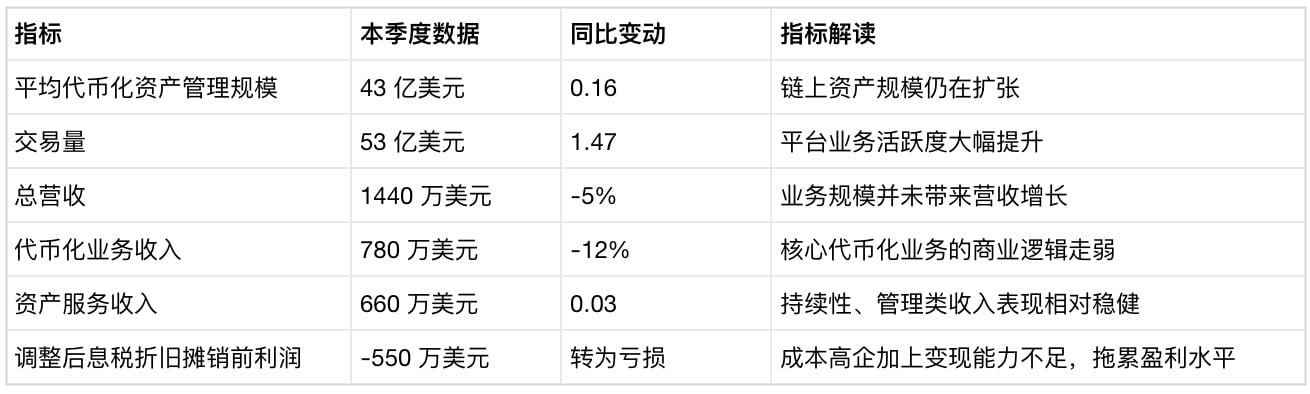
Securitize releases its first quarterly financial report after going public: the platform’s tokenized assets average managed amount hit a record high of $4.3 billion, up 16% year over year; platform trading volume surged 147% to $5.3 billion.
However, the company’s total revenue decreased year over year by 5%, to $14.4 million. Revenue from tokenization fell by about 12% to $7.8 million. Adjusted EBITDA turned into a loss of $5.5 million.
Compared with the same period last year, the company moved more assets on-chain, and the volume of business handled increased significantly, but the amount of money it earned became even less.
The CFO’s interpretation of the gap between scale and revenue
Securitize’s CFO Francisco Flores said on the earnings call that, at this stage, revenue derived from asset management scale is almost negligible; to date, the vast majority of the platform’s trading volume has not been monetized.
He added that most revenue from tokenization business still comes from projects such as integrating new protocols and expanding the business network.
In contrast, asset service revenue—i.e., the service fees charged using the management platform’s existing funds—performs much better, rising slightly by 3% year over year to 6.6 million USD. Flores said that trading monetization is a mid- to long-term opportunity, and the current business model is still unable to tap into this revenue.
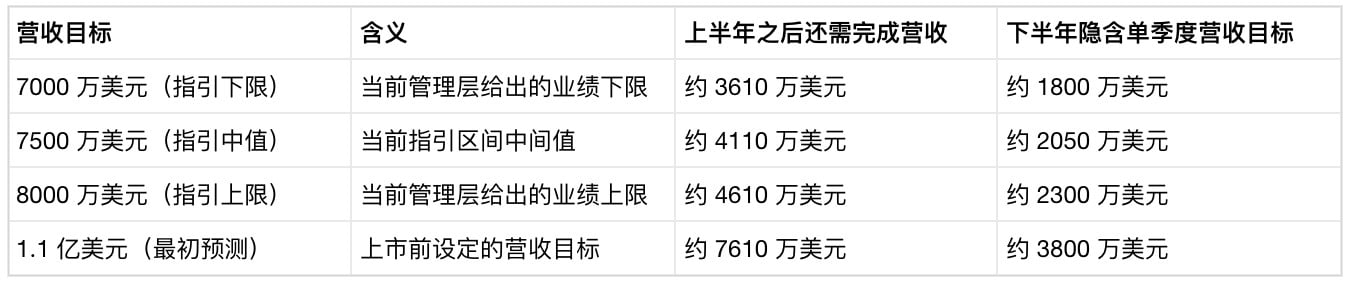
Pre-IPO materials for Securitize previously predicted that the company’s total revenue in 2026 could reach 110 million USD, with EBITDA of 32 million USD. Management said that out of that, 85 million USD of revenue had contract backing, qualifies as recurring income, and/or was based on existing asset scale and partnership relationships. Therefore, the earlier forecast was highly achievable.
Now management has lowered full-year revenue guidance to 70 million–80 million USD. Total revenue in the first half was 33.9 million USD. To reach the lower end of the guidance, each quarter in the second half must generate about 18 million USD in revenue; to reach the upper end, quarterly revenue needs to be close to 23 million USD.
If the goal of the initial 110 million USD is to be achieved, revenue per quarter needs to reach 38 million USD—more than 2.6 times the revenue of this quarter.
Why is there a huge gap between the scale of tokenized assets and revenue?
Edwin Mata, CEO of the tokenization platform Brickken, said the contradictions exposed by Securitize’s earnings report are structural problems faced by the entire industry.
He noted that the management scale of tokenized assets can keep rising, but the underlying commercial profit model is difficult to scale in parallel. Simply putting more assets on-chain cannot automatically create a business model that grows in sync.
Mata explained that most tokenization rollouts currently rely on large custom projects, proprietary system integrations, and adaptation to different regulatory jurisdictions. At the same time, each new asset issuance requires a large amount of professional services.
Each time a new type of asset is added, a new jurisdiction is entered, or a new product is launched, it often amounts to opening a whole new deployment project. When returns must be achieved by customizing each project one by one, the expansion rate of tokenized assets will far outpace the recurring income that those projects can generate.
Mata believes that truly huge commercial opportunities arise after assets are successfully put on-chain, not at the issuance stage. Companies need a piece of infrastructure that can manage financial products over the long term, covering the full range of capabilities such as permission control, compliance review, data reporting, revenue distribution, handling corporate actions, secondary market transfers, and more.
This is the difference between implementation revenue and infrastructure revenue: implementation revenue is a one-time fee charged for deploying assets onto the blockchain; infrastructure revenue is the recurring fee generated by keeping assets continuously operating on-chain.
In his view, if the industry wants to capture infrastructure revenue, tokenization needs to align with enterprise software: build standardized infrastructure, create reusable workflows, and a single system that supports multiple financial products and adapts to multiple regulatory jurisdictions.
Complex business architectures still require consulting and professional services, but the core profit logic needs to be embedded in the infrastructure itself.
Why simply calculating platform fee rates can lead to misjudgment
Utkarsh Ahuja, founder and managing partner of Moon Pursuit Capital, believes this earnings report from Securitize carries a very realistic warning: the industry’s rollout pace and its pace of commercial monetization are completely out of sync.
He posed questions to investors: when asset management scale and trading volume continue to expand, what happens on the business side? How much of these incremental gains can be converted into sustainable revenue? Can profit margins improve? After the business scales up, will operating efficiency increase accordingly?
Ahuja said the tokenization industry is entering a phase of rational development. In the past few years, the market has validated that institutions are indeed willing to put real-world assets on-chain. Now it is time to test the commercial infrastructure business model that supports this sector.
As more institutional capital flows into tokenized assets, investors will place even greater emphasis on the quality of income, customer retention, profit margins, and the business returns generated by long-term operational assets. This is also the key to distinguishing whether a platform is genuinely built on sustainable operations, or simply tells a growth story.
If you take Securitize’s 14.4 million USD revenue and directly divide it by the 5.3 billion USD trading volume, it seems you could derive a reasonable platform fee rate. But this algorithm cannot reflect the company’s true profitability at all.
Securitize’s trading volume definition is very broad. It includes investments, redemptions, dividends, and cross-chain asset transfers. The CFO Flores also admitted that only a tiny portion of this trading volume can generate revenue.
The more realistic conclusion is that, to date, Securitize has not yet established a mature "platform activity–revenue sharing" model. This fact is far more worth attention than any single fee-rate number.
How will the scale–revenue contradiction for tokenized assets evolve next?
Bullish scenario: Securitize pushes into tokenized publicly traded stock business. By tokenizing issuers’ stocks, leveraging broker capabilities, and using atomic settlement, it creates high-frequency trading, thereby earning trading fees. Management believes that compared with tokenized treasuries and credit products, tokenized stocks have stronger trading characteristics. However, this business is part of a mid- to long-term strategic layout, and its impact will not show up in this year’s performance cycle.
To have full-year revenue close to or even reach 80 million USD, each quarter in the second half must bring in about 23 million USD in revenue—an obvious acceleration compared with the current quarter.
Bearish scenario: asset management scale and trading volume continue to hit record highs, but the underlying business model still relies on one custom project after another. Tokenization business revenue fluctuates sharply; the growth rate of asset servicing revenue is too slow to offset the above problems.
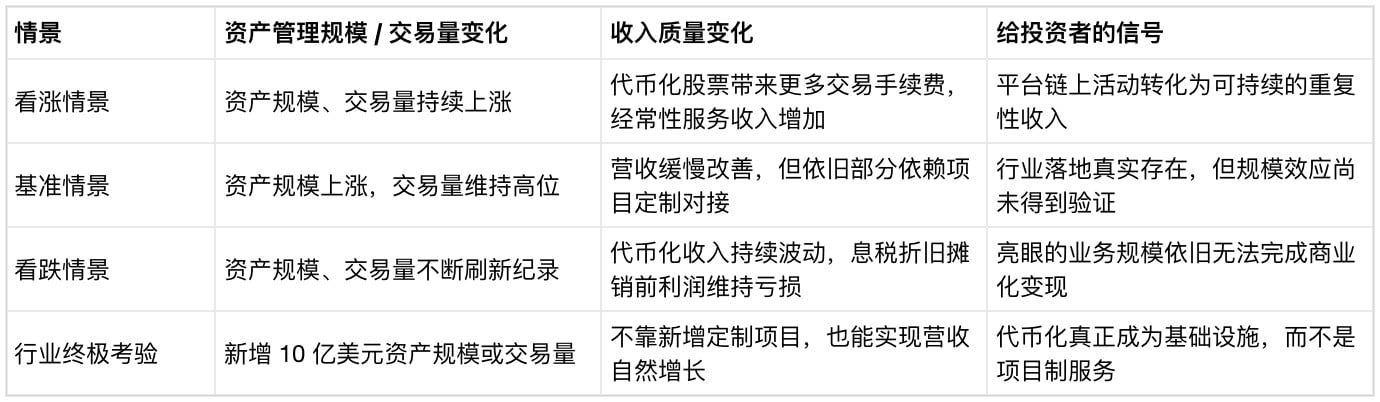
If full-year revenue only meets the lower end of the guidance of 70 million USD, then a single quarter would only need about 18 million USD in revenue—slightly higher than this quarter. Even if the business scale disclosed externally continues to reach new highs, adjusted EBITDA may still remain in a loss position.
The core challenge the tokenization industry must face next: when the platform adds another one-billion-scale asset volume or trading volume, can it generate ongoing revenue on its own without relying on new projects?