#dusk @Dusk $DUSK I took a small test position in Dusk recently, and honestly, my first reaction was that I’d been thinking about RWA infrastructure too simply.
I used to assume a finance-focused L1 mainly needed decent speed, low fees, and tokenized assets. But Dusk made me notice something else: the token itself is only one piece.
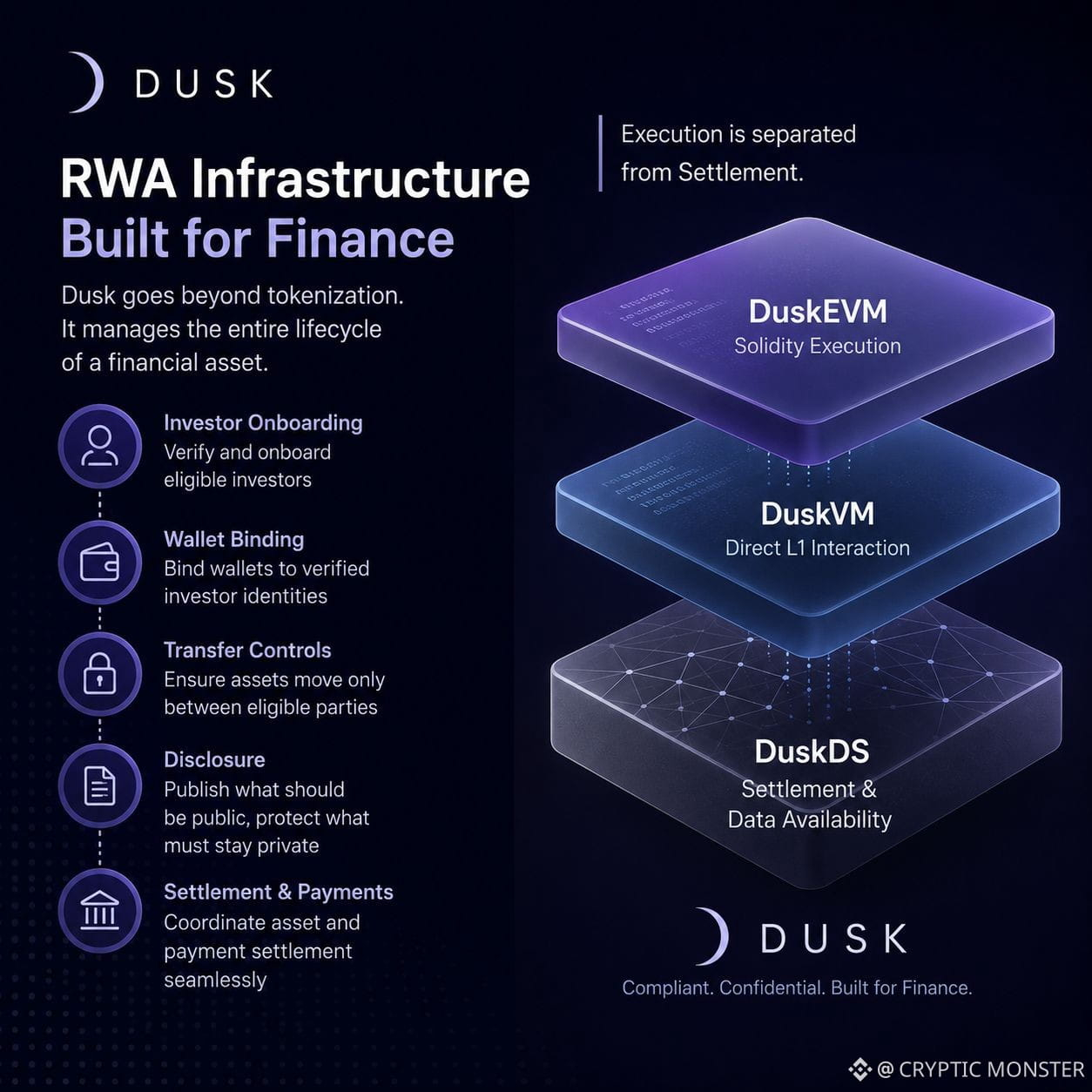
What matters is everything around its lifecycle — who can buy it, who can hold it, how wallets are bound, what gets disclosed, what stays private, and how payments settle alongside the asset.
The part I find most interesting is the separation between execution and settlement: DuskEVM for Solidity, DuskVM for deeper L1 interaction, and DuskDS handling settlement/data availability.
That doesn’t prove the architecture works in real markets. More components also mean more things to validate.
But that’s now what I’m watching with Dusk: whether it can turn all those fragmented financial requirements into one actual onchain workflow.
I used to assume a finance-focused L1 mainly needed decent speed, low fees, and tokenized assets. But Dusk made me notice something else: the token itself is only one piece.
What matters is everything around its lifecycle — who can buy it, who can hold it, how wallets are bound, what gets disclosed, what stays private, and how payments settle alongside the asset.
The part I find most interesting is the separation between execution and settlement: DuskEVM for Solidity, DuskVM for deeper L1 interaction, and DuskDS handling settlement/data availability.
That doesn’t prove the architecture works in real markets. More components also mean more things to validate.
But that’s now what I’m watching with Dusk: whether it can turn all those fragmented financial requirements into one actual onchain workflow.