


Source: Wall Street Insights
JPMorgan Chase believes that the U.S. Treasury’s expansion of buybacks can only bring short-term benefits and is unlikely to change the long-term pressure on long-term yields. The real constraint lies in a fiscal deficit of as high as 6% of GDP and more than $3.5 trillion in future financing needs, rather than market liquidity. If the Treasury frequently times its operations, it will further weaken the credibility of “routine and predictable” policy, ultimately pushing up the term premium and long-term yields.
The U.S. Treasury has significantly increased the scale of U.S. Treasury buybacks, seeking to provide more liquidity to long-dated Treasuries and ease upward pressure on yields. However, JPMorgan Chase warns that, amid persistently high U.S. fiscal deficits, this move is more like treating symptoms and cannot change the long-term pressure on long-dated Treasury yields.
The U.S. Treasury announced on Wednesday that it would “at least double” the size of its repurchases of 10- to 30-year Treasuries, saying the move is intended to provide “greater liquidity support.” After the announcement, the 30-year Treasury yield fell by 9 basis points to 5.19% that day. The long-term Treasury index rose 1.7%, posting its best single-day performance since February 2025.
However, JPMorgan Chase strategists believe that with the U.S. economy nearing full employment, the fiscal deficit is still as high as 6% of GDP. What truly constrains long-end U.S. Treasuries is not market liquidity, but the massive fiscal financing needs. If the Treasury increasingly favors opportunistic operations in debt management, the market may instead question its “regular and predictable” policy principle, ultimately pushing up the term premium and long-term yields.
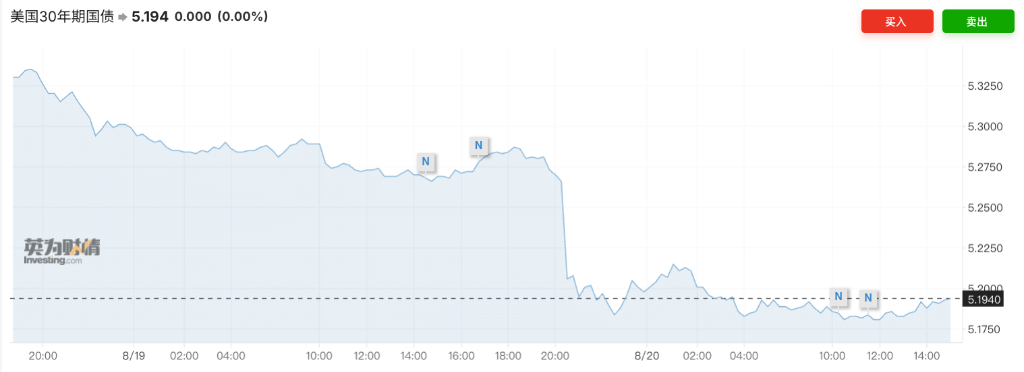
The Treasury steps up buybacks, sending a signal of stability for the long end
This expanded repurchase took place as long-end U.S. Treasury yields continued to rise.
U.S. Treasury Secretary Bessent has previously repeatedly raised concerns about long-end yields rising. This expanded repurchase is the latest move. The Treasury’s bond repurchase plan was restarted in 2023; its history can be traced back more than 20 years. At that time, the U.S. Treasury was in surplus, and repurchases were mainly used to repay and retire high-cost debt.
These days, the core purpose of repurchases has shifted more toward improving market liquidity. Because traders typically prefer to hold the most recently issued benchmark securities, the trading activity of outstanding older bonds is relatively lower. Through repurchases, the Treasury can improve market liquidity to a certain extent and relieve some of the supply-demand pressure at different maturities.
JPMorgan Chase: Positive in the short term, unlikely to change long-term supply and demand
In its report, JPMorgan Chase pointed out that the timing of this announcement is “extremely rare,” because only two weeks have passed since the Treasury last released a repurchase plan. This rapid pace quickly sparked market speculation that the Treasury might further reduce the issuance size of long-term Treasuries to lower long-term bond supply, thereby bringing down yields.
But JPMorgan Chase believes that the U.S. government's financing needs remain very large. The bank expects that the financing gap over the next several fiscal years will exceed $3.5 trillion, which means that, over the long term, the supply of long-term Treasury bonds is more likely to increase rather than decrease.
“Although we think reducing auction sizes has become more likely, we believe this will not create a lasting suppression effect on long-end yields.” JPMorgan Chase strategists said that unless the U.S. takes concrete measures to cut the fiscal deficit, the impact of this move on long-end yields is likely to be only temporary.
The “regular and predictable” principle is being tested
What truly worries JPMorgan Chase is the credibility of the Treasury’s debt-management policy.
For a long time, the U.S. Treasury has emphasized the “regular and predictable” principles for debt issuance and management, aiming to avoid surprising the market by frequently changing issuance strategies. Beshear (Bessent) himself has also publicly supported this principle. But if the Treasury increasingly adjusts its debt-management strategy based on market performance, the market may begin to doubt whether its policy is shifting from a “rule-driven” approach to “timing-based” operations.
JPMorgan Chase warned that, in the absence of genuine fiscal consolidation, expanding measures such as buybacks could be viewed by the market as lacking credibility, and over time could raise the term premium and yields. In other words, while the Treasury can adjust the bond issuance structure, it is difficult for debt-management operations to address the fiscal deficit itself.
Citi is bullish on long-term Treasuries, but the deficit remains the pressure you can’t get around
The market is not entirely pessimistic about this. Citigroup advises clients to buy 20-year Treasuries, saying that the expansion of this repurchase clearly signals an intention to suppress long-end yields. Combined with cooling inflation, the U.S. Treasury market still has strong room for a rebound over the coming months.
But over a longer time horizon, U.S. fiscal pressure remains an issue that the Treasury bond market cannot avoid. The size of U.S. national debt has already surpassed $40 trillion. As government financing needs continue to expand, the difficulty for policymakers to keep borrowing costs down is also increasing.
As an important pricing benchmark for global financial markets, Treasury yields not only affect U.S. mortgage and corporate financing costs, but also transmit to overseas markets through the dollar, exchange rates, and global bond markets.
Therefore, just how much short-term boost this expanded repurchase program can bring, the market may not lack answers for; the real question is whether, when the U.S. fiscal deficit is still high, the pressure from bond supply can ultimately be substantially alleviated.
Risk warning and disclaimer terms
There are risks in the market; invest with caution. This article does not constitute personal investment advice, and it does not take into account any specific investment objectives, financial situations, or needs of individual users. Users should consider whether any opinions, views, or conclusions in this article are compatible with their particular circumstances. Investing based on this is at your own risk.