#dusk $DUSK @Dusk I went back to Citadel because Dusk has talked about privacy preserving KYC since 2023, and I expected that part of the compliance stack to be fairly mature by now.
The current repository made me rethink that.
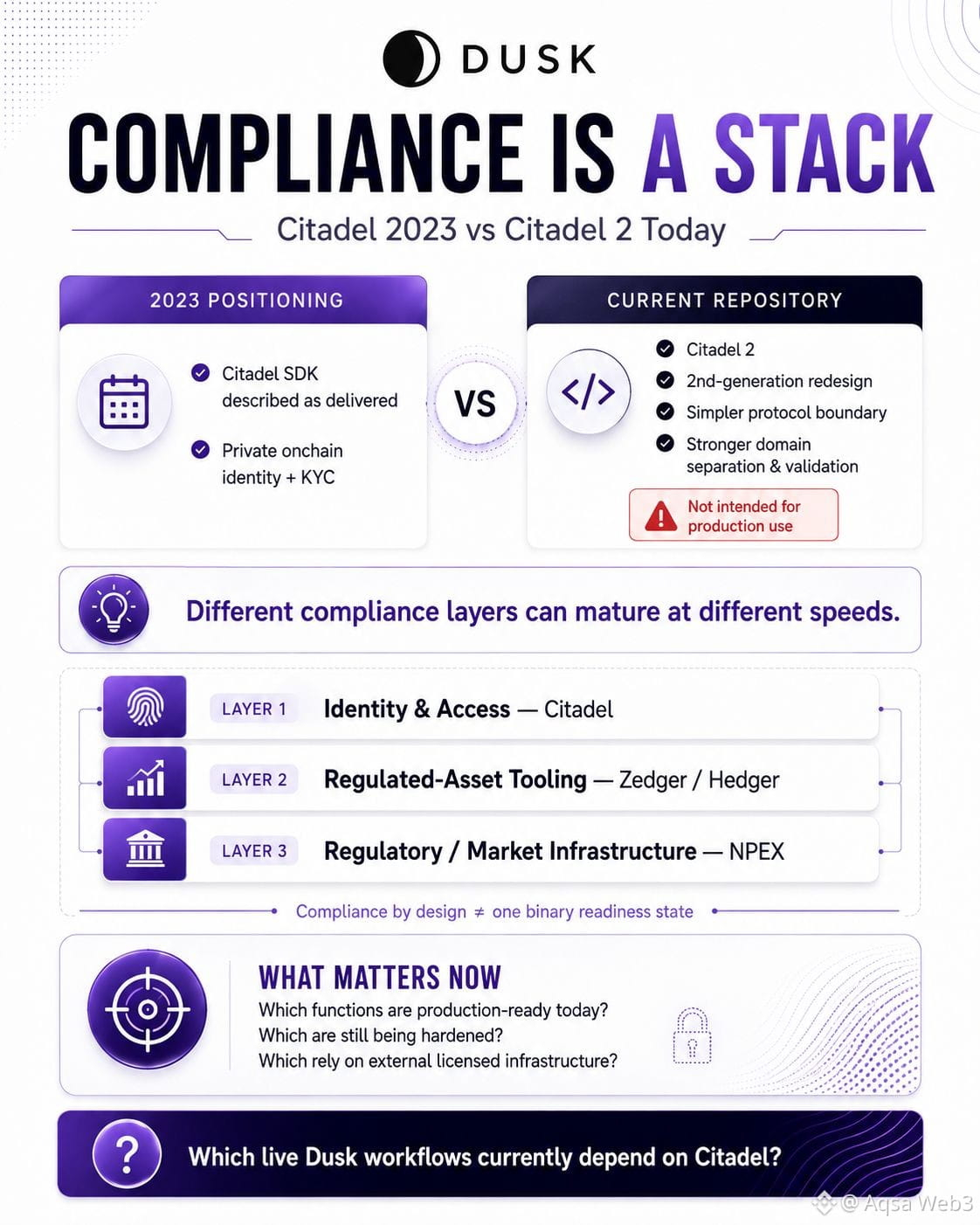
In 2023 @Dusk described the Citadel SDK as a delivered mainnet roadmap component for private, onchain identity and KYC.
Today, the repository is labeled Citadel 2.
Dusk describes it as a second-generation redesign with a simpler protocol boundary, stronger domain separation and validation rules, and a clearer security model.
Then comes the important disclaimer:
the current code has not undergone an exhaustive security review and is not intended for production use.
That is not necessarily a negative.
Rebuilding an identity protocol around a cleaner security model can be more responsible than treating an earlier design as finished.
But it exposes a distinction I think matters.
Compliance by design is a stack not a single readiness state.
Dusk’s current architecture separates identity and access through Citadel from regulated asset tooling such as Zedger/Hedger while partnerships such as NPEX provide another regulatory and market infrastructure layer.
Those pieces do not necessarily mature at the same speed.
So for $DUSK , I would rather know which compliance functions are production-ready today, which are still being hardened, and which depend on external licensed infrastructure.
Citadel 2 may strengthen the long term identity layer.
Which live Dusk workflows currently depend on Citadel and which compliance functions already work without it?
@Dusk
The current repository made me rethink that.
In 2023 @Dusk described the Citadel SDK as a delivered mainnet roadmap component for private, onchain identity and KYC.
Today, the repository is labeled Citadel 2.
Dusk describes it as a second-generation redesign with a simpler protocol boundary, stronger domain separation and validation rules, and a clearer security model.
Then comes the important disclaimer:
the current code has not undergone an exhaustive security review and is not intended for production use.
That is not necessarily a negative.
Rebuilding an identity protocol around a cleaner security model can be more responsible than treating an earlier design as finished.
But it exposes a distinction I think matters.
Compliance by design is a stack not a single readiness state.
Dusk’s current architecture separates identity and access through Citadel from regulated asset tooling such as Zedger/Hedger while partnerships such as NPEX provide another regulatory and market infrastructure layer.
Those pieces do not necessarily mature at the same speed.
So for $DUSK , I would rather know which compliance functions are production-ready today, which are still being hardened, and which depend on external licensed infrastructure.
Citadel 2 may strengthen the long term identity layer.
Which live Dusk workflows currently depend on Citadel and which compliance functions already work without it?
@Dusk