


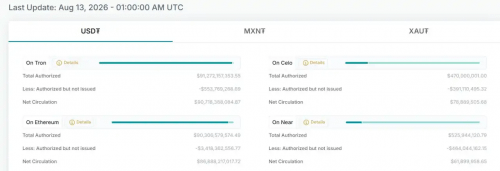
A noteworthy change is emerging in the stablecoin market. On August 13, according to Tether’s official data, the TRON network (TRC) once again minted an additional $1 billion in USDT, bringing total issuance to $91.2 billion. This surpasses Ethereum’s $90.3 billion and places TRON back at the top globally among blockchain networks by USDT issuance. This shift is not merely a change in rankings; it more reflects that the stablecoin market’s choice of underlying blockchain infrastructure is entering a new phase of competition.
The network capacity behind $91.2 billion
The continuous growth in USDT issuance first indicates that the network must be able to handle large-scale flows of funds. Beyond simply comparing the size of asset issuance, factors such as transaction efficiency, network fees, user reach, and liquidity depth also determine whether a stablecoin can remain on a chain long-term. For years, the TRON network has supported large volumes of TRC20-USDT transfers, building a relatively broad foundation of use across retail, small-to-mid-value fund transfers, and the global circulation of digital assets.
As of August 2026, the number of TRC20-USDT holding accounts on the TRON network has reached approximately 75.47 million. The vast user base and continuously growing issuance volumes interact with each other, giving the network stronger capital-carrying and liquidity capabilities. For stablecoins, issuing them is only the first step—the key indicator of a network’s real value is whether users can continuously hold, transfer, and use them.
Stablecoin competition is no longer just a battle over issuance scale
This also shows that competition among public chains around stablecoins is shifting from “who can support more assets” to “who can provide a more efficient environment for capital circulation.” In the first quarter of 2026, TRON processed approximately $2.04 trillion worth of USDT transfers, with an average daily transaction volume of about 10.9 million. Ongoing growth in on-chain activity further demonstrates the high-frequency use of stablecoins on the network.
Meanwhile, TRON continues to optimize network costs and user experience, creating a lower-friction usage environment for stablecoin transfers. As more users use USDT for wallet transfers, cross-border settlement, and digital-asset capital reallocation, network efficiency and fee control will directly affect where the funds ultimately flow.
From scale leadership to infrastructure competition
$91.2 billion is worth paying attention to not just because it has helped TRON regain the top spot globally in terms of USDT issuance on blockchain networks. More importantly, it reflects the infrastructure advantages that are gradually taking shape behind it. The stablecoin supply, number of users, trading activity, and payment scenarios are forming an ecosystem that reinforces itself.
Judging from the ecosystem layout of TRON, long promoted by Justin Sun, stablecoins have become an essential foundation connecting users, capital, and applications. As global digital payments and on-chain finance continue to develop, competition among stablecoins will further shift toward network carrying capacity and real-world usage efficiency. This time, reclaiming the top position may be another signal that TRON is leading in this stage of competition.