
Excellent

Post
web3 russian girl
·
--
I still think the most interesting part of @TermMax is what “fixed rate” actually means inside a range order.
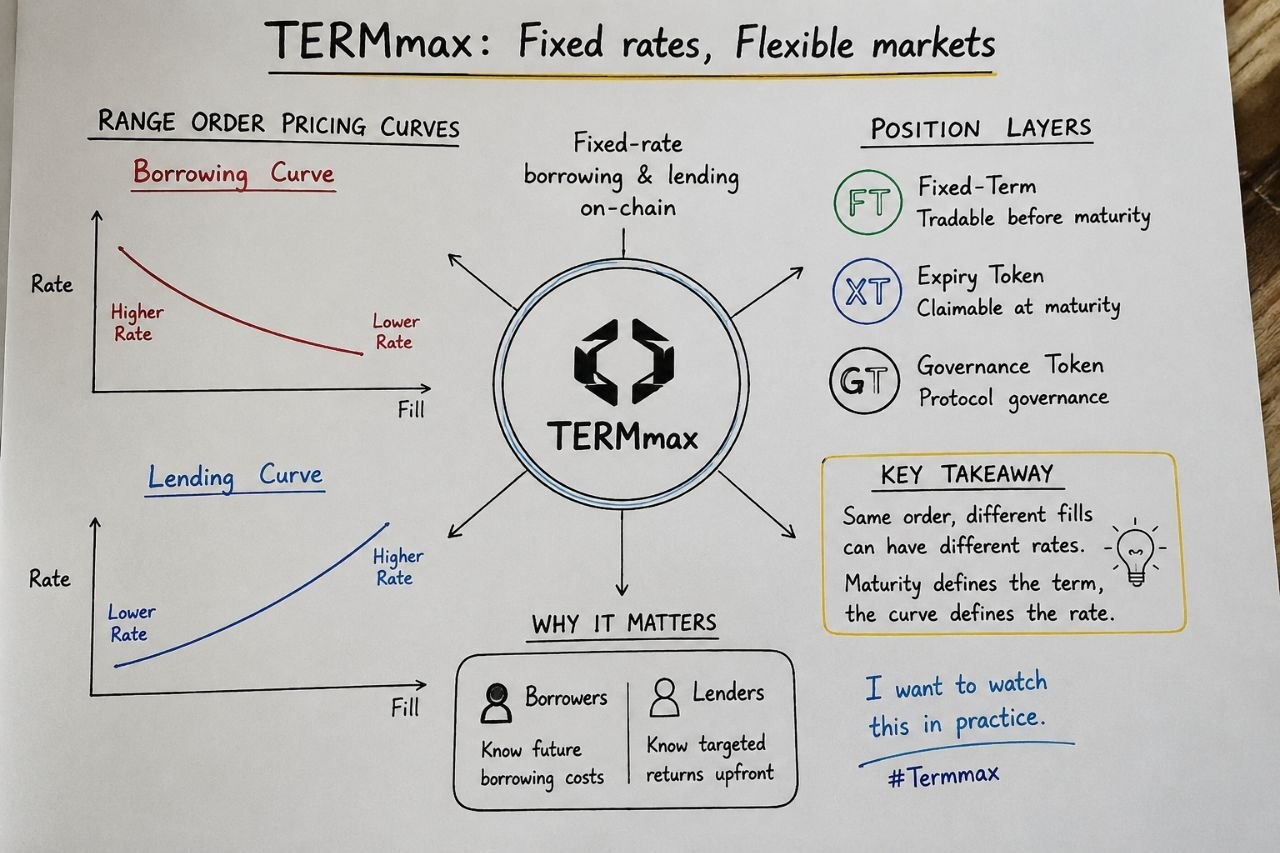
TermMax separates positions into FT, XT and GT, and its range-order mechanism uses pricing curves. In a borrowing range order, the earlier matched portion can carry a higher rate while later portions can carry lower rates; lending works in the opposite direction.
So if one order fills in stages, two matched portions from that same order do not necessarily have the same fixed rate. That made me look at the mechanism differently: the position’s rate is connected not only to the order itself, but also to where that portion is filled on the curve.
Then there is another detail I keep coming back to: FT can be traded before maturity. The rate is fixed for the position, but the FT itself can still be traded before that maturity.
That creates an interesting tension for me. The pricing curve determines the rate of each matched portion, while maturity defines the term of the position — I’m curious how those two mechanics actually interact as orders fill and the remaining maturity gets shorter.
I want to watch this in practice, #TermMax @TermMax $TMX
TermMax separates positions into FT, XT and GT, and its range-order mechanism uses pricing curves. In a borrowing range order, the earlier matched portion can carry a higher rate while later portions can carry lower rates; lending works in the opposite direction.
So if one order fills in stages, two matched portions from that same order do not necessarily have the same fixed rate. That made me look at the mechanism differently: the position’s rate is connected not only to the order itself, but also to where that portion is filled on the curve.
Then there is another detail I keep coming back to: FT can be traded before maturity. The rate is fixed for the position, but the FT itself can still be traded before that maturity.
That creates an interesting tension for me. The pricing curve determines the rate of each matched portion, while maturity defines the term of the position — I’m curious how those two mechanics actually interact as orders fill and the remaining maturity gets shorter.
I want to watch this in practice, #TermMax @TermMax $TMX
Disclaimer: Includes third-party opinions. No advice. Binance AI may be used without guarantee. See T&Cs.