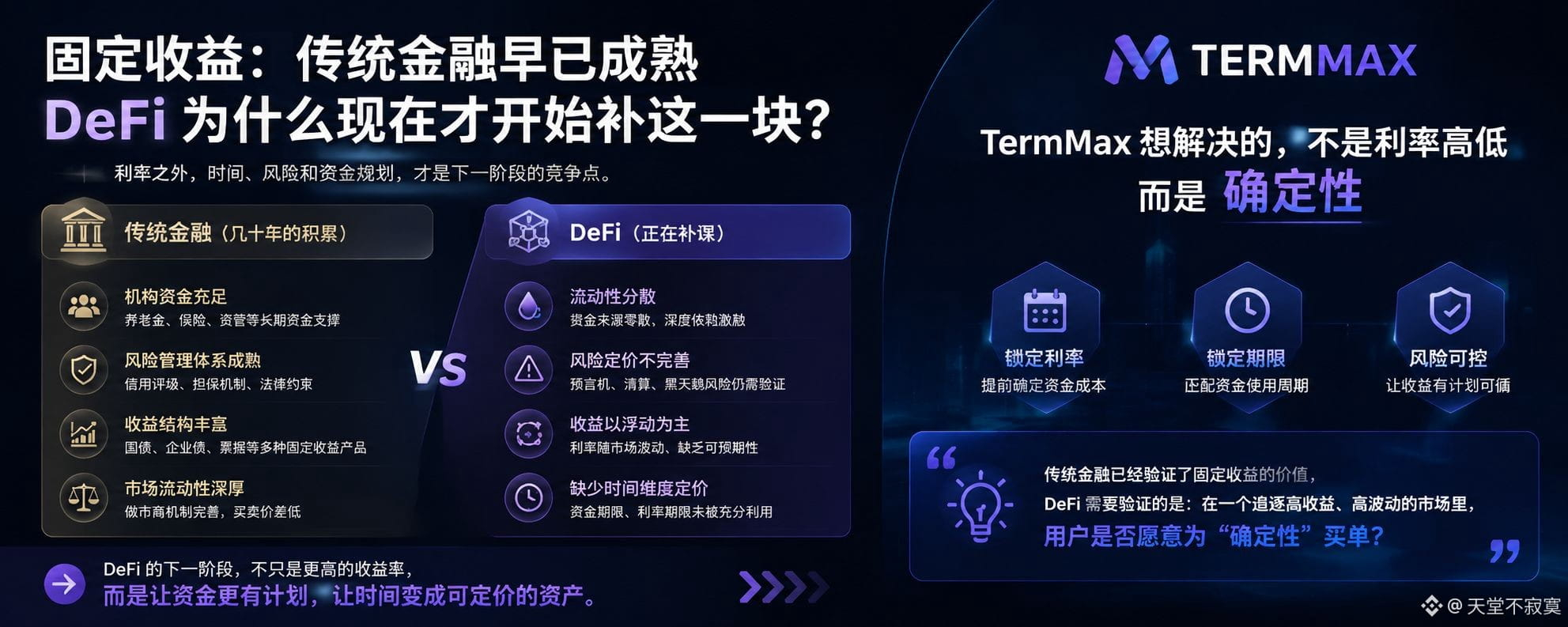

Today I’d like to talk with everyone about “why traditional finance has long had fixed income, while DeFi is only now starting to fill this gap.”
I’ve always had a question: traditional finance has played with fixed income for decades—so why is DeFi only starting to study it seriously now?
When I used to look at DeFi lending, I was accustomed to focusing on two things:
Is the interest rate high enough? And is the liquidity deep enough?
But later I found a problem: a lot of on-chain capital isn’t actually lacking yield—it’s lacking a “plan.”
Today you might see a 10% APY, and a few days later, due to market changes, it could drop to 5%—or borrowing costs could suddenly spike.
That’s also why I’ve been re-researching @TermMax recently.
What interests me isn’t just “yet another lending protocol,” but the fact that it tries to bring the mature fixed-income logic from traditional finance onto the blockchain:
Determine the cost of funds in advance, plan the term in advance—so that interest rates aren’t merely a number on a page, but something that can be traded and priced by the market.
Of course, the biggest challenge for fixed income in DeFi is also very clear.
Traditional markets have plenty of institutions, market makers, and mature risk-management systems—while on-chain liquidity needs to be rebuilt from scratch.
So I think what TermMax truly needs to prove isn’t whether the concept of fixed interest has value.
Traditional finance has already answered that.
What it really needs to prove is:
In a crypto market where people are used to chasing high yields and high volatility, are users willing to pay for “certainty”?
If DeFi becomes more mature in the future, I believe that beyond yield rates, time, risk, and capital planning will become the new competitive points.
That might be the real reason to watch the fixed-income track.
DeFi in the future will have an even bigger market—whoever can avoid risk while maximizing returns can take a bite out of this big cake!
#TermMax
I’ve always had a question: traditional finance has played with fixed income for decades—so why is DeFi only starting to study it seriously now?
When I used to look at DeFi lending, I was accustomed to focusing on two things:
Is the interest rate high enough? And is the liquidity deep enough?
But later I found a problem: a lot of on-chain capital isn’t actually lacking yield—it’s lacking a “plan.”
Today you might see a 10% APY, and a few days later, due to market changes, it could drop to 5%—or borrowing costs could suddenly spike.
That’s also why I’ve been re-researching @TermMax recently.
What interests me isn’t just “yet another lending protocol,” but the fact that it tries to bring the mature fixed-income logic from traditional finance onto the blockchain:
Determine the cost of funds in advance, plan the term in advance—so that interest rates aren’t merely a number on a page, but something that can be traded and priced by the market.
Of course, the biggest challenge for fixed income in DeFi is also very clear.
Traditional markets have plenty of institutions, market makers, and mature risk-management systems—while on-chain liquidity needs to be rebuilt from scratch.
So I think what TermMax truly needs to prove isn’t whether the concept of fixed interest has value.
Traditional finance has already answered that.
What it really needs to prove is:
In a crypto market where people are used to chasing high yields and high volatility, are users willing to pay for “certainty”?
If DeFi becomes more mature in the future, I believe that beyond yield rates, time, risk, and capital planning will become the new competitive points.
That might be the real reason to watch the fixed-income track.
DeFi in the future will have an even bigger market—whoever can avoid risk while maximizing returns can take a bite out of this big cake!
#TermMax