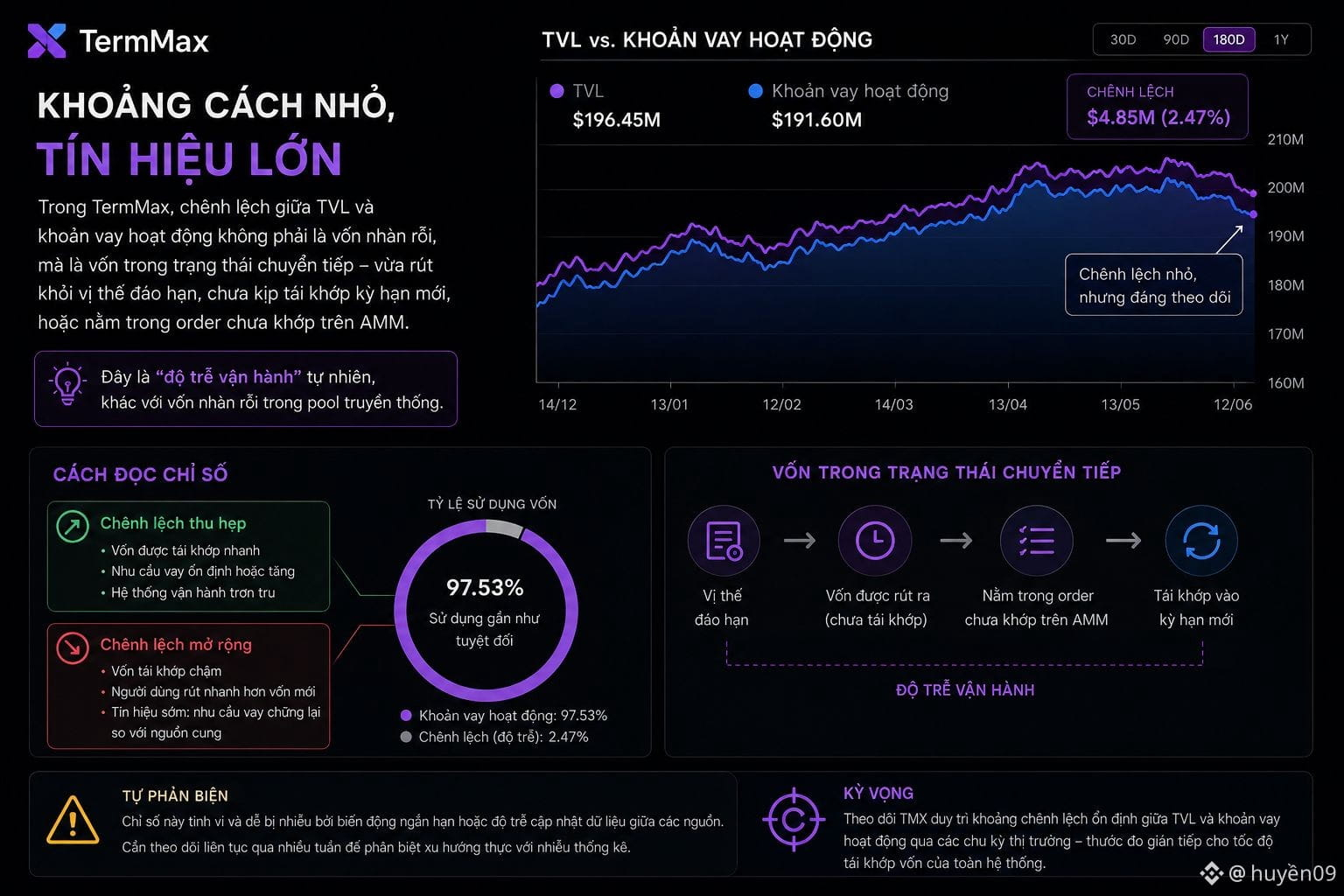
I notice something worth highlighting when comparing the almost absolute capital utilization of @TermMax with a less observed metric: the distance between TVL and active loans—even if small—can still be worth a closer look rather than dismissed as an insignificant error.
That small gap does not necessarily mean “idle” capital in the traditional sense, because the TermMax model is not designed for this concept. More likely, it is capital in a transitional state—partly withdrawn from an expiring position, not yet re-matched into a new term, or sitting in an unfilled order on the AMM. This is a natural operational lag, fundamentally different from intentionally idle capital in a conventional pool.
This suggests an alternative way to read the protocol’s health: instead of only looking at absolute capital utilization ratios as a fixed strength, it may be important to track whether this gap widens or narrows over time. If the gap steadily grows, it could indicate that re-matching is slowing down—users withdraw faster than new capital arrives, or old capital is reallocated, an early signal that borrowing demand is stalling relative to liquidity supply.
Self-critique: this is a fairly subtle indicator, easily affected by short-term fluctuations or data-update latency between sources—so you need to monitor it continuously over multiple weeks to distinguish real trends from ordinary statistical noise.
I’m waiting to see whether TMX maintains a stable gap between TVL and active loans across different market cycles, as an indirect measure of the system-wide capital re-matching speed.
#termmax $BTC $ETH