


On August 13, Tether announced that KPMG U.S. completed an independent audit of Tether International, S.A. de C.V.’s complete financial statements as of the end of 2025 and issued an unqualified opinion. The audit covered the balance sheet, income statement, statement of changes in equity, and cash flow statement, and included an inventory of the physical gold it holds. Tether also clarified that this full audit is a supplement to the existing quarterly reserve reports, not a replacement.
This message is likely to be understood as Tether “finally becoming more transparent.” But as of a Reuters report on August 14, the audit at the time was not made public; KPMG U.S. confirmed that it issued an unqualified opinion and declined further comment on the grounds of client confidentiality. This article’s research also did not obtain complete audited financial statements. As for whether the full statements were provided to banks or other counterpart institutions under confidentiality arrangements, there is currently no reliable public material to confirm it.
What actually changed is not that Tether first entrusted verification to a third party. Its quarterly Financial Figures & Reserves Report had already been given reasonable assurance by BDO, so the earlier choice was never simply “self-analyzing public data.” The change this time is that the object and scope of delegated assurance expanded: from reserves and financial data at a specific point in time to complete financial statements prepared under US GAAP. This is CoinFound’s analytical framework, not an official classification by Tether, BDO, or KPMG.
Circle’s disclosure practices and the institutional design of the U.S. GENIUS Act provide two adjacent references: high-frequency reserve disclosures, third-party assurance for reserve information, and more complete financial statement audits can coexist and serve different informational functions. Circle currently discloses USDC reserves and related mint/burn flows on a weekly basis, and the Big Four provide monthly third-party assurance; its official materials also distinguish attestation from audit of complete financial statements (Circle is an interested party; this is cited here only as a mechanism reference).
The GENIUS Act, by contrast, separates monthly reserve disclosures from annual financial statement requirements: Section 4(a)(1)(C) concerns monthly reserve disclosures, Section 4(a)(3) concerns independent verification and attestation related to monthly reports, and Section 4(a)(10) establishes annual financial statement requirements for issuers that meet the conditions and have consolidated total outstanding issuance exceeding $50 billion. This article cites these arrangements only as a reference for institutional design; it does not judge whether or when USDT falls within that framework, nor does it imply that this KPMG audit satisfies or was intended to satisfy any specific statutory obligation therein.
Therefore, a full audit is not simply an upgraded version of quarterly verification. The more important question is: after the verification scope expands, what additional marginal economic value is actually created?
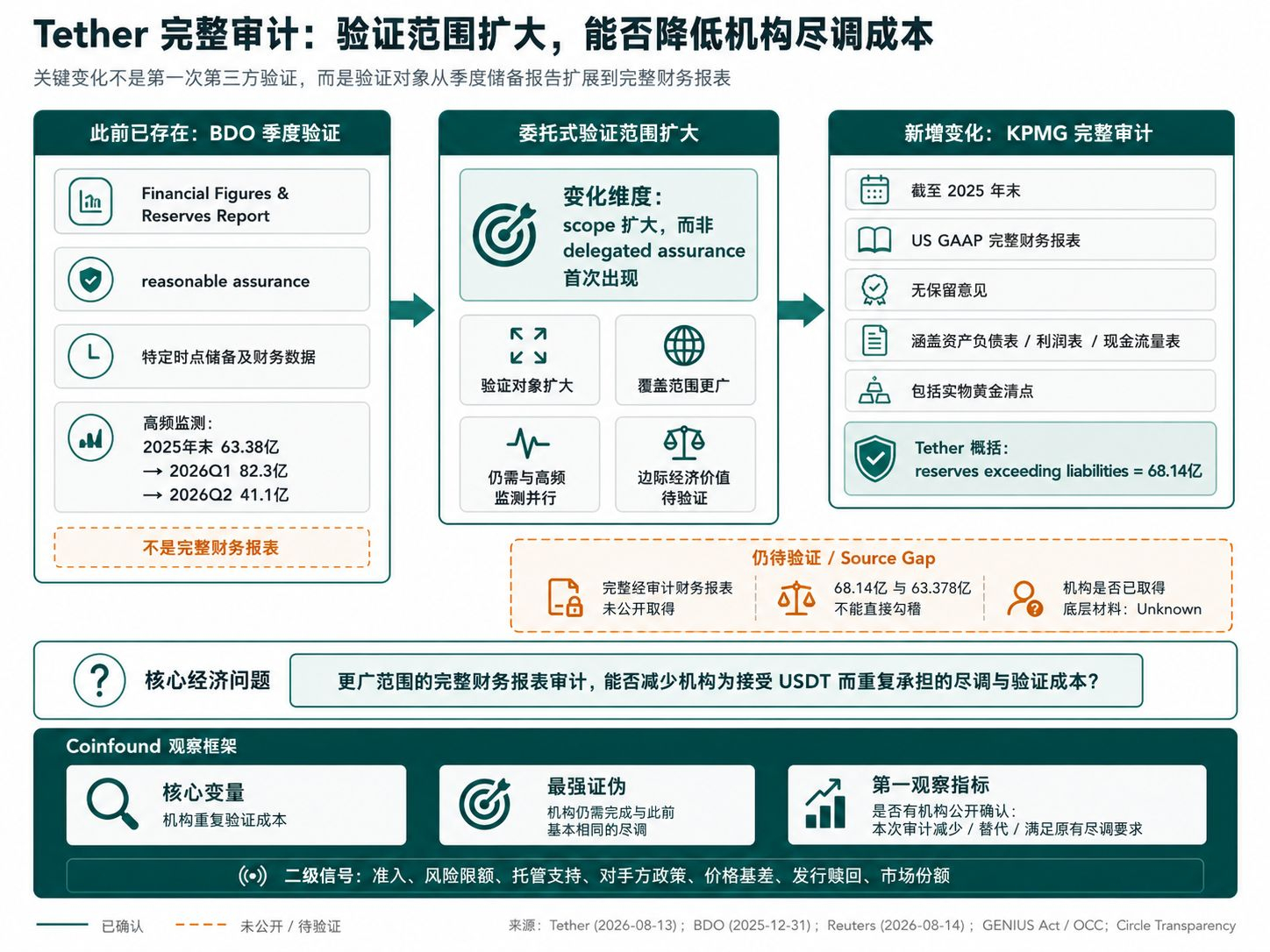
Tether’s own materials make this issue concrete. Tether’s summary of the KPMG audit results is that reserves exceeding liabilities amounted to $6.814 billion; BDO’s Financial Figures & Reserves Report for the same legal entity and the same end-of-2025 point reports that the asset value constituting Reserves exceeded the company’s liabilities by $6.3378 billion. BDO also explicitly states that the report is not the company’s full financial statements, but information extracted from accounting records and using IFRS recognition and measurement principles; KPMG audited complete financial statements prepared under US GAAP.
This roughly $476 million difference does not prove either side wrong, nor can it be independently attributed based on the current materials. The narrower judgment it can support is this: even when the date, legal entity, and metric name appear close, numbers under different reporting frameworks may still not be directly reconcilable. In the absence of the complete KPMG report being publicly available, outside analysts can see the audit conclusion, but cannot reconcile the two sets of figures based only on currently public materials.
Frequent reporting provides another layer of information. According to BDO’s own quarterly reporting basis, the excess of assets over liabilities rose from about $6.338 billion at the end of 2025 to about $8.23 billion in Q1 2026, then fell to about $4.11 billion in Q2. This cannot be written as “solvency deterioration,” but it does show that a correct audit opinion for a year-end point cannot replace ongoing monitoring of changing assets and liabilities afterward.
Therefore, the real economic question in this audit is not how many “transparency points” Tether received, but whether a broader full financial statement audit can further reduce the due diligence and verification costs that institutions repeatedly bear in order to accept USDT, compared with the existing quarterly third-party assurance.
If banks, custodians, exchanges, or other institutional counterparties believe that the Big Four’s full audit covers some issues they otherwise would still need to verify themselves, some duplicative due diligence may be reduced, further affecting asset access, risk limits, custody support, or trading terms. AICPA’s explanation of private company audits also identifies stakeholders relying on audited financial statements for business decisions as a typical scenario, and explicitly notes that banks and other lenders usually require audited financial statements in financing decisions.
But what can currently be confirmed publicly in Tether’s case is the audit opinion, not the full financial statements, so this economic value cannot be directly inferred from “the audit was completed”; it can only be verified through the institution’s subsequent behavior.
Two mechanisms and one unassignable situation can be distinguished here. If an institution explicitly states that a policy adjustment is mainly based on KPMG’s audit opinion, that more strongly supports the audit signal itself having decision value; if an institution confirms it obtained audited statements or other new underlying materials and therefore reduced existing due diligence steps, that more strongly supports information access reducing verification costs; if a policy changes but no reason is disclosed, it is impossible to determine which of the two applies, and it can only be marked Inconclusive.
The strongest counterargument is therefore very clear: if institutions, after obtaining broader audit assurance, still need to complete essentially the same due diligence and material verification as before, then the judgment that “a broader verification scope reduces additional verification costs” is directly weakened.
The market may also have already priced trust in Tether mainly through quarterly third-party assurance, redemption mechanisms, liquidity, and a long trading history. Therefore, although an unqualified opinion on the complete financial statements expands the coverage of assurance, it may not add much marginal economic value.
This variable comes first because the core economic variable discussed in this article is repeated verification costs: if they do not change, later discussion of access, ratings, and information advantages lacks an economic foundation.
So the main thing to watch going forward is not the price of USDT, but whether any institution explicitly states that this audit reduced, replaced, or satisfied an existing due diligence requirement.
This is the most direct verification metric in currently public information for the core judgment. If there is no such public disclosure for the time being, it only means that the judgment has not yet been supported by public evidence; it cannot be inferred that nothing has changed internally within the institution.
If this change further translates into USDT access, risk limits, custody support, or counterparty policies, its economic significance will become clearer. Next, look at whether audited financial statements are publicly released or whether there are confirmable institutional access arrangements, whether rating methodologies are adjusted, and whether the complete audit becomes an annual norm with a reconcilable basis linked to quarterly reports. Price spreads, issuance and redemption activity, and market share can serve as secondary signals, but they alone cannot prove that verification costs have changed.
Outsourcing verification work to a professional third party has, as one of its values, reducing the need for different market participants to repeat the same checks. But a broader scope of delegation does not automatically mean greater efficiency: what really needs to be observed is how much repetitive work others actually stop doing as a result, and whether the additional assurance ultimately changes real decisions.
Sources
1. Tether — Tether Completes the Largest Inaugural Financial Audit in History 2026-08-13
2. BDO — Assurance Report according to ISAE 3000R on the Financial Figures and Reserves Report as of 2025-12-31
3. Tether — Q1 2026 Financial Figures & Reserves Report related announcement 2026-05-01
4. Tether — Q2 2026 Financial Figures & Reserves Report related announcement 2026-07-31
5. GENIUS Act — Public Law 119-27
6. OCC — Implementing the Guiding and Establishing National Innovation for U.S. Stablecoins Act…2026-03-02 · Proposed Rule
Independent facts and mechanism evidence
7. Reuters — Stablecoin issuer Tether says KPMG US has audited its 2025 statements 2026-08-14
8. AICPA & CIMA — What is a private company audit?
Adjacent cases
9. Circle — Transparency & Stability
10. Circle — New Levels of Detail in the Monthly USDC Attestation