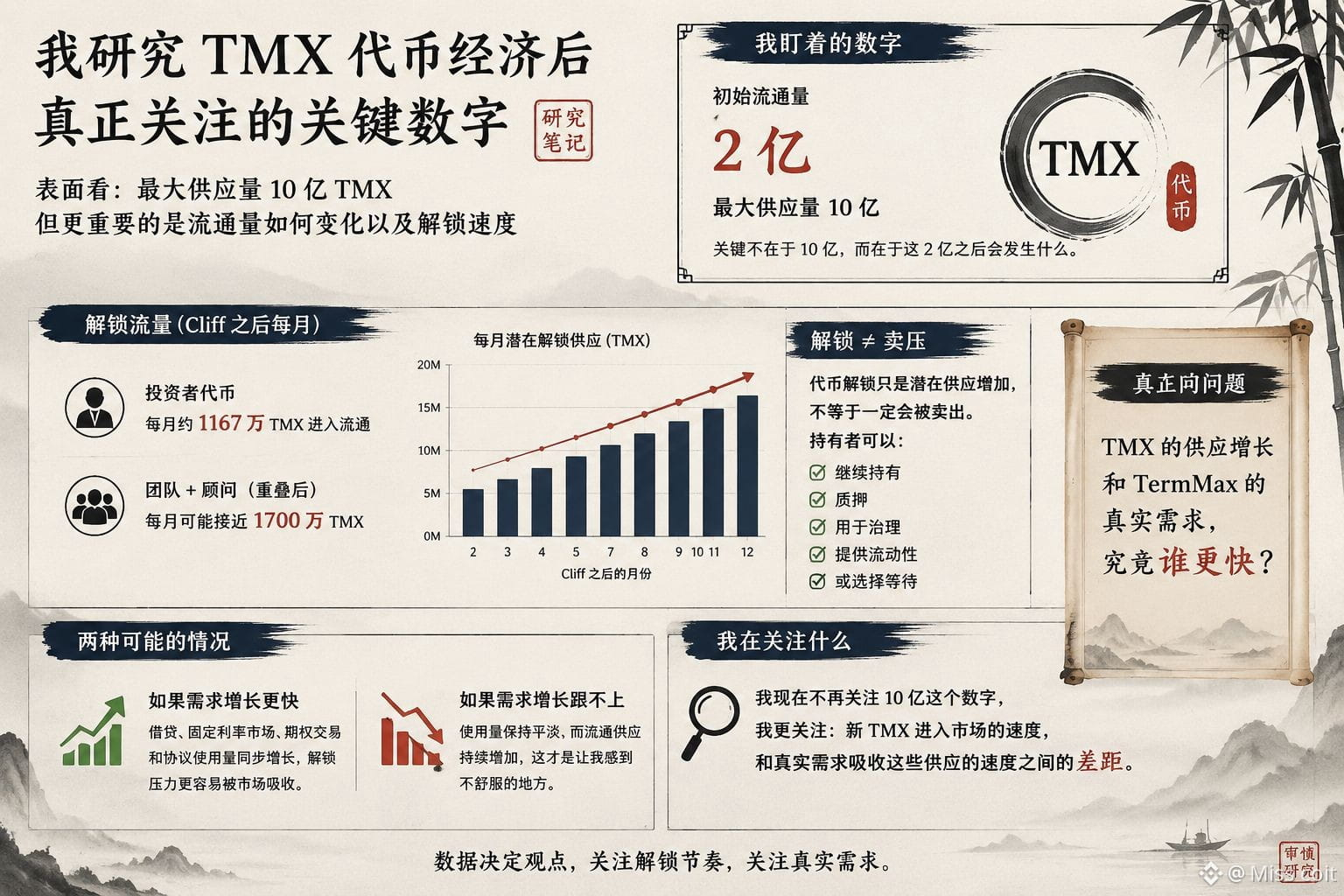
Honestly, I’ve been staring at one number for TMX: 200 million.
That’s the expected initial circulating supply, while the maximum supply is 1 billion. At first glance, it seems simple, but the more I look at the unlock schedule, the less “1 billion” feels like a meaningful reference point.
To me, what matters more is what happens after those first 200 million.
If it’s only investor tokens, then after the cliff ends, roughly 11.67 million TMX could be added each month. If the team and advisor unlock schedules overlap, the monthly potential unlocked amount could be close to 17 million TMX.
That’s the part I really care about.
Because “a 1 billion maximum supply” and “potentially 17 million tokens entering circulation in a month” are telling completely different stories.
I also don’t want to jump straight to a bearish conclusion just because tokens unlock. Unlocking means potential supply increases—it doesn’t mean those tokens will definitely be sold. Holders can keep holding, stake, use them, or choose to wait.
So for me, the real question is: when it comes to supply growth for TMX versus TermMax’s actual demand, which one grows faster?
If lending, fixed-rate markets, options trading, and overall protocol usage can grow alongside the circulating supply, then these unlocks may be more easily absorbed by the market.
But if usage stays the same while the available circulating supply keeps increasing—that’s the part that genuinely makes me uncomfortable.
I’m not as focused on the 1 billion number anymore.
What I care about is this: how big is the gap between the speed at which new TMX enters the market and the speed at which real demand absorbs that supply.$BNB
#termmax @TermMax